
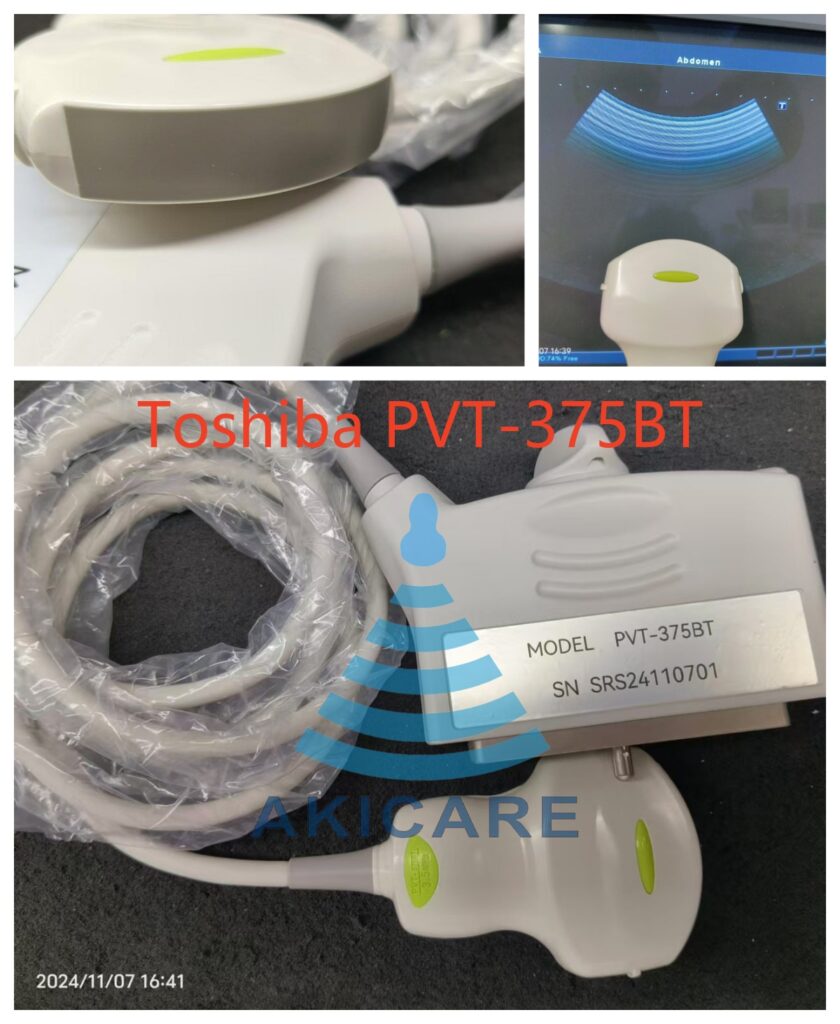
When should i buy a new Canon Toshiba PVT-375BT ultrasound probe?
2025-05-22 ·
7:19 PM

1. Understanding the Canon Toshiba PVT-375BT Ultrasound Probe

1.1 Introduction to the Canon Toshiba PVT-375BT Ultrasound Probe

The Canon Toshiba PVT-375BT ultrasound probe is a critical component of diagnostic ultrasound systems, designed to convert electrical energy into high-frequency sound waves and vice versa. This bidirectional conversion enables real-time imaging of internal body structures, making it indispensable for medical professionals in fields like cardiology, obstetrics, and general diagnostics. As a mechanoelectrical transducer, its performance directly impacts image clarity, depth penetration, and diagnostic accuracy.

1.2 Core Technical Specifications and Functional Design

Frequency and Resolution:
The PVT-375BT operates within a specific frequency range (typically 5-12 MHz for diagnostic probes), balancing resolution and tissue penetration. Higher frequencies offer finer detail for superficial tissues (e.g., muscles, tendons), while lower frequencies enhance imaging of deeper organs.

Example: In obstetrics, its resolution aids in visualizing fetal anatomy, while its penetration supports cardiac examinations.
Probe Type and Application:
Classified as a linear array transducer, the PVT-375BT is optimized for high-resolution imaging of superficial structures (e.g., thyroid, breast) and musculoskeletal systems. Its compact design and ergonomic grip facilitate prolonged use during detailed scans.

Key Components:

Piezoelectric crystals: Generate and receive ultrasonic waves.
Matching layers: Optimize acoustic impedance for efficient energy transfer.
Lens and housing: Protect components while focusing sound waves.
Role in Medical Diagnostics
The PVT-375BT’s performance hinges on its ability to:

Generate High-Fidelity Images:
By emitting ultrasonic pulses and interpreting returning echoes, it constructs cross-sectional views of tissues. This is critical for detecting anomalies like tumors, blood clots, or fetal abnormalities.
Support Dynamic Workflows:
Its durability and compatibility with Canon/Toshiba systems ensure seamless integration into fast-paced clinical environments.
Enable Specialist Applications:
Cardiology: Assess heart valve function and blood flow via Doppler technology.
Obstetrics: Monitor fetal growth and placental positioning.
General Imaging: Guide needle biopsies or evaluate soft tissue injuries.
Differentiation from Competing Models
While alternatives like Akicare’s portable transducers prioritize affordability and mobility, the PVT-375BT distinguishes itself through:

Canon/Toshiba’s Legacy in Precision Engineering:
A reputation for reliability, backed by decades of innovation in medical imaging.
Customizable Software Integration:
Advanced features (e.g., harmonic imaging, spectral Doppler) tailored to high-end diagnostics.
Long-Term Durability:
Built to withstand frequent use, with a lifespan extending 5–7 years under proper maintenance—critical for hospital settings.
User Considerations for Optimal Performance
Compatibility: Ensure the probe is compatible with your ultrasound machine’s software and hardware specifications.
Training: Familiarize users with its ergonomic design and advanced modes (e.g., real-time elastography).
Cost-Benefit Analysis: While pricier than generic alternatives, its longevity and diagnostic versatility often justify the investment.

2. Key Indicators That Signal the Need for Replacement

2.1 Physical Damage and Wear and Tear

Cracks or Deformation in Housing:
Visible cracks in the probe’s plastic or metal housing compromise structural integrity, risking internal component exposure.
Example: A fractured lens distorts acoustic coupling, reducing signal transmission efficiency.
Cable and Connector Issues:
Frayed wires, loose connectors, or insulation peeling disrupt electrical conductivity.
Solution: Test continuity with multimeters; irreparable damage necessitates replacement.
Contaminated or Worn Probe Tip:
Accumulated biofilm, dried gel, or eroded matching layers degrade acoustic impedance.
Fix: Use manufacturer-approved disinfectants; persistent damage requires professional servicing.

2.2 Degradation in Imaging Performance

Reduced Image Clarity (Lower SNR):
Fuzzy images or grainy textures indicate deteriorating piezoelectric crystal efficiency.
Benchmark: Compare scans with a calibrated probe to quantify SNR loss (target >20 dB).
Diminished Penetration Depth:
Inability to visualize deep tissues (e.g., abdominal organs in obese patients) signals crystal fatigue.
Test: Use a tissue-mimicking phantom to measure depth resolution at 12 MHz.
Persistent Artifacts:
Ring artifacts, shadowing, or “comet-tail” effects arise from misaligned transducer elements.
Fix: Realign crystals during repair; irreparable misalignment requires replacement.

2.3 System Errors and Calibration Issues

Frequent Calibration Failures:
Recurring “Probe Not Detected” or “Gain Mismatch” errors (e.g., Error 0x80070002) point to hardware faults.
Action: Run diagnostic software (e.g., Canon’s calibration tool) to isolate issues.
Signal Loss During Scans:
Sudden dropout of ultrasound waves mid-examination suggests loose connections or dead transducer elements.
Fix: Inspect cable solder joints; replace if 3+ elements are non-functional.

2.4 Exceeding Manufacturer Guidelines

Age and Usage Thresholds:
Exceeding Canon’s recommended lifespan (5–7 years) or scan count (50,000–100,000 scans).
Track usage via the probe’s internal sensor or maintenance logs.
Technological Obsolescence:
Incompatibility with newer ultrasound systems (e.g., Aplio 5000 series) or features like AI-driven analysis.
Example: Older probes lack bandwidth for 14 MHz high-frequency imaging.

2.5. Economic and Safety Considerations

High Repair Costs:
Repairing critical components (e.g., replacing the piezoelectric array) exceeds 50% of the probe’s current market value.
Cost Comparison: New PVT-375BT costs 4,500; array replacement may cost 3,000+.
Compliance and Safety Risks:
Unsanitary probes (due to uncleanable cracks) violate infection control protocols (e.g., WHO Guidelines).
Example: Contaminated probes risk cross-infection in high-volume clinics.
Actionable Recommendations
Preventive Maintenance Schedule:
Conduct monthly SNR and artifact checks using QC phantoms (e.g., CIRS Model 040GS).
Cost-Benefit Analysis Tool:
Use ROI calculators to weigh replacement costs against diagnostic downtime.
Documentation:
Maintain a log of error incidents, repair history, and calibration results to justify replacements.
Technical Insights for Diagnostics
Piezoelectric Crystal Aging: Over time, these crystals lose their dielectric properties, reducing ultrasonic wave amplitude (Britannica, 2023).
Matching Layer Erosion: The polymer layer between crystals and skin degrades, causing impedance mismatch (Elprocus, 2023).
By addressing these indicators early, institutions ensure patient safety, maintain diagnostic accuracy, and align with evolving clinical demands.

3. Maintenance and Lifespan Optimization

3.1 Daily Habits That Make a Big Difference

Clean Right After Every Use:
Use soft, lint-free cloths and manufacturer-approved disinfectants (like alcohol wipes). Avoid harsh chemicals that can eat into the probe’s coating.
Tip: Wipe gently in one direction to prevent scratching the lens or crystal surface.
Dry Thoroughly:
Moisture trapped inside the probe can corrode electronics. Use a soft brush to remove dried gel or debris from crevices.
Handle with Care:
Avoid dropping it or twisting the cable. The connector end is fragile—store it upright to reduce strain on wires.

3.2 Weekly & Monthly Checks You Can’t Skip

Inspect for Wear and Tear:
Look for cracks, bent tips, or frayed cables. Even tiny cracks can let bacteria in or weaken signal strength.
Pro Tip: Shine a flashlight at an angle to spot hairline cracks you might miss otherwise.
Test Basic Functionality:
Do a quick scan on a phantom model (a dummy tissue-like object) to check for image clarity. If it’s grainy or shows weird shadows, it’s a red flag.
Store Smart:
Keep it in a dry, climate-controlled area (away from heat vents or direct sunlight). Use a padded case to prevent bumps.
Don’t leave it plugged in when not in use—this can drain the battery or stress the circuits.

3.3 The Importance of Regular Calibration

Why It Matters:
Over time, the probe’s piezoelectric crystals (the bits that make the sound waves) get tired. Calibration ensures they’re firing at the right frequency and strength.
How Often?:
Monthly minimum for high-use clinics. Use Canon’s built-in software tools or send it to a certified tech every 6 months.
What Happens if You Skip It?:
Images get fuzzy, colors wash out, or you miss small details—like a tiny tumor. It’s like driving with blurry glasses!

3.4 Fixing Common Issues Before They Worsen

Problem: The Probe Feels “Slippery”:
Cause: The acoustic gel is drying out the protective coating.
Fix: Clean it, then apply a thin layer of silicone lubricant (ask your supplier for recommendations).
Problem: Static or Noisy Images:
Cause: Loose cables or dust inside the connector.
Fix: Unplug and replug the cable. If it persists, do not open the probe yourself—call Canon support.
Problem: The Tip Smells Funky:
Cause: Bacteria grew in tiny cracks.
Fix: Soak the tip in a disinfectant soak (follow the manual’s guidelines) and let it air-dry completely.

3.5 When to Say “Goodbye” (Even If It Still Works)

Age Matters:
Canon recommends replacing probes every 5–7 years—even if they “seem fine.” Older probes risk sudden failure during critical scans.
Cost vs. Benefit:
If repairs cost more than 50% of a new probe’s price (around 4,000–6,000), it’s cheaper to upgrade.
Tech Obsolescence:
Newer models (like the PVT-375BT Plus) have better resolution and compatibility with AI tools. If your clinic is upgrading systems, it might be time.

4. When Upgrading Makes Strategic Sense

4.1 My Old Probe Feels Like a Typewriter in a Smartphone World” (Technological Lag)

What’s Happening:
Your current probe works, but newer models (e.g., PVT-375BT Plus or Canon’s latest series) now offer 4D imaging, AI-guided scans, or higher frequencies (like 14 MHz for finer details).
Why It Matters:
Example: A cardiologist using a 12 MHz probe might miss tiny heart valve defects that a 14 MHz model can catch.
New probes integrate with cloud-based software, letting you share images instantly with specialists.
Action:
Compare your probe’s specs to Canon’s latest releases. If your clinic relies on cutting-edge diagnostics (e.g., fetal heart screenings), it’s time to upgrade.

4.2 My Team Spends More Time Fixing Than Scanning” (Costly Repairs vs. New Probe)

The Math:
Repairing a broken crystal or cable might cost 2,500–4,000.
A new PVT-375BT costs around 5,000–6,000.
Break-Even Point:
If repairs eat up more than 50% of a new probe’s price, buying fresh is cheaper—and avoids downtime.

Bonus Tip:
Check if your warranty covers parts. If it’s expired, repairs = out-of-pocket expenses.

4.3 Our Patients Are Bigger, Deeper, or Need Faster Results” (Changing Clinical Needs)

Scenarios That Demand an Upgrade:
Deeper Imaging: Obese patients? Newer probes penetrate 30% deeper at lower frequencies without losing resolution.
Speed Matters: A wireless probe (some Canon models) cuts setup time by half in ER or mobile clinics.
Specialization: Shifting to interventional radiology? New probes guide needles with real-time 3D overlays.
Ask Yourself:
Does your current probe bottleneck your clinic’s growth (e.g., turning away complex cases)?

4.4 The Old One’s a Biohazard Waiting to Happen” (Safety and Compliance Risks)

Red Flags:
Cracks or Unfixable Wear: These harbor bacteria—violation of OSHA or HIPAA if an infection outbreak occurs.
Outdated Safety Features: New probes auto-log disinfection history (e.g., via RFID tags), proving compliance to auditors.

4.5 Our Next Ultrasound Machine Won’t Talk to This Probe” (Future-Proofing)

Compatibility Crisis:
If your clinic is upgrading to Canon’s Aplio 5000 series or another system, your old probe might not sync with new software features (e.g., AI tumor detection algorithms).
The Fix:
Newer probes often come with backward/forward compatibility guarantees—ask Canon’s sales team for a compatibility matrix.

5. Buying Guide: Ensuring Authenticity and Value

5.1 Choose Reputable Suppliers: Where to Buy

Authorized Dealers Only:
Purchase directly from Canon Medical Systems or certified resellers (e.g., Healthcare Equipment Supply Co.).
Verify dealer legitimacy via Canon’s official website (e.g., check their dealer locator tool).
Avoid Unverified Online Platforms:
Sites like eBay or Alibaba may sell refurbished or counterfeit probes.
Red flags: “90% new” listings, lack of warranty, or prices 30–50% below market rate (5,000–6,000 for new probes).
Negotiate with Volume Buyers:
Hospitals or clinics buying in bulk can leverage discounts (e.g., “buy 3 probes, get a 15% discount”).

5.2 Validate Authenticity: How to Spot a Fake

Check the Packaging:
Genuine probes come in Canon-branded boxes with holographic seals and clear labeling.
Counterfeit boxes may have misspellings, blurry logos, or mismatched serial numbers.
Inspect the Probe Itself:
Serial Number: Match it to Canon’s online database via their product verification portal.
Build Quality: Authentic probes have smooth edges, precise connectors, and no visible glue seams.
Test Functionality:
Request a demo scan to ensure it works with your ultrasound system.
Test for common issues: image artifacts, calibration errors, or connectivity problems.

5.3 Compare Prices and Warranty Terms

Benchmark Market Rates:
New PVT-375BT probes cost 5,000–6,000; refurbished models start at $3,000.
Beware of “too good to be true” deals—$2,000 might signal a stolen or non-functional unit.
Leverage Warranty Coverage:
Canon offers 1–3 years of warranty for new probes. Extended warranties (up to 5 years) are available for an extra cost.
Refurbished units often have 6–12 month warranties—insist on this in contracts.
Negotiate for Bundles:
Ask for free accessories (e.g., probe warmers, carrying cases) or training sessions.

5.4 Ensure Compatibility and Future-Proofing

Match with Your Ultrasound System:
Confirm the probe works with your existing machine (e.g., Canon Aplio 500 series).
Check software version compatibility—older systems may require firmware upgrades.
Future-Proof Against Obsolescence:
Opt for probes with backward/forward compatibility (e.g., PVT-375BT Plus supports AI-driven tools).
Ask dealers about upgrade paths to newer models if needed.
Consider Wireless Options:
If your clinic moves probes between rooms, invest in Canon’s wireless probe models for convenience.

5.5 Post-Purchase Steps: Protect Your Investment

Register the Warranty Immediately:
Send the serial number and purchase receipt to Canon’s customer service to activate coverage.
Keep All Documentation:
Save the original box, warranty card, and user manual for resale or troubleshooting.
Schedule Training:
Request a hands-on training session for staff to avoid misuse (e.g., dropping the probe or improper cleaning).
Red Flags to Avoid
No Serial Number or Documentation: A clear sign of counterfeit goods.
Dealer Refuses Warranty Registration: Legitimate sellers will assist with Canon’s process.
Pressure to Pay in Advance: Reputable dealers accept payment upon inspection.

6. FAQs About the Canon Toshiba PVT-375BT Probe

6.1 What is the Canon Toshiba PVT-375BT probe used for?

Answer:
Designed for high-resolution imaging of superficial tissues (e.g., thyroid, muscles, and blood vessels). It’s ideal for obstetrics, cardiology, and vascular studies. Its 5–12 MHz frequency range ensures detailed views of small structures.

6.2 How often should I replace this probe?

Answer:
Canon recommends replacement every 5–7 years or after 50,000–100,000 scans, whichever comes first. If repairs cost over 50% of a new probe’s price (~$5,000), it’s cheaper to upgrade.

6.3 When do I need to replace it immediately?

Answer:
Red flags include:
Cracks in the housing or frayed cables (risk of internal damage).
Persistent calibration errors (e.g., “Probe Not Detected”).
Image noise exceeding -20 dB or unfixable artifacts.
Contact Canon support if these occur.

6.4 Can I repair a damaged probe instead of replacing it?

Answer:
Minor issues (e.g., loose cables, minor contamination) can be fixed by certified technicians.
Major damage (e.g., cracked crystals, fried circuitry) may cost 2,500–4,000—often half the price of a new probe. Compare costs before deciding.

6.5 How do I clean and disinfect it properly?

Answer:
Daily cleaning: Use alcohol wipes or Canon-approved disinfectants. Avoid harsh chemicals.
Deep clean: Use a soft brush to remove gel buildup from crevices. Never soak the probe—only the tip.
Dry thoroughly: Use a lint-free cloth; moisture causes corrosion.

6.6 Is it compatible with my ultrasound machine?

Answer:
Works with Canon/Toshiba systems like the Aplio 500 series. For older machines (e.g., pre-2015 models), check firmware compatibility. Newer probes (e.g., PVT-375BT Plus) may require system upgrades.

6.7 What’s the warranty period?

Answer:
New probes: 1–3 years from purchase.
Refurbished probes: 6–12 months.
Register the warranty via Canon’s portal using the serial number (found on the probe’s label).

6.8 Are there cheaper alternatives?

Answer:
Yes, brands like Akicare or Sonoscape offer lower-cost probes (2,000–3,000). However, Canon probes excel in image clarity, longevity, and compatibility with advanced features (e.g., AI tools).

6.9 How do I avoid buying a counterfeit probe?

Answer:
Buy only from Canon-authorized dealers (check Canon’s website).
Verify the serial number via Canon’s online database.
Reject deals priced under $3,000 (unless refurbished)—counterfeits often undercut prices.

6.10 Can I use third-party accessories?

Answer:
Cables and covers: Third-party options work, but ensure they’re compatible with the probe’s connector type.
Warranty risk: Using unapproved parts may void Canon’s warranty.
Bonus Tips for Users
Storage: Keep the probe in a dry, climate-controlled area; avoid extreme temperatures.
Training: Attend Canon’s online workshops to learn advanced techniques (e.g., reducing motion artifacts).
Cost-Saving Hack: Leverage volume discounts if buying multiple probes for your clinic.

Do you have needs? We'd love to help you!

To see our product list and get a special offer

Get Probe List & Best Price

We can repair and make ultrasound probes for most of famous brands like :GE,PHILIPS,SIEMENS,ESAOTE,SAMSUNG,MEDISON,MINDRAY,ALOKA,HITACHI,TOSHIBA,UTRASONIX,SONOSITEFUKUDA,CHISON,SIUI,EDAN,EMPROR,SONOSCAPE,Landwind,etc