
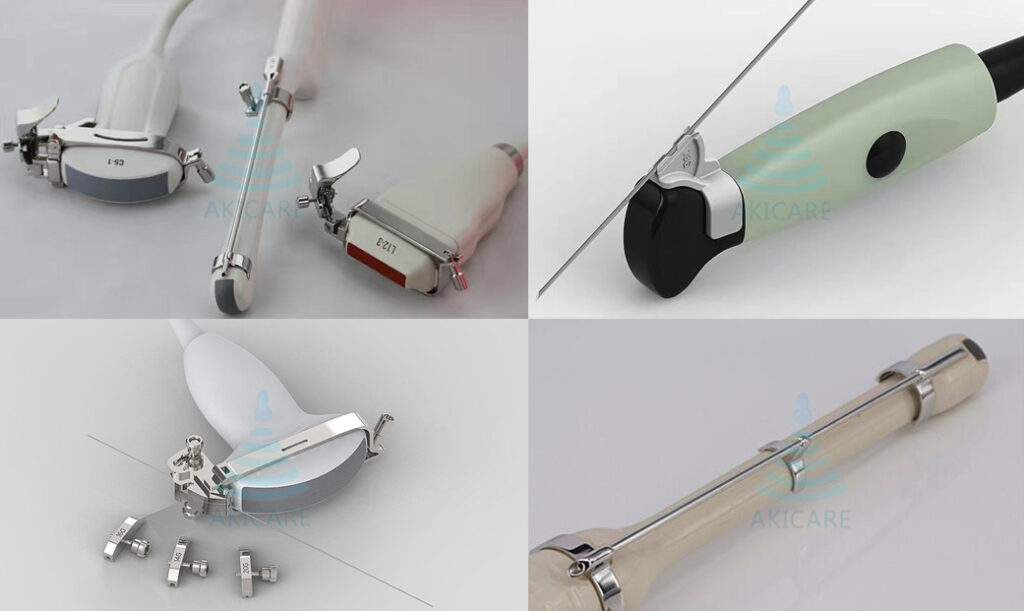
Answer first: A Hitachi L64 biopsy guide should be selected from evidence tied to the exact L64 probe, not from the Hitachi or Aloka family name alone. Procurement should reconcile the probe label, housing, proposed bracket reference, guide format, host-system record and current instructions before approving the item. Catalogue pages can identify candidates, but they do not replace an item-specific fit and procedure check.
Start with the L64 identity record
The current catalogue associates L64 with a Hitachi Aloka linear probe and lists several guide products whose titles explicitly name L64. That is useful discovery evidence. Before a quote is approved, copy every character from the probe label and photograph the full housing, cable entry and connector. Keep the offered guide part number in the same record. A supplier should state whether its image is representative or shows the physical item being quoted.
Older Hitachi, Aloka and Fujifilm-labelled records may appear together in procurement databases. Do not resolve that naming history by deleting the label brand or shortening the model. Preserve what is printed on the equipment and ask the supplier to explain the match to the exact offered guide in writing. That makes the decision reviewable if two catalogues use different brand-family labels.
Hitachi L64 biopsy guide evidence matrix
| Decision field | Evidence to collect | Reason for the check |
|---|---|---|
| Probe identity | Complete label, housing photographs and internal equipment reference | Prevents a nearby linear-probe model from being substituted |
| Guide identity | Manufacturer or supplier, part number and current product record | Ties the quotation to one bracket or single-use item |
| Physical interface | Written fit statement for L64 and current guide instructions | Separates a possible family match from exact housing fit |
| Guidance record | Host-system model and the owner’s applicable overlay-verification process | Keeps console guidance separate from bracket attachment |
| Guide format | Reusable or single-use designation stated by the product record | Determines which instructions and facility workflow apply |
| Commercial scope | Contents, exclusions, availability check, shipping responsibility and remedy | Defines what the quote actually supplies |
Compare exact catalogue candidates without assuming interchangeability
The Akicare AKR-064 guide record for Hitachi EUP-L75 and L64 and the Akicare AKD-067 single-use guide record for Hitachi L75 and L64 both contain the L64 model string. Their presence does not mean they are the same offer or that either is automatically suitable for a facility’s procedure. Compare the exact reference, supplied components, guide instructions and written fit basis for the L64 named in the request.
The Hitachi Aloka L64 probe record helps reconcile the parent probe. It should not be used to borrow guide specifications. Keep probe facts and accessory facts in separate rows so that a correct probe page cannot accidentally supply an unsupported angle, insert or processing statement for a guide.
A seven-step purchasing workflow
- Photograph the installed equipment. Capture the complete probe and system labels before searching by a shortened name.
- Define the request. State whether procurement needs a reusable bracket, a single-use guide or alternatives for comparison without assuming equivalence.
- Shortlist exact-name records. Use listings that name L64, then keep each supplier part number and product type separate.
- Request the evidence set. Ask for the fit basis, current product instructions, included components, item imagery when applicable and quote-specific commercial terms.
- Route processing questions correctly. Use the guide instructions and the facility’s approved infection-control process rather than a generic sales paragraph.
- Review the parent probe. If the L64 has visible damage or a repeatable image concern, document it and use the probe repair assessment path before treating a guide purchase as the complete solution.
- Reconcile on receipt. Compare the delivered reference and supplied documents with the approved record before the owner’s acceptance and procedure checks.
Common mistakes in mixed Hitachi Aloka fleets
- Ordering from “Hitachi linear guide” without preserving the complete L64 marking.
- Using a photograph of a similar bracket as proof that the latch and channel match.
- Copying a gauge or angle from another product page into the L64 quotation.
- Treating reusable and single-use records as the same deliverable because both mention L64.
- Leaving the host system, supplied components or processing-document revision out of the purchase file.
- Using a product-family association as a clinical or compatibility conclusion.
Condition, processing and evidence limits
AIUM’s official transducer statement supports regular assessment of transducer operation and quality control after repair. It does not certify the condition of a particular L64 or guide. The published BMUS multicentre survey illustrates why visible and performance faults should be documented in ultrasound fleets, but its results cannot be applied as a diagnosis of this item.
CDC healthcare-equipment guidance explains that cleaning, disinfection or sterilization decisions depend on intended contact and manufacturer instructions. It is a framework, not a model-specific processing cycle. For an L64 guide request, obtain the current guide instructions, probe instructions and facility procedure, and leave any missing requirement visibly pending.
Commercial next step
Use the model-led ultrasound product catalogue to compare exact L64 records. Send the complete probe label, host-system label, required guide format and evidence requirements with the enquiry. The written quotation should identify the offered part and what remains subject to the equipment owner’s verification.
Frequently asked questions
Can any Hitachi linear-probe bracket be used as a Hitachi L64 biopsy guide?
No. The bracket has to identify the L64 explicitly and seat securely on that housing. A family name, similar shape or nearby EUP model is not enough evidence of fit.
What should be sent with an L64 guide enquiry?
Send clear photographs of the complete probe label and housing, the host-system model, the intended guide format and the current instructions or facility requirements that govern the procedure.
Does a product listing prove the needle path is ready for use?
No. A listing supports catalogue discovery. The equipment owner must verify the supplied guide, probe, console overlay and applicable procedure under the current instructions before use.
Should the L64 probe be assessed before a guide is ordered?
Yes. Record visible housing, lens, cable and strain-relief condition and any repeatable image concern. A damaged or unidentified probe should be assessed before an accessory purchase is approved.
Sources and scope
- AIUM transducer testing and repair statement — a professional statement about transducer assessment and repair quality control, not proof for an uninspected item.
- CDC healthcare-equipment disinfection and sterilization guidance — a processing framework that points users to the applicable device instructions.
- BMUS multicentre probe-condition survey — fleet-level research that supports documented inspection, not a finding about this L64.