
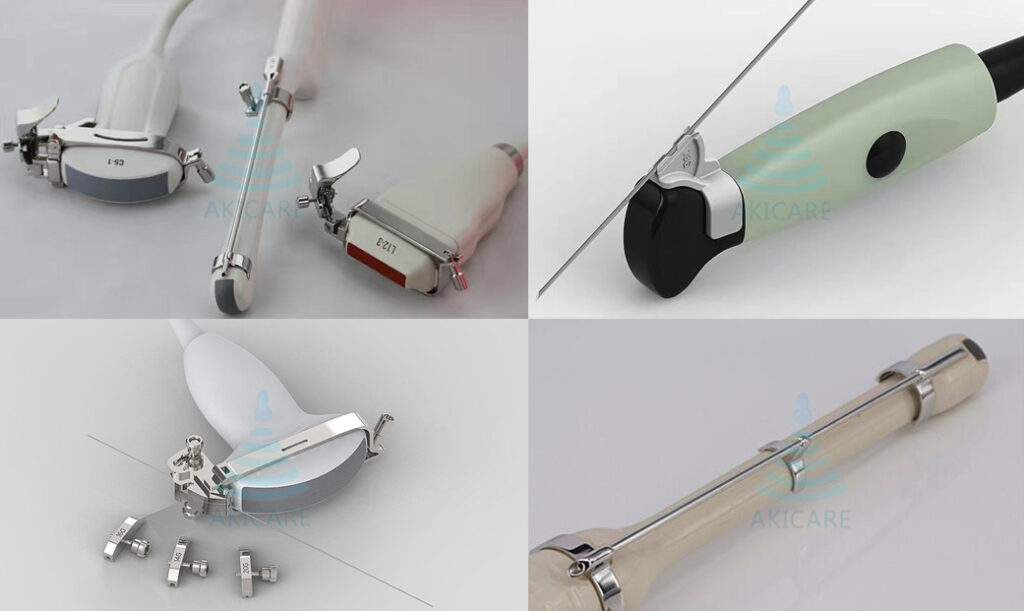
A Mindray L13-3 biopsy guide is a bracket that attaches to the Mindray L13-3 linear ultrasound probe and constrains the biopsy needle to a known path inside the imaging plane. The bracket is specific to the L13-3 housing: guides for the L13-3N, L13-3NS, or L13-3S variants are separate items because the housings differ. Below is what to check on compatibility, specifications, and reusable versus disposable formats before you buy.
Probe Variants and System Compatibility
Mindray sells several probes in the L13-3 family, and this is the most common ordering mistake. Confirm the exact designation printed on your probe connector:
- L13-3 — the base linear probe covered by this guide.
- L13-3N / L13-3NS / L13-3S — variants used on different Mindray console generations; each takes its own bracket.
The L13-3 is a high-frequency linear array used for small parts, vascular access, and superficial biopsy work on Mindray diagnostic consoles. The console’s biopsy guideline software must include an entry for the L13-3 at the bracket’s needle angle; that overlay, not the bracket alone, is what you follow on screen during the procedure. Akicare’s reusable biopsy guide list shows which bracket part fits which Mindray probe.
Key Specifications
| Specification | Typical value for L13-3 guides |
|---|---|
| Needle gauge range | 14G–20G via interchangeable needle inserts; confirm the insert set on the datasheet covers your core and FNA needle sizes. |
| Needle angle | Fixed-angle or multi-angle versions; the selected angle must match a guideline preset on your Mindray console. |
| Bracket material | Reusable versions are stainless steel; disposable versions are single-use medical polymer, supplied sterile. |
| Kit contents | Disposable kits generally bundle a sterile probe cover, gel, and bands; reusable brackets need sterile inserts and covers purchased separately. |
Reusable vs. Disposable
Reusable stainless steel bracket
One bracket serves hundreds of procedures; only the sterile needle insert and probe cover are consumed per case. The bracket is reprocessed by autoclave or high-level disinfection according to its instructions for use — the L13-3 transducer itself is never autoclaved. This is the lower total-cost option for any department doing regular biopsy volume.
Single-use disposable guide
Supplied sterile and discarded after the case. There is no reprocessing labor and no cycle tracking, which suits low-volume sites, mobile services, and facilities without central sterile processing capacity, at a higher per-procedure cost.
OEM vs. Compatible Pricing
Compatible third-party guides for the L13-3 typically run 40–70% below OEM list pricing. Akicare guides are compatible with Mindray probes — we are not Mindray and do not represent our brackets as OEM parts — and each product page lists the exact probe models and needle specifications supported. See the biopsy guide catalog and the Mindray probe section to cross-check your transducer.
Mounting and Pre-Procedure Alignment Check
For reusable L13-3 brackets, the working sequence is: attach the cleaned stainless steel bracket to the probe housing, gel the lens, pull the sterile probe cover over probe and bracket, then snap the sterile needle insert of the correct gauge onto the bracket through the cover. Disposable guides arrive as one sterile piece and mount over the covered probe directly.
Then run the alignment check every department should do before the first pass: bring up the biopsy guideline on the Mindray console, advance a needle through the guide into a sterile water bath or gel pad, and watch the needle echo. It should track the on-screen line along its full visible length. If it drifts off the line, check three things in order — the angle selected on a multi-angle bracket versus the console preset, whether the insert is fully seated, and whether the console has the correct probe and bracket entry selected. Skipping this check is how mismatched presets reach patients.
Frequently Asked Questions
My probe says L13-3N. Can I use the L13-3 guide? No. Order the bracket listed for the L13-3N. The variants differ in housing geometry even though the acoustic specifications are close, and a bracket that does not clamp firmly cannot hold a repeatable needle path.
How long does a reusable bracket last? A stainless steel bracket routinely survives years of autoclave cycles. Replace it when the clamp no longer grips the housing firmly, the needle channel shows wear or corrosion, or it fails the water-bath alignment check — those are the functional end-of-life signs, not a fixed cycle count.
Does switching consoles require a new guide? No. The bracket matches the transducer. Just confirm the new console lists the L13-3 with your bracket angle in its biopsy guideline menu.
How to Order
Email us the exact probe designation (L13-3 vs. L13-3N/NS/S), your console model, and preferred needle gauges, and we will confirm the correct bracket before invoicing. If the probe itself has lens wear or element dropout, probe repair typically costs 30–60% of a replacement with a 5–10 business day turnaround. Request a quote for current pricing and stock.
Evidence boundary and verification record
For Mindray L13-3 Biopsy Guide: Compatibility and Buying Guide, catalogue compatibility is only the discovery layer. The purchase record should keep the exact guide reference, parent probe label, guide format, current instructions and host-system context together. A nearby probe name, similar bracket image or broad family list should not be treated as exact fit evidence.
CDC healthcare-equipment guidance explains that processing decisions depend on intended contact and applicable manufacturer instructions; it does not supply a model-specific cycle for Mindray L13-3 Biopsy Guide: Compatibility and Buying Guide. AIUM’s statement supports regular transducer assessment and quality control after repair, while the BMUS survey illustrates why probe condition should be documented. None of these sources proves guide fit or item condition without the exact records.
Primary sources and limits
- AIUM transducer testing and repair statement — professional guidance on transducer assessment and post-repair quality control.
- CDC healthcare-equipment disinfection and sterilization guidance — a processing framework tied to device use and instructions.
- BMUS multicentre probe-condition survey — published fleet research, not an item-level diagnosis.
Evidence questions
Does this evidence prove the exact compatibility described in Mindray L13-3 Biopsy Guide: Compatibility and Buying Guide?
No. It defines what should be collected and reviewed. Exact compatibility remains tied to the complete labels, configuration, current documentation and written item-specific decision.
Can the commercial terms for Mindray L13-3 Biopsy Guide: Compatibility and Buying Guide be assumed from this article?
No. Availability, condition, included work, timing, logistics, exclusions and remedy must be confirmed in the current quotation for the exact request.