
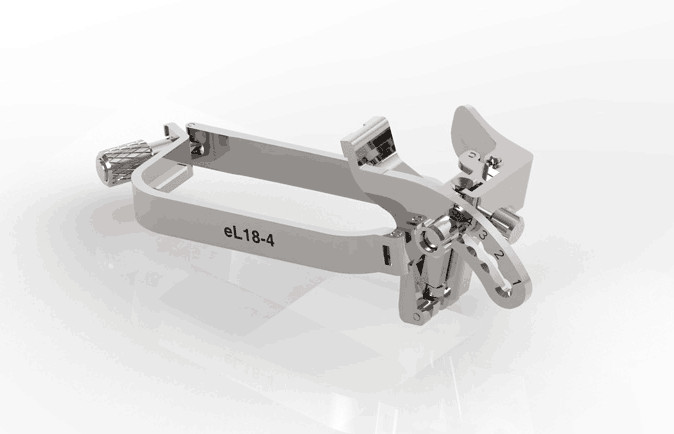
A Philips eL18-4 biopsy guide is a needle-guidance bracket that clips onto the Philips eL18-4 linear ultrasound probe and holds the biopsy needle on a fixed path within the imaging plane. It is sold separately from the transducer, and because the bracket is machined to the exact housing profile of the eL18-4, guides made for other Philips linear probes will not fit. This article explains how to confirm compatibility, what specifications to check, and how reusable and disposable options compare.
Which Probe and Systems the Guide Must Match
The bracket itself only has to match the transducer housing, not the console. The eL18-4 is a PureWave linear array used for small parts, breast, musculoskeletal, and vascular work on Philips EPIQ and Affiniti platforms. In practice you should confirm two things before ordering:
- Probe model: the guide must be listed for the eL18-4 specifically. The eL18-5, L12-3, and other Philips linear probes have different housing geometries and take different brackets.
- System software: your EPIQ or Affiniti console must have the biopsy guideline overlay enabled for the eL18-4 so the on-screen needle path matches the physical bracket angle.
If you are unsure which probe revision you have, the model and part number are printed on the connector housing. Akicare’s reusable biopsy guide list maps each bracket to its supported probe models.
Specifications to Check Before You Order
Datasheets for eL18-4 guides differ by manufacturer, so compare the following line items rather than relying on the product name alone:
| Specification | What to verify |
|---|---|
| Needle gauge range | Most linear-probe guides accept common core and FNA needles through interchangeable inserts; confirm the insert set covers the gauges your department uses (for example 14G core needles and finer FNA needles). |
| Needle angle | Fixed-angle and multi-angle versions exist. The selectable angles must match the biopsy guideline presets in the Philips console software. |
| Bracket type | Reusable stainless steel bracket with single-use sterile needle inserts, or fully disposable single-use guide. |
| Sterile kit contents | Disposable kits usually include the probe cover, gel, and bands; reusable brackets require separately purchased sterile inserts and covers. |
Reusable vs. Disposable: Cost and Sterilization
The choice usually comes down to procedure volume.
Reusable stainless steel bracket
- Higher one-time purchase price, low per-procedure cost: only the sterile needle insert and probe cover are replaced each case.
- Sterilized by autoclave or high-level disinfection per the bracket manufacturer’s instructions for use; the eL18-4 probe itself must never be autoclaved.
- Economical for departments running biopsies weekly or daily.
Single-use disposable guide
- Arrives sterile, no reprocessing workload, no tracking of sterilization cycles.
- Higher per-procedure cost, so it suits low-volume sites or facilities without in-house reprocessing capacity.
OEM vs. Compatible Guides
Philips-branded guides are the OEM route. For eL18-4, compatible guide pricing depends on the exact probe model, bracket geometry, needle requirements, order quantity, and availability; confirm fit and obtain an RFQ. Akicare supplies compatible guides — engineered to fit the Philips eL18-4, not manufactured by or affiliated with Philips — and states the supported probe list and needle specifications on each product page so you can verify fit before purchase. Browse the full biopsy guide catalog or the Philips probe section to match the guide to your transducer.
Mounting Sequence and Needle-Path Verification
Reusable brackets for Philips linear probes follow a standard attachment sequence: snap the cleaned bracket onto the eL18-4 housing, apply gel to the lens, drape the sterile probe cover over the probe and bracket together, then clip the sterile single-use needle insert onto the bracket through the cover. Disposable guides combine the bracket and insert in one sterile part that mounts over the covered probe.
Before the first pass on a patient, verify alignment: display the biopsy guideline on the console, pass a needle through the guide into a sterile water bath or gel pad, and confirm the needle echo tracks the on-screen line. If it deviates, the usual causes are a multi-angle bracket set to a different angle than the console preset, an insert that is not fully seated, or the wrong probe selected on the console. This check takes under a minute and catches nearly every setup error before it matters.
Frequently Asked Questions
Will a guide for the eL18-5 or L12-3 fit the eL18-4? No. Each Philips linear probe has its own housing profile, and the bracket clamp is machined to that profile. A mismatched bracket either will not seat or will sit loosely, and a loose bracket shifts the needle path.
Can the reusable bracket go in the autoclave with the probe? The stainless steel bracket can be steam-sterilized on its own per its instructions for use. The eL18-4 transducer must never be autoclaved — heat destroys the acoustic stack. Always separate the two before reprocessing.
Do I need a new guide if I move the probe to a different console? No. The bracket fits the transducer, not the console. You only need to confirm the new console has the eL18-4 biopsy guideline preset enabled.
How to Order
Send us your probe model (eL18-4), your console model, and the needle gauges you plan to use, and we will confirm the correct bracket and insert set. If your eL18-4 probe itself has image dropout or housing damage, our probe repair service For eL18-4, repair pricing and turnaround depend on the fault, probe model, parts availability, and agreed test scope; request an assessment before comparing repair with replacement. Request a quote and we will respond with pricing and lead time.
Evidence boundary and verification record
For Philips eL18-4 Biopsy Guide: Compatibility and Buying Guide, catalogue compatibility is only the discovery layer. The purchase record should keep the exact guide reference, parent probe label, guide format, current instructions and host-system context together. A nearby probe name, similar bracket image or broad family list should not be treated as exact fit evidence. Date the source check so later changes in documents or availability do not silently alter the decision.
CDC healthcare-equipment guidance explains that processing decisions depend on intended contact and applicable manufacturer instructions; it does not supply a model-specific cycle for Philips eL18-4 Biopsy Guide: Compatibility and Buying Guide. AIUM’s statement supports regular transducer assessment and quality control after repair, while the BMUS survey illustrates why probe condition should be documented. None of these sources proves guide fit or item condition without the exact records.
Primary sources and limits
- AIUM transducer testing and repair statement — professional guidance on transducer assessment and post-repair quality control.
- CDC healthcare-equipment disinfection and sterilization guidance — a processing framework tied to device use and instructions.
- BMUS multicentre probe-condition survey — published fleet research, not an item-level diagnosis.
Evidence questions
Does this evidence prove the exact compatibility described in Philips eL18-4 Biopsy Guide: Compatibility and Buying Guide?
No. It defines what should be collected and reviewed. Exact compatibility remains tied to the complete labels, configuration, current documentation and written item-specific decision.
Can the commercial terms for Philips eL18-4 Biopsy Guide: Compatibility and Buying Guide be assumed from this article?
No. Availability, condition, included work, timing, logistics, exclusions and remedy must be confirmed in the current quotation for the exact request.