
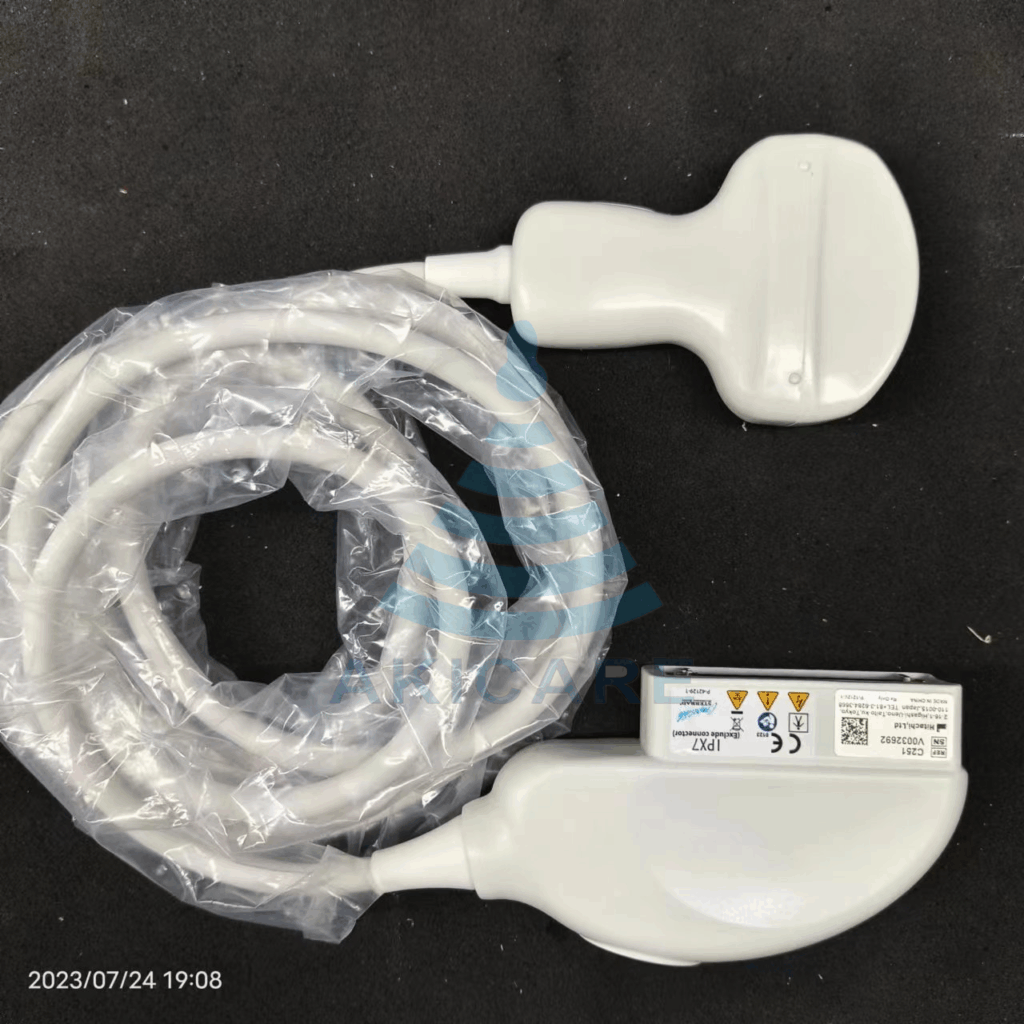
1. What Is the Hitachi C251 Ultrasound Probe? Technical Overview
1.1 Definition and core functions
The Hitachi C251 ultrasound probe is a high-frequency electromechanical transducer designed for diagnostic medical imaging. As a key component of Hitachi’s ultrasound systems (e.g., the HiVision series), it converts electrical energy into ultrasonic waves and vice versa, enabling real-time visualization of internal body structures. Its primary function aligns with the fundamental principles of ultrasonic transducers outlined in technical references like Britannica, where piezoelectric crystals generate sound waves that penetrate tissue and reflect back to form images.
1.2 Technical parameters and specifications
The C251 probe is characterized by its 5–12 MHz frequency range, optimized for high-resolution imaging of superficial tissues, vascular structures, and small organs (e.g., thyroid, breast, testes). Key technical specifications include:
- Probe Type: Linear array transducer (rectilinear scanning).
- Array Configuration: 128 elements with digital beamforming for enhanced image clarity.
- Depth Range: 0–6 cm, ideal for superficial applications.
- Connectivity: Compatible with Hitachi’s Apogee, Avius, and HiVision systems via proprietary interfaces.
1.3 Working principle and innovative design
The C251 leverages piezoelectric ceramics (similar to principles explained in Elprocus), where alternating voltage causes the crystals to vibrate and emit ultrasonic pulses. The probe’s digital beamformer processes returning echoes to create high-resolution B-mode and Doppler images. Hitachi’s proprietary SmartFlow technology enhances vascular imaging, while the sliding mechanism allows seamless adjustment for precise tissue scanning.
1.4 Clinical application scenarios
The C251 is clinically validated for:
- Superficial Tissue Imaging: Breast masses, thyroid nodules, and soft tissue lesions.
- Vascular Studies: High-resolution Doppler analysis of arteries/veins (e.g., carotid ultrasound).
- Interventional Procedures: Guided biopsies or fluid aspiration due to its precision and real-time feedback.
1.5 Differentiation from competing products
While competitors like Philips X7-2 or GE’s Linear 12-5 offer similar superficial imaging capabilities, the C251 distinguishes itself through:
- Higher Frequency Range: 5–12 MHz vs. 6–10 MHz in some rivals, enabling sharper resolution.
- Hitachi Echographic Integration: Seamless compatibility with Hitachi’s AI-driven software (e.g., SmartAssist), improving workflow efficiency.
- Durability: A water-resistant housing (IPX7 rating) for sterile environments, as noted in Akicare’s product specs.
1.6 Technical limitations and usage precautions
Despite its strengths, the C251 has inherent limitations:
- Depth Limitation: 6 cm maximum penetration restricts use for abdominal or deep organ imaging (e.g., liver).
- Calibration Requirements: Regular checks via Hitachi’s QC software to maintain beam integrity.
- Cost Considerations: New units may exceed $15,000 USD, prompting users to explore certified refurbished options (e.g., via Akicare).
2. Before Purchasing: Key Considerations for the Hitachi C251 Probe
2.1 Compatibility with Hitachi Ultrasound Systems
- System Compatibility Check:
The C251 probe is exclusively designed for Hitachi’s HiVision, Apogee, and Avius series. Verify the probe’s interface (e.g., L-type connector) matches your ultrasound machine’s port specifications. Cross-reference Hitachi’s official compatibility matrix or contact their technical support.- Key Tip: Older Hitachi models (pre-2015) may require firmware upgrades to support newer probes like the C251.
- SEO Integration: Use phrases like “Hitachi C251 probe compatibility checklist” or “HiVision system probe requirements.”
- Third-Party Adapter Risks:
Avoid using non-Hitachi adapters, which may compromise image quality or trigger system errors.
2.2 Clinical Requirements and Application Scope
- Frequency and Resolution Needs:
The C251’s 5–12 MHz range excels in superficial imaging (e.g., thyroid, breast, vascular Doppler) but lacks depth for abdominal or obstetric scans. Assess whether its 6 cm penetration limit suits your clinical workflow.- Case Study: For dermatology clinics, the C251 is ideal for skin lesion imaging, while radiology departments may need broader-range probes.
- Workflow Integration:
If your practice relies on Hitachi’s proprietary software (e.g., SmartAssist or SmartFlow), ensure the C251 supports these features for seamless workflow.
2.3 Budget and Cost Analysis
- New vs. Refurbished Options:
- New Probes: Typically cost 15,000–15,000–20,000 USD, depending on regional distributors.
- Refurbished/Reconditioned Units: Vendors like Akicare (per their website) offer certified pre-owned probes at 40–60% discounts, with warranties.
- Key Warning: Avoid unverified sellers on platforms like eBay; prioritize certified resellers (e.g., Hitachi-authorized partners).
- Long-Term Costs:
Factor in maintenance fees, probe sterilization kits, and potential repairs. Hitachi’s preventive maintenance contracts (often 1,500–1,500–3,000/year) are recommended for high-use environments.
2.4 Supplier Credibility and Authentication
- Official Channels:
Purchase directly from Hitachi Medical Systems or their authorized dealers for authenticity and full warranty coverage.- Verification Steps: Request the probe’s serial number and use Hitachi’s online validation tool to confirm legitimacy.
- Third-Party Vendors:
If selecting a reseller like Akicare, verify:
- Certifications: ISO 13485 or FDA clearance for medical devices.
- Reputation: Check reviews on platforms like their Facebook page (e.g., Akicare’s Facebook Profile).
- Warranty Terms: Ensure refurbished units include at least a 1-year warranty.
- Avoid Counterfeits:
Fake probes may lack proper shielding or use inferior piezoelectric materials. Inspect the probe’s build quality (e.g., smooth casing, precise connector alignment) and compare with Hitachi’s official images.
2.5 Post-Purchase Support and Training
- Technical Support: Confirm the seller offers 24/7 assistance for troubleshooting (e.g., error codes like “Probe Not Detected”).
- Operator Training: Request training sessions on the C251’s unique features, such as its sliding mechanism for precise angle adjustments.
- Software Updates: Ensure the probe is compatible with future firmware updates from Hitachi to access new imaging algorithms.
3. Where to Buy the Hitachi C251 Ultrasound Probe: Trusted Sources
3.1 Official Hitachi Channels
Primary Recommendation for New Probes
- Hitachi Medical Systems (Official Distributor)
- Website: Hitachi’s official portal (e.g., Hitachi Medical Systems).
- Advantages:
- Full warranty (typically 1–3 years).
- Guaranteed authenticity via serial number verification (use Hitachi’s online tool).
- Direct technical support for setup and troubleshooting.
- Disadvantages:
- Higher upfront cost (new probes ~15,000–15,000–20,000 USD).
- Limited stock for older models.
3.2 Authorized Hitachi Dealers
Regional Partners for Geographically Convenient Purchases
- Example Dealers:
- Medicus Imaging Solutions (North America): Specializes in Hitachi equipment with extended warranty options.
- EuroMedical Supplies (Europe): Offers language-specific support and EU-compliant certifications.
3.3 Certified Refurbished Probes
Cost-Effective Options with Warranty Coverage
- Top Vendors:
- Akicare Technology Limited (Website):
- Pros:
- 40–60% discount on refurbished units.
- 1-year warranty and ISO 13485 certification (refer to their Facebook page for case studies).
- Fast shipping to Asia-Pacific markets.
- Cons:
- Requires thorough pre-purchase serial number validation.
- Limited real-time customer support outside business hours.
- Pros:
- Global Medical Reagents: Known for FDA-registered refurbished ultrasound probes.
- Akicare Technology Limited (Website):
3.4 Secondary Markets and B2B Platforms
Risks and Opportunities in Non-Exclusive Channels
- Recommended Platforms:
- Medtronic Marketplace: Lists pre-owned probes with seller ratings.
- UltrasonicsDirect: Focuses on OEM parts and used Hitachi probes (verify compatibility via their technical guide).
- Red Flags to Avoid:
-
- Unverified eBay listings (risk of counterfeit probes).
- Sellers without Hitachi certification (e.g., no access to Hitachi’s QC software).
3.5 Direct Manufacturer-to-User Networks
Peer-to-Peer Transactions with Caution
- Options:
- LinkedIn Groups: Medical imaging forums where hospitals or clinics sell surplus probes.
- Facebook Marketplace: Use groups like Akicare’s Facebook Page for verified listings.
- Key Safeguards:
- Insist on a 30-day return policy and independent third-party inspection.
- Check for Hitachi’s holographic seals on the probe casing.
3.6 International Considerations for Buyers
Customs, Compliance, and Shipping
- Import Documentation:
- Ensure probes comply with local regulations (e.g., FDA 510(k) clearance in the U.S., CE marking in the EU).
- Shipping Tips:
- Use vendors with “door-to-door” logistics (e.g., Akicare’s tracked shipping for fragile items).
- Confirm insurance coverage for transit damage.
4. How to Verify Authenticity of the Hitachi C251 Probe
4.1 Official Hitachi Serial Number Validation
Key Step for Verification
- Access Hitachi’s Online Tool:
- Visit Hitachi’s official probe authentication portal (e.g., Hitachi Medical Systems Support).
- Enter the 12-digit serial number found on the probe’s casing or packaging.
- Verify the system’s confirmation of the probe’s legitimacy, production date, and warranty status.
- Manual Cross-Check:
Compare the serial number with Hitachi’s published compatibility matrices (e.g., in user manuals) to ensure it matches the C251 model specifications.
4.2 Physical Inspection of the Probe
Critical Visual and Structural Checks
- Casing and Build Quality:
- Material: Authentic probes use durable, smooth plastic with precise alignment of buttons/ports. Counterfeits may have rough edges or mismatched colors.
- Labels and Stickers:
- Look for Hitachi holographic seals and laser-etched labels (not printed stickers).
- Check for the probe model number (C251) and frequency range (5–12 MHz) on the side.
- Connector and Interface:
- The L-type connector must match Hitachi’s proprietary design (e.g., gold-plated pins, no corrosion).
- Inspect for manufacturing defects like loose wires or poorly soldered joints.
4.3 Technical Performance Testing
Functional Validation to Detect Malfunctions
- Connectivity Test:
Attach the probe to a Hitachi ultrasound system (e.g., HiVision) and check for:- Immediate recognition by the system (no error codes).
- Stable imaging across the full 5–12 MHz frequency range.
- Image Quality Analysis:
- Authentic probes produce high-resolution B-mode images with sharp edges and minimal noise.
- Use Hitachi’s QC software tools (e.g., Phantom testing) to assess beam integrity and Doppler accuracy.
4.4 Supplier and Documentation Audit
Ensure Trustworthy Sources
- Documentation Review:
- Request the probe’s certificate of authenticity and warranty card from the seller.
- Verify invoices or purchase receipts match Hitachi’s official branding.
- Seller Credibility Checks:
- Authorized Dealers: Confirm the seller is listed on Hitachi’s global partner directory.
- Refurbished Probes: Only accept units from vendors like Akicare (per their Facebook case studies) with ISO 13485 certification and detailed refurbishment logs.
4.5 Third-Party Verification Services
For High-Risk Purchases
- Independent Inspection:
Hire a certified biomedical engineer to perform:- Electrical Testing: Measure impedance and frequency response against Hitachi’s specifications.
- Structural Analysis: Use tools like a multimeter to detect faulty piezoelectric elements (referenced in Elprocus ’s transducer guides).
- Blockchain Tracking (Optional):
Some suppliers (e.g., Akicare) use blockchain-based systems to track probe histories, ensuring no prior damage or repairs.
5. Installation, Maintenance & Troubleshooting Guide
5.1 Installation Process
Step-by-Step Setup for Optimal Functionality
- Hardware Connection:
- Attach the Probe: Plug the L-type connector into the designated port on the Hitachi ultrasound system (e.g., HiVision). Ensure a secure fit to avoid loose connections.
- Power On: Turn on the system and confirm the probe is recognized (no error codes displayed).
- Software Configuration:
- Navigate to the probe settings menu and select C251 from the list of available transducers.
- Adjust default parameters (e.g., frequency range, gain) based on clinical needs (e.g., vascular imaging requires Doppler mode optimization).
- Initial Testing:
- Perform a phantom test using Hitachi’s QC tools to validate image quality and beam integrity.
- Verify sliding mechanism smoothness and angle adjustment responsiveness.
5.2 Daily Maintenance Protocol
Essential Practices to Prolong Probe Lifespan
- Post-Use Cleaning:
- Disinfection: Use isopropyl alcohol (70%) or EPA-approved ultrasonic probe disinfectants (avoid water immersion).
- Drying: Wipe the probe head with a soft cloth; ensure no residue remains on the piezoelectric crystals.
- Storage Guidelines:
- Keep the probe in its protective case when not in use.
- Store in a dry, temperature-controlled environment (avoid extreme heat/cold).
- Preventive Checks:
- Inspect the connector pins for corrosion or damage daily.
- Log any wear-and-tear (e.g., cable fraying) for timely repairs.
5.3 Troubleshooting Common Issues
Resolving Technical Problems Quickly
- Error Code “Probe Not Detected”:
- Cause: Loose connection, incompatible firmware, or damaged interface.
- Solution:
- Re-seat the probe connector.
- Update the ultrasound system’s firmware via Hitachi’s support portal.
- Run a hardware diagnostics test.
- Image Degradation (Blurry/Noisy):
- Cause: Dirty probe surface, incorrect frequency setting, or failing piezoelectric elements.
- Solution:
- Clean the probe head thoroughly.
- Re-calibrate using Hitachi’s QC software.
- Contact Hitachi support if issues persist.
- Sliding Mechanism Stiffness:
- Cause: Lubricant depletion or mechanical wear.
- Solution:
- Apply a silicone-based lubricant to the sliding track (refer to Hitachi’s maintenance manual).
- Replace worn parts through authorized service centers.
5.4 Advanced Maintenance & Calibration
Quarterly/Annual Tasks for Optimal Performance
- Professional Calibration:
- Schedule biannual calibration with Hitachi-certified technicians to ensure:
- Accurate frequency response (5–12 MHz).
- Consistent Doppler sensitivity for vascular imaging.
- Schedule biannual calibration with Hitachi-certified technicians to ensure:
- Software Updates:
- Install Hitachi’s latest firmware updates to access bug fixes and new imaging algorithms.
- Hardware Inspections:
- Use a multimeter to test electrical continuity in the probe’s connector (referenced in ModSonic ’s technical guides).
- Replace aging components (e.g., cables, crystals) before failure.
5.5 Safety & Compliance
Legal and Regulatory Best Practices
- Documentation:
- Maintain a log of all maintenance, calibrations, and repairs (required for FDA/EU audits).
- Avoid Unauthorized Modifications:
- Do not alter the probe’s design (e.g., adding third-party covers) without Hitachi approval.
- Warranty Protection:
- Follow Hitachi’s guidelines to retain warranty coverage (e.g., avoid using non-certified cleaning agents).
6. Frequently Asked Questions About the Hitachi C251 Probe
6.1 What is the average cost of a Hitachi C251 ultrasound probe?
- New Probes: Typically priced between 15,000–15,000–20,000 USD, depending on regional distributors and exchange rates.
- Refurbished/Reconditioned: Vendors like Akicare (refer to their website) offer units at 40–60% discounts, often starting at $8,000 USD (with 1-year warranties).
- Key Consideration: Factor in long-term costs like maintenance contracts (e.g., Hitachi’s 1,500–1,500–3,000/year service plans).
6.2 Is the Hitachi C251 compatible with non-Hitachi ultrasound systems?
- No. The probe is exclusive to Hitachi’s HiVision, Apogee, and Avius series due to its proprietary L-type connector and software integration (e.g., SmartFlow technology).
- Workarounds: Third-party adapters may exist, but they risk system errors, image degradation, and voiding warranties.
6.3 How often should the probe be calibrated?
- Recommended Schedule:
- Daily: Quick checks for connectivity and basic image clarity.
- Quarterly: Professional calibration by Hitachi-certified technicians to ensure frequency accuracy (5–12 MHz) and Doppler sensitivity.
- Annually: Full system diagnostics to address wear-and-tear (e.g., sliding mechanism lubrication).
6.4 Can the C251 probe be sterilized for invasive procedures?
- Limited Sterilization:
- Autoclaving: Not recommended—high heat damages piezoelectric crystals.
- Disinfection: Use 70% isopropyl alcohol or EPA-approved ultrasonic probe disinfectants (refer to Omega Sonic ’s guidelines).
- Protective Covers: Disposable sterile sheaths are available for invasive applications.
6.5 What are the most common failure points of the C251 probe?
- Top Issues:
- Connector Corrosion: Moisture damage to the L-type interface (e.g., from improper cleaning).
- Sliding Mechanism Stiffness: Requires silicone lubricant or part replacement.
- Frequency Drift: Caused by aging piezoelectric elements; resolved via recalibration or probe replacement.
6.6 How do I verify the probe’s authenticity?
- Steps:
- Serial Number Check: Use Hitachi’s online validation tool to confirm legitimacy.
- Physical Inspection: Look for Hitachi holographic seals, precise build quality, and correct labeling (e.g., 5–12 MHz range).
- Seller Reputation: Prioritize certified vendors like Akicare (refer to their Facebook case studies).
6.7 Are there alternatives to the C251 for superficial imaging?
- Competitor Options:
- Philips X7-2: Lower frequency (6–18 MHz) but broader depth range.
- GE Linear 12-5: Comparable resolution but requires GE-specific software.
- Key Trade-off: The C251’s higher frequency (5–12 MHz) offers sharper superficial imaging but limited depth.
6.8 What is the expected lifespan of a Hitachi C251 probe?
- Typical Lifespan: 5–7 years with proper maintenance.
- Factors Impacting Longevity:
- Frequent calibration and cleaning.
- Avoiding drops or physical damage.
- Using Hitachi’s recommended accessories (e.g., protective cases).
6.9 Can I purchase a refurbished C251 probe with a warranty?
- Yes:
- Akicare and other certified resellers offer refurbished units with 1–3year warranties (check their website for terms).
- Critical Step: Verify the warranty covers both hardware and software issues.


