
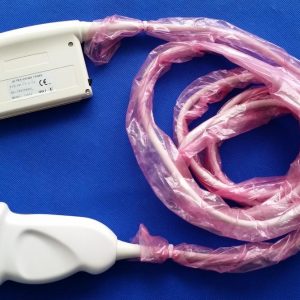
Answer first: The main types of ultrasound probes are linear, convex or curvilinear, phased array, endocavity, transesophageal, volume, and pencil or continuous-wave designs. Those names describe array geometry or use context, but they do not prove that a specific probe will work with a specific ultrasound system. Selection still requires the complete model, connector, supported host-system configuration, intended application, frequency range and current manufacturer documentation.
Types Of Ultrasound Probes: evidence matrix
| Decision field | Evidence to collect | Why it matters |
|---|---|---|
| Linear array | Flat footprint and rectangular image format | Useful as a family description; exact bandwidth and system support remain model-specific |
| Convex/curvilinear | Curved footprint and widening field | Radius, size and frequency differ across models |
| Phased array | Small footprint and electronically steered sector | Connector and system generation are essential to the match |
| Endocavity | Purpose-shaped internal-use transducer | Reprocessing and immersion limits must follow the exact IFU |
| TEE | Flexible transesophageal assembly with controls | Identity, mechanical condition and reprocessing records require special review |
| 3D/4D volume | Mechanical or matrix volume-acquisition design | Movement mechanism and supported modes cannot be inferred from appearance |
| Pencil/CW | Small non-imaging or Doppler-focused form | Do not confuse a Doppler accessory with an imaging-array probe |
Array type is the first filter, not the final answer
A buyer often starts with linear, convex or phased array because those terms describe the footprint and image geometry. That narrows the catalogue, but many physically similar probes use different connectors, pin layouts, system generations or software support. Keep array type as one column in the request and preserve the full label as the controlling identifier. A category page can show candidates; it cannot turn every candidate into a confirmed match.
Frequency is a range and a trade-off
Ultrasound transducers operate across model-specific bandwidths. Higher frequency generally supports finer spatial resolution but is attenuated more quickly, while lower frequency supports greater penetration with lower resolution. That physics principle helps explain why probe families differ, but it is not a substitute for the intended application, the supported preset and the system documentation. Never copy a range from a similar-looking model into a quotation.
Footprint and access shape the shortlist
A large curved footprint, a small phased-array face, a narrow hockey-stick face and an endocavity form solve different access problems. Record the required footprint and intended use in neutral purchasing language. Clinical suitability remains with qualified users and the equipment owner's process; the supplier's role is to identify the offered device and evidence accurately.
Separate product identity from condition
Two records can share a model name while representing OEM-brand, third-party compatible, used, refurbished or repair service paths. After the model match, ask for current item photos, condition, test scope and written commercial terms. A representative catalogue image is navigation evidence, not proof of the quoted unit's condition.
Verification workflow
- Capture the requirement: Record intended system, use context, array family and footprint constraint.
- Match the label: Use the complete model, part number and connector photos.
- Confirm the document: Check current manufacturer or configuration-specific support.
- Confirm the offer: Tie condition, test evidence, availability and terms to the quotation.
How to keep the decision auditable
Use one reference across the enquiry, photographs, source documents, quotation and later inspection or acceptance record. Save the date and origin of each fact. When the model, system, condition, quantity or service scope changes, create a new revision rather than silently reusing evidence from another item. Mark unresolved fields as pending; a missing answer should not be converted into a positive compatibility, condition or availability claim.
Before approval, have a second reviewer compare the complete model characters, connector, host-system context and quotation scope. This catches mixed photo sets, copied specifications and broad catalogue statements that do not belong to the physical item. The written quote is the final commercial control point and should identify the exact offer, evidence, exclusions, availability basis, shipping responsibility and remedy terms.
Evidence that belongs to the exact item
Keep general source material separate from item-level proof. A manufacturer page or technical reference can explain terminology and decision boundaries. A catalogue page can show that Akicare currently has a related record. Neither one proves the serial identity, present condition, stock position or test result of a unit offered today. Those facts require photographs, labels, inspection records or quotation statements tied to the same item reference. This separation is especially important when a page uses representative imagery or when a model name appears across several systems.
Questions to resolve before commitment
Ask whether every specification comes from the exact model document, whether the connector and host-system configuration were checked, whether photographs show the offered unit, and whether the test statement names its method and exclusions. Also confirm what is included, what remains pending, when availability was checked, who carries shipping responsibility and what remedy applies if the received identity or condition differs from the written record. These questions turn a broad search result into a reviewable B2B purchasing or service decision.
Record negative findings as carefully as positive ones. If a source does not establish a model pairing, if a photograph is representative, or if a test excludes part of the device, say so beside the affected field. Clear limitations help the next reviewer act; vague confidence only hides the remaining work.
Open the relevant Akicare catalogue or assessment
Frequently asked questions
Are probe and transducer the same term?
In ultrasound catalogues they are often used for the same device, but the complete model remains the useful identifier.
Can array type prove compatibility?
No. It narrows the family; the connector, host system and configuration still require confirmation.
Which probe type is best?
There is no universal best type. Selection depends on the intended use, access, depth-resolution trade-off and supported system configuration.
Can I identify a probe from the image alone?
Use the image as a clue, then verify the full label, connector and system documentation.
Related Akicare resources
Sources and evidence boundary
- NCBI ultrasound physics and instrumentation
- AIUM transducer testing and repair statement
- Akicare ultrasound probe catalogue
Sources checked 3 August 2026. Use the current exact manufacturer document, facility procedure and jurisdiction-specific requirement for the device involved.