
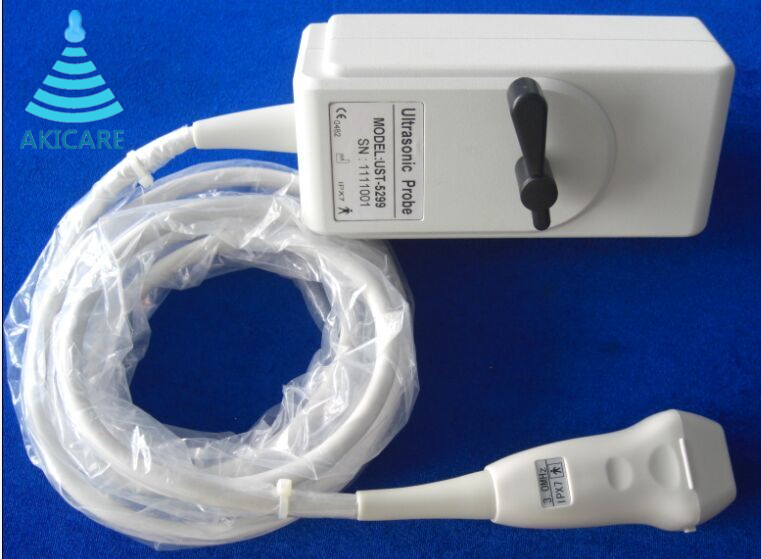
The practical reason to buy an Aloka UST-5299 from an independent supplier such as Akicare is simple: this is a discontinued transducer for legacy Aloka consoles, and the OEM channel no longer offers a straightforward new-purchase path. Facilities keeping these systems in service rely on tested stock, refurbished units, and probe repair. This article explains what the UST-5299 is, what a trustworthy supplier must be able to show you, and when repairing your existing probe beats buying another one.
What the UST-5299 Is and Why Sourcing It Is Different
The UST-5299 is an endocavity (transvaginal) transducer built for Aloka’s SSD-series diagnostic consoles — platforms that predate the Hitachi Aloka merger and remain in service in many clinics precisely because they are durable and paid off. Aloka probe compatibility is strictly console-family based: a UST-series probe fits the SSD generations it was designed for and nothing else, so always confirm the probe model against your console model before ordering. The connector type and probe ID must both match; a physically similar Aloka probe from a different console generation will not work.
Because the platform is legacy, the sourcing landscape looks different from a current-model GE or Philips probe:
- No meaningful new-OEM channel — Hitachi Aloka’s successor organization focuses parts support on current platforms.
- Supply comes from tested used stock, refurbished units, and repair of existing probes.
- Condition varies enormously, because every unit in circulation has years of clinical use behind it.
That last point is why the supplier’s testing process, not the price, should drive your choice. Our UST-5299 product page lists the units we currently have tested and ready.
What a Credible Supplier Must Provide
For a legacy endocavity probe, insist on all four of the following before payment:
| Item | Why it matters |
|---|---|
| Per-element test report | Each array element is driven and measured individually; dead or weak elements appear as numbers, not opinions. This is the only objective evidence of acoustic condition on a used probe. |
| Photos of the actual unit | Stock photos hide sheath wear and lens damage — both critical on a transvaginal probe. |
| Written warranty in months | A seller confident in their testing will stand behind the array for a defined period. |
| Confirmation against your console model | Puts compatibility responsibility on the supplier, in writing. |
On arrival, verify before clinical use: inspect the insertion tube and lens for cuts or delamination (an infection-control issue, not cosmetics), connect and confirm the console recognizes the probe, then scan a uniform target and look for vertical dropout lines that indicate dead elements.
Repair First: Often the Better Answer on Legacy Probes
If your own UST-5299 has failed, evaluate repair before hunting for a replacement. On legacy probes the case for repair is stronger than usual, for two reasons: replacement stock is finite and variable in quality, while your existing probe’s history is fully known to you. Typical repairable failures — damaged sheath, lens wear from disinfection cycles, cable conductor breaks, connector faults — cost 30–60% of a replacement probe to fix, with a standard turnaround of 5–10 working days. Repair stops making sense mainly when the array itself has widespread element failure or fluid has penetrated the housing; a proper evaluation identifies this before you spend anything. The process is described on our probe repair service page.
A sensible pattern for clinics running SSD-era consoles: keep one verified spare probe on the shelf, and route failures through repair. This covers you against the day when tested UST-5299 stock becomes genuinely hard to find, without paying spot prices under time pressure.
Bottom Line
Buy the UST-5299 from a supplier who can hand you a per-element test report, real photos, a written warranty, and a console-match confirmation — those four items separate a professional source from a parts flipper, whatever name is on the storefront. If your existing probe is repairable, repair at 30–60% of replacement cost is usually the stronger move on a legacy platform. Our tested Hitachi Aloka probe inventory covers the UST series; send us your console model and probe symptoms for a same-day answer on whether repair or replacement is the cheaper path for your unit.
Aloka UST-5299 ultrasound probe: current evidence update
Answer first: A Aloka UST-5299 ultrasound probe request should preserve the complete probe and host-system labels, connector photographs, supply path, current condition, item-specific photos, named test scope and written compatibility basis. A catalogue record is a shortlist; it does not prove the condition or support of every revision.
| Field | Evidence | Control |
|---|---|---|
| Probe identity | Brand, full model, suffix and label | Keep this field tied to the exact Aloka UST-5299 ultrasound probe request. |
| Host system | Console model and configuration context | Keep this field tied to the exact Aloka UST-5299 ultrasound probe request. |
| Connector | Contact face, housing, latch and cable entry | Keep this field tied to the exact Aloka UST-5299 ultrasound probe request. |
| Offer type | OEM-brand, compatible, used, refurbished or repair | Keep this field tied to the exact Aloka UST-5299 ultrasound probe request. |
| Condition | Current lens, housing, cable and connector photos | Keep this field tied to the exact Aloka UST-5299 ultrasound probe request. |
| Test evidence | Named checks, conditions, result format and exclusions | Keep this field tied to the exact Aloka UST-5299 ultrasound probe request. |
Why this page is different from a product listing
The article explains how to evaluate the request and routes readers to current catalogue records. A product or category page owns the commercial inventory intent. This article should not compete by repeating a long list of unverified models; it adds decision evidence, limitations and an RFQ workflow that a product card cannot provide.
Model and configuration boundaries
For repair, describe what appears, when it appears and whether movement changes the symptom; do not assign an internal cause remotely. For purchase, ask the quotation to identify the offered item, current condition and availability at the time of the request.
Keep general documentation separate from item-level proof. A source can explain terminology or testing boundaries, while the physical label, current photos, inspection record and quotation establish facts about the exact item. Mark unresolved fields pending instead of copying a specification or compatibility statement from a similar model.
Four-step review
- Capture complete labels and all relevant physical interfaces.
- Check the exact current document or written match basis.
- Separate catalogue discovery from item condition and test evidence.
- Approve only a quotation that repeats the identity, scope, exclusions and terms.
Related catalogue and service links
Frequently asked questions
Does the model phrase alone prove the correct Aloka UST-5299 ultrasound probe?
No. Verify the complete labels, physical interface and current configuration-specific evidence.
Can a catalogue image prove condition?
No. Request current photos tied to the quoted item or service record.
What should the written quote identify?
Exact identity, compatibility basis, condition, evidence, included items, availability basis, shipping responsibility and remedy terms.
Sources
Evidence update checked 3 August 2026. Use current exact documentation for the device and jurisdiction involved.