
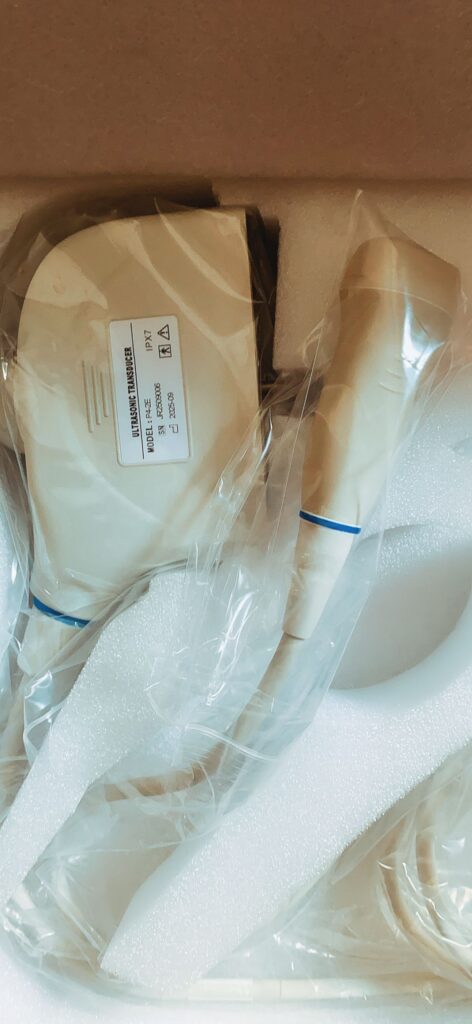
There are three practical channels for a Mindray P4-2E ultrasound probe: a new OEM unit through Mindray’s sales network, a tested compatible probe from an independent supplier such as Akicare, or a repair of your current P4-2E if the damage is localized. For P4-2E, repair pricing and turnaround depend on the fault, probe model, parts availability, and agreed test scope; request an assessment before comparing repair with replacement.
What the Mindray P4-2E Is Used For
The P4-2E is a phased array transducer operating in the 2-4 MHz range, designed primarily for adult cardiac imaging, with additional use in abdominal and critical-care applications. It supports B-mode, M-mode, and color Doppler imaging, and its small sector footprint suits intercostal cardiac windows.
In daily use, the most common P4-2E failures we see are dropped elements from handling impacts, lens wear from repeated high-level disinfection, and cable faults near the connector or strain relief. Each of these is repairable; a fully degraded array is not.
System Compatibility
The P4-2E is used on Mindray color Doppler platforms, including the DC-8 series. Mindray has shipped multiple connector and software revisions across its product lines, so always confirm your exact console model and software version before ordering. Send us your system model and the part number printed on your current probe, and we will verify fit before quoting.
OEM vs Compatible vs Repair: Cost Comparison
| Option | Typical cost | Lead time | Best for |
|---|---|---|---|
| New OEM probe from Mindray | Highest (list price) | Varies by distributor | Facilities on OEM service agreements |
| Compatible probe (Akicare) | For P4-2E, compatible or refurbished probe pricing depends on the exact model, condition, test documentation, availability, and order terms; compare a current RFQ with OEM supply. | In-stock units ship promptly | Cost-controlled replacement |
| Repair of your existing probe | For P4-2E, compatible or refurbished probe pricing depends on the exact model, condition, test documentation, availability, and order terms; compare a current RFQ with OEM supply. | For P4-2E, compatible or refurbished probe pricing depends on the exact model, condition, test documentation, availability, and order terms; compare a current RFQ with OEM supply. | Lens, cable, housing, or limited element faults |
Our compatible probes are built and tested to work with the corresponding Mindray systems. They are not manufactured by Mindray and are not sold as OEM parts; what you are paying for is verified function at a substantially lower price.
Element-by-Element Test Reports
Every compatible P4-2E we ship and every repair we return includes an element-by-element acoustic test report. Each array element is measured individually for sensitivity, so weak or dead elements are documented as numbers, not judged by eye from a phantom image. Your biomedical engineering team can keep the report as a baseline and re-check the probe against it at future intervals.
When Repair Beats Replacement
- Repair For P4-2E, compatible or refurbished probe pricing depends on the exact model, condition, test documentation, availability, and order terms; compare a current RFQ with OEM supply.
- Replace when there is widespread element failure, liquid ingress into the array, or damage from a previous failed repair. A compatible unit is usually the more economical choice at that point.
Handling Practices That Prevent the Most Common Failures
The three failure modes listed above — impact damage, lens wear, and cable faults — are largely preventable, and a few departmental habits make a measurable difference to how long any P4-2E lasts:
- Return the probe to its holder between patients. Most element damage we trace back to a drop or a probe left resting on the edge of the console.
- Never carry or hang the probe by its cable, and avoid tight coiling; strain at the connector end is the usual origin of intermittent image noise.
- Use only disinfectants approved in Mindray’s care documentation for this probe, and keep liquid away from the connector. Unapproved agents accelerate lens softening and delamination.
- Wipe gel off the lens immediately after each exam rather than letting it dry.
- Add a quick weekly visual check of lens and cable to your department routine, and compare periodic image checks against the element test report you received with the probe.
Frequently Asked Questions
What information do you need to quote a P4-2E? Your console model, its software version, and a photo of the label on your current probe. That is enough to confirm connector and system fit before any money changes hands.
What happens if my probe turns out to be unrepairable? The evaluation’s element data will show why — typically widespread array failure or liquid ingress. In that case we quote a compatible replacement instead, and you decide with the measurements in front of you.
Is a compatible probe physically identical to the OEM unit? It uses the same connector and is built to be recognized and operated by the matching Mindray consoles, but it is independently manufactured. The element-by-element report is the objective proof of function.
How to Order
To buy: see the Mindray P4-2E compatible probe product page or browse all Mindray-compatible probes. For a failing probe, request an evaluation through our probe repair service. Include your console model and a photo of the probe label, and we will respond with a compatibility-confirmed quote.
Evidence boundary and verification record
For Buying a Mindray P4-2E Ultrasound Probe: Options, Pricing, and Repair, the complete label, connector, host-system record and physical item must remain linked. Similar model stems can describe different probes, and representative photographs do not establish the condition of a used or refurbished unit. Keep discovery, item and commercial evidence in separate rows.
AIUM describes why transducer operation and repair quality control require structured assessment. The published BMUS multicentre survey supports documenting physical and performance condition across a probe fleet. Applied to Buying a Mindray P4-2E Ultrasound Probe: Options, Pricing, and Repair, these sources justify item-level checks but do not diagnose a probe or establish a system match remotely.
Primary sources and limits
- AIUM transducer testing and repair statement — professional guidance on transducer assessment and post-repair quality control.
- CDC healthcare-equipment disinfection and sterilization guidance — a processing framework tied to device use and instructions.
- BMUS multicentre probe-condition survey — published fleet research, not an item-level diagnosis.
Evidence questions
Does this evidence prove the exact compatibility described in Buying a Mindray P4-2E Ultrasound Probe: Options, Pricing, and Repair?
No. It defines what should be collected and reviewed. Exact compatibility remains tied to the complete labels, configuration, current documentation and written item-specific decision.
Can the commercial terms for Buying a Mindray P4-2E Ultrasound Probe: Options, Pricing, and Repair be assumed from this article?
No. Availability, condition, included work, timing, logistics, exclusions and remedy must be confirmed in the current quotation for the exact request.