
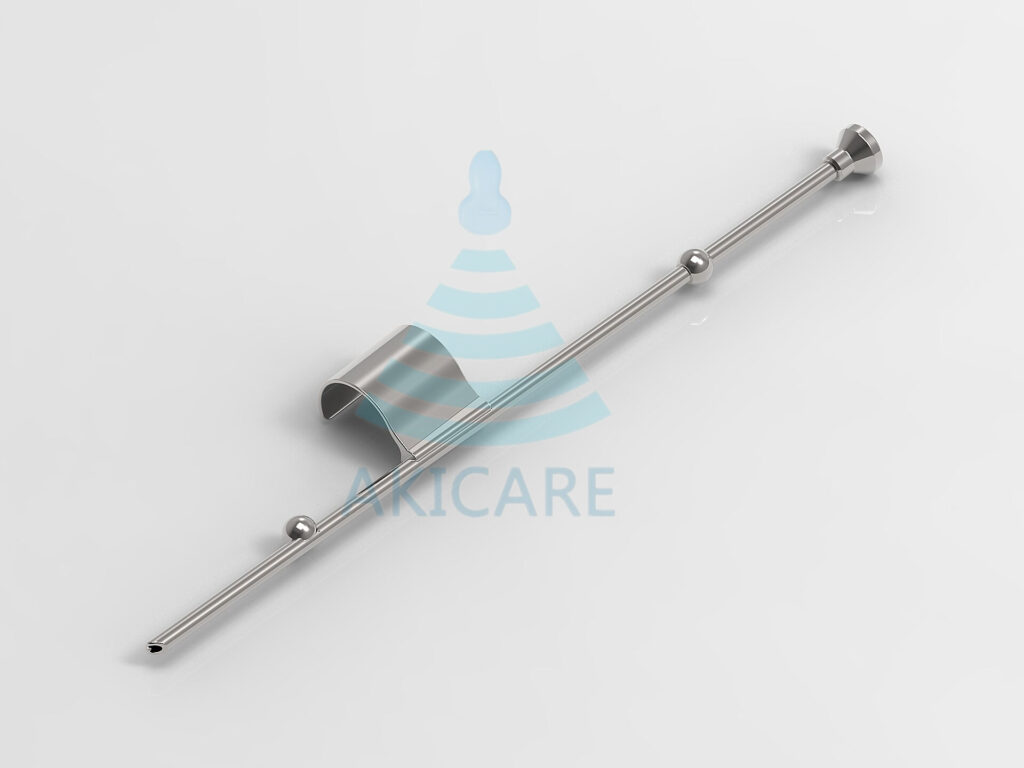
When you are deciding where to buy a GE RIC5-9A-RS biopsy guide, the platform itself matters less than the evidence behind the listing. The right supplier is the one that can confirm in writing that the guide is machined for the RIC5-9A-RS housing specifically, state whether the unit is reusable or single-use, and describe the reprocessing or handling requirements that apply. A marketplace listing, a distributor catalogue, or a specialist probe supplier can all be acceptable sources — but only if the model designation, the construction type, and the documentation match what your facility actually needs. This page gives you the checklist to make that decision.
What the RIC5-9A-RS Biopsy Guide Does
The RIC5-9A-RS is a 4D micro-convex endocavity transducer used for transvaginal imaging and ultrasound-guided procedures on GE Voluson systems. During a freehand biopsy, the operator has to hold the needle path steady against a moving image. A dedicated guide fixes the needle channel to the probe body at a set angle, so the needle track appears as a predictable overlay line on the Voluson display.
Because a guide is machined to the exact contour of the RIC5-9A-RS handle, a bracket made for a different endocavity probe — even a closely named one such as RIC5-9-RS or RIC5-9W-RS — will not necessarily seat correctly. The letter suffix is part of the model identity, and the guide, probe, procedure, and processing records must all match.
What a Good Buying Platform Must Show You
Whether you buy from a general marketplace, a regional distributor, or a specialist ultrasound-probe supplier, the listing or quotation should give you four things before you commit:
- Exact model designation. The guide must be identified for the RIC5-9A-RS by that full string. A title that lists other models in the RIC5-9 family is not evidence of fit for your probe.
- Construction type. Reusable metal guides and sterile-packed single-use guides are different products with different cost and reprocessing profiles. The listing must say which one it is.
- Written compatibility confirmation. If any part of the fit is ambiguous, require the supplier to confirm compatibility in writing before purchase rather than inferring it from a photo or a similar model name.
- Documentation trail. Your biomedical engineering and infection-control records should be able to tie the purchased guide to the probe, the procedure type, and the reprocessing method used.
A platform that cannot supply these four items is a catalogue discovery tool, not a procurement destination. Use it to identify candidate part numbers, then move to a supplier that will document them.
Reusable vs. Single-Use: Which Version to Order
Guides for this probe family come in two constructions, and the right choice depends on your procedure volume and sterilization capability.
| Factor | Reusable (stainless steel) | Single-use (sterile packed) |
|---|---|---|
| Cost profile | Higher up front, lower per procedure at volume | Low per unit, recurring cost |
| Reprocessing | Cleaned and reprocessed between cases per your facility protocol | None; discarded after the case |
| Best fit | High-volume procedure rooms with validated reprocessing | Low or intermittent volume, or sites without reprocessing capacity |
| Records | Reprocessing logs must track each cycle | Lot and usage records per case |
Do not assume a needle gauge, channel angle, or material from a listing title. Only order against facts the supplier states explicitly for the exact guide you are buying, and keep those statements with the purchase record.
Step-by-Step Buying Workflow
- Confirm the probe. Verify the probe on the Voluson system is the RIC5-9A-RS by reading the label on the probe housing, not from memory or a purchase order for a different unit. The matching probe is catalogued as the GE RIC5-9A-RS endocavity ultrasound probe.
- Decide reusable vs. single-use. Agree this with the clinical and reprocessing teams before searching, so listings can be filtered immediately.
- Shortlist suppliers. Compare a specialist probe supplier’s product catalogue against any marketplace or distributor offers you already have.
- Request written evidence. Ask each candidate supplier to confirm the guide model, its intended probe, and its construction in writing. Apply the same discipline you would use to evaluate ultrasound probe supplier evidence for the probe itself.
- Check reprocessing alignment. For a reusable guide, confirm your facility’s cleaning and sterilization workflow covers the item before it arrives. For single-use, confirm storage and lot tracking.
- Document and receive. On receipt, match the delivered guide’s markings against the written confirmation and file both with the probe’s service and procedure records.
Common Mistakes When Choosing a Platform
- Buying on a family name. A guide listed for the RIC5-9 family broadly, or for sibling models such as RIC5-9-D or RIC5-9W-RS, is not confirmed for the RIC5-9A-RS housing. Treat those listings as leads that require written confirmation, not as proven fits.
- Trusting a photograph. A connector or bracket photo shows shape, not fit. Machining tolerances are what determine seating, and those are only established by the supplier’s stated specification.
- Ignoring reprocessing. Ordering a reusable guide for a site without a validated reprocessing pathway creates an unusable asset. Decide construction type first.
- Mixing records. The guide, the probe serial or asset record, the procedure documentation, and the reprocessing log must reference the same model. Mismatched records are a common audit finding.
- Assuming condition or testing. Unless the supplier states item condition and any inspection performed, assume nothing about either — ask.
Why Evidence Discipline Matters for Endocavity Accessories
Endocavity probes and their accessories sit in the highest-scrutiny category of ultrasound equipment. The AIUM’s official statement on transducer testing and repair sets expectations for how transducers should be inspected and maintained, and the CDC guidance on disinfection and sterilization of healthcare equipment frames the reprocessing requirements that apply to devices used in semi-critical and critical applications. A multicentre survey of probe condition published in Ultrasound (BMUS probe-condition survey) found that physical damage to probes in routine clinical use is common enough that accessories and their fit should be checked rather than assumed. None of this is unique to the RIC5-9A-RS, but it is why a biopsy-guide purchase should be treated as a documented clinical-equipment decision, not a consumable top-up.
Commercial Next Step
Start with the GE RIC5-9A-RS probe listing to confirm the probe identity, then browse the biopsy guide category or the broader products catalogue for candidate guides. Because guide candidates listed for sibling models do not by themselves prove fit for the RIC5-9A-RS, request written compatibility confirmation through the contact page before placing an order. If your probe also needs attention, the probe repair page describes how repair enquiries are handled.
Frequently Asked Questions
Does a biopsy guide listed for the RIC5-9 family fit the RIC5-9A-RS?
Not automatically. A guide must be machined for the RIC5-9A-RS housing specifically, and a listing that names sibling models such as RIC5-9-D or RIC5-9W-RS is not evidence of fit. Require written compatibility confirmation for the full RIC5-9A-RS designation before ordering.
Should I order a reusable or a single-use guide?
Match the construction to your procedure volume and reprocessing capability. A reusable stainless steel guide suits high-volume rooms with a validated reprocessing workflow; a sterile-packed single-use guide suits lower volume or sites without reprocessing capacity.
Is a photo of the guide enough to confirm compatibility?
No. A photograph shows shape, not machining tolerance or fit. Only the supplier’s stated specification, confirmed in writing against the full probe model string, establishes compatibility.
What records should accompany a biopsy-guide purchase?
Keep the written compatibility confirmation, the construction type (reusable or single-use), and the purchase documentation tied to the probe’s asset record. For reusable guides, reprocessing logs must track each cycle; the guide, probe, procedure, and processing records must all match.
Sources
- AIUM, Transducer Testing and Repair (official statement): aium.org/resources/official-statements/view/transducer-testing-and-repair
- CDC, Disinfection and Sterilization of Healthcare Equipment: cdc.gov/infection-control/hcp/disinfection-sterilization/healthcare-equipment.html
- BMUS multicentre probe-condition survey, Ultrasound: pmc.ncbi.nlm.nih.gov/articles/PMC5098704