
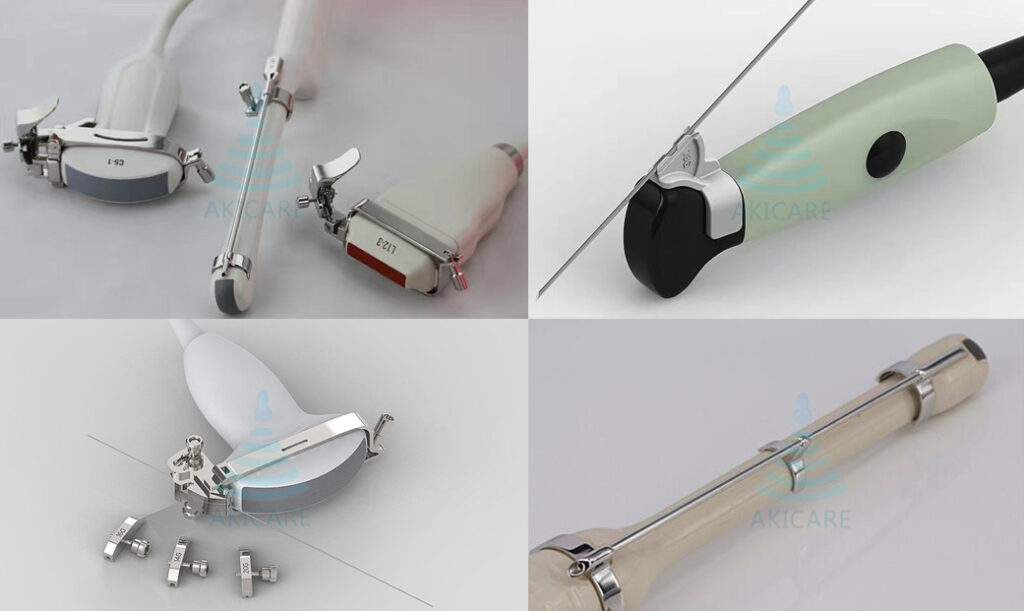
Answer first: An Aloka UST-9124 biopsy guide should be sourced by exact probe and guide references. The UST-9124 label, housing, host-system context, proposed bracket or single-use item, current instructions and written commercial scope must stay connected. A guide for a nearby UST-91xx model should remain a separate candidate until exact UST-9124 fit is documented.
Why the 9124 suffix matters
Legacy Aloka and later Hitachi Aloka catalogues contain similar UST model strings. The shared prefix is useful for navigating a catalogue, but the suffix identifies a different equipment record. A bracket has to engage the physical probe housing and support the owner’s applicable guidance process. Similar appearance, a shared scanner family or a seller’s broad “UST series” label does not establish those points.
Record the label exactly as found. Do not silently change Aloka to Hitachi Aloka or replace UST-9124 with a nearby model because a guide image looks alike. A clean audit trail preserves the label brand, full model, serial or asset reference, system context and the supplier’s explanation of the proposed match.
UST-9124 guide decision table
| Question | Acceptable evidence | Do not substitute |
|---|---|---|
| Which probe is involved? | Complete UST-9124 label and photographs of the actual housing | A UST-9123 or general UST-series description |
| Which guide is offered? | Supplier, exact part number, guide format and current product record | A representative bracket image without a reference |
| What supports fit? | Written UST-9124 listing or quote-specific explanation tied to the part | A shared scanner name or visual similarity |
| Which process applies? | Current guide and probe instructions plus the facility’s approved procedure | A generic cleaning or sterilization promise |
| What is supplied? | Item, components, documents, exclusions and item imagery where applicable | An undefined “complete kit” statement |
| What are the terms? | Dated availability check, logistics, responsibility and remedy in the quote | Old catalogue availability or fixed site-wide promises |
Use exact UST-9124 catalogue records as candidates
The Leapmed 120069 reusable guide record and the Leapmed 10203702 single-use guide record both name UST-9124. That satisfies the catalogue-discovery threshold, not the complete purchasing threshold. The requester must still compare the exact offered reference, instructions, supplied components and written fit basis.
The UST-9124 endocavity probe record helps confirm the parent device. It must not be used to invent the accessory’s channel, material, processing cycle or usable life. Product roles stay separate even when they share the same model string.
Separate fit, guidance and processing
Physical fit answers whether the guide mounts as intended on the named probe. Guidance answers how the equipment owner checks the relationship between the guide and the configured system. Processing answers which cleaning, disinfection or sterilization steps apply to the exact reusable or single-use product. One answer cannot fill a missing record in another layer.
For an endocavity context, the processing boundary is especially important. CDC guidance classifies equipment processing by intended contact and directs users to manufacturer instructions. This article therefore does not prescribe a chemistry, exposure time, temperature, cycle or reuse limit. Obtain the current instructions for the guide and probe and follow the responsible facility’s approved procedure.
An eight-step UST-9124 procurement workflow
- Capture exact identity. Save readable probe and console labels and assign one enquiry reference.
- Describe the required guide format. State whether the facility is comparing reusable and single-use options without treating them as equivalent.
- Shortlist records that name UST-9124. Keep each supplier part and guide format on a separate row.
- Request a written fit basis. Ask how the offered part is matched to the UST-9124 housing.
- Collect current instructions. Route procedure and processing questions to the exact documents and facility owner.
- Inspect the parent probe record. Document visible damage or image concerns and use the probe repair assessment route when the transducer itself may need attention.
- Approve one commercial scope. Tie supplied components, exclusions, availability, logistics and remedy to the exact part.
- Reconcile delivery. Compare the received item and documents with the approved record before the owner’s acceptance process.
Failure modes to reject before approval
- The quotation says only “Aloka endocavity guide” and omits UST-9124.
- A UST-9123 page is treated as proof because its number is close.
- A guide’s format or supplied components are inferred from a photograph.
- A reusable guide is approved without current instructions and facility processing ownership.
- The probe, console and accessory references are kept in separate emails with no common item reference.
- Current availability, exclusions or remedy are absent from the written quote.
What independent sources do and do not establish
AIUM’s transducer statement supports regular assessment of probe operation and repair quality control. The BMUS survey supplies fleet-level evidence that ultrasound probes can have faults that are not resolved by a clean catalogue image. Neither source establishes the condition or accessory fit of this UST-9124.
CDC healthcare-equipment guidance supports instruction-led processing decisions. It does not supply a UST-9124 guide cycle. These sources define prudent evidence boundaries; the exact guide instructions, equipment records and written offer still own the item-level decision.
Commercial next step
Browse the model-led catalogue and attach the complete UST-9124 label, host-system label, required guide format and evidence checklist. The Hitachi Aloka browse page can help locate adjacent records, while the exact quotation should name the offered part and every pending verification.
Frequently asked questions
Is a UST-9123 bracket automatically a substitute for an Aloka UST-9124 biopsy guide?
No. A nearby UST model is not evidence of the same housing geometry. Require a guide record that names UST-9124 and a written fit basis for the offered part.
Which records should accompany a UST-9124 guide request?
Keep the full probe and host-system labels, the proposed guide part number, current item photographs when relevant, the guide instructions and the facility’s applicable procedure in one request.
Can a reusable and a single-use UST-9124 guide be compared by unit price alone?
No. Compare the supplied components, instructions, facility workflow, item-specific fit evidence, availability check, logistics, exclusions and remedy under the same request.
Does a console family name prove that the biopsy overlay matches the guide?
No. The system record helps define the configuration, but the equipment owner must verify the guide, probe and applicable guidance process under current instructions.
Sources and scope
- CDC healthcare-equipment guidance — a general processing framework that requires use of applicable device instructions.
- AIUM transducer testing and repair statement — a professional quality-control boundary for probes, not a guide-fit certificate.
- BMUS multicentre probe-condition survey — published fleet research, not a diagnosis of this item.