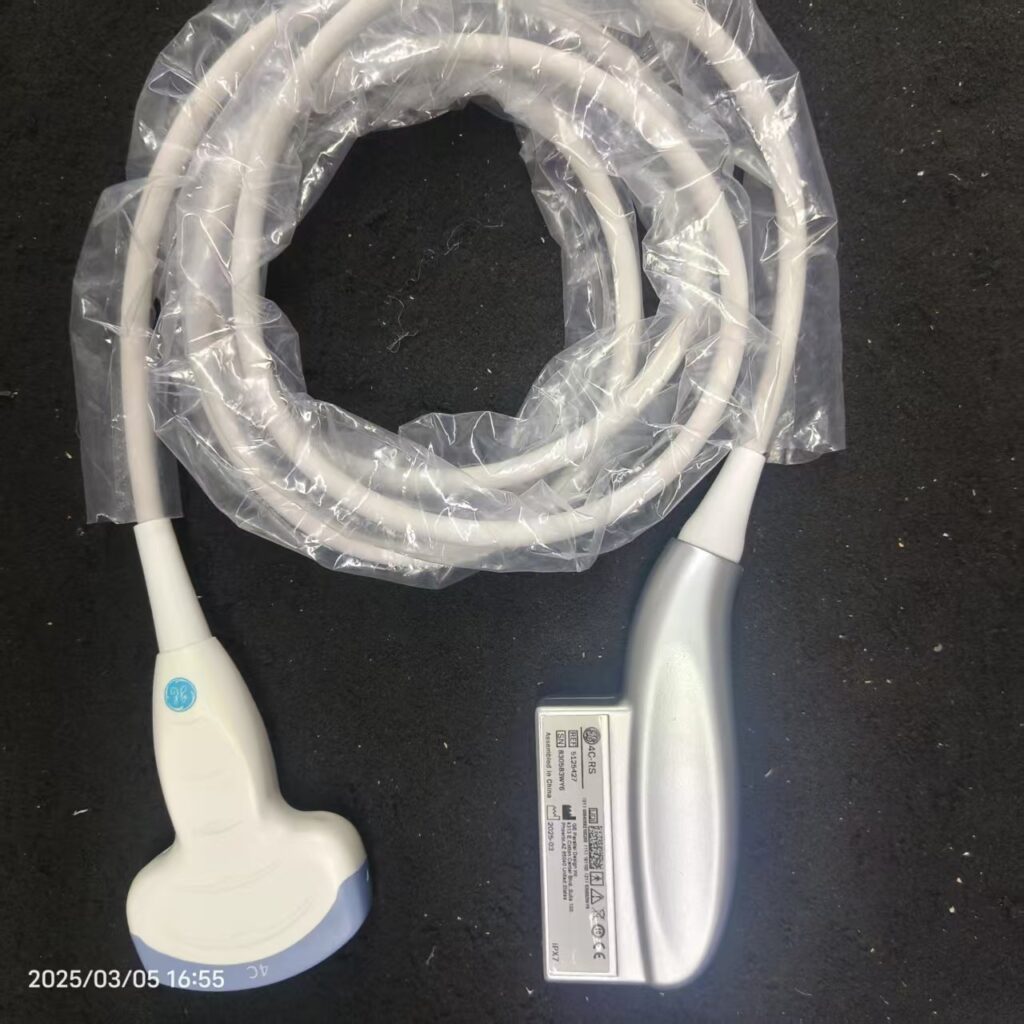
You can source a GE 4C-RS ultrasound probe from three channels: GE as new OEM stock, the secondary market as tested refurbished or compatible units, or a repair service if your existing probe is the one that failed. Which channel makes sense depends on the fault, your budget, and how quickly the scanner needs to be back in service. This guide covers the probe’s specifications, the GE consoles it connects to, and how the three options compare on cost.
What the GE 4C-RS Is and Where It Fits
The 4C-RS is a curved (convex) array transducer built for GE’s portable and compact console families. The “RS” suffix refers to the compact RS connector used on GE’s laptop-style systems, so the probe is not interchangeable with full-size GE connectors such as those on the LOGIQ 9 or Voluson E8 — a frequent and expensive ordering mistake.
| Attribute | Detail |
|---|---|
| Array type | Curved / convex array |
| Operating bandwidth | Approximately 2.0–5.5 MHz |
| Connector | GE RS (compact) |
| Primary applications | Abdominal, OB/GYN, urology, general imaging |
The lower end of the bandwidth gives the penetration needed for abdominal work on larger patients; the upper end sharpens resolution for first-trimester OB and renal studies. For most portable GE owners this is the default general-purpose abdominal probe.
Console Compatibility: Confirm Before You Buy
The 4C-RS is fielded on GE’s RS-connector portables, including:
- LOGIQ e and LOGIQ i
- Vivid e, Vivid i, and Vivid q
- Voluson e and Voluson i
Two checks matter before ordering. First, confirm the connector physically matches — GE sells a 4C (full-size connector) and a 4C-RS, and listings frequently blur the two. Second, confirm your console’s software revision lists the probe; an otherwise healthy transducer will simply not register on a system that lacks the corresponding probe table entry. Send us your console model and software version and we will confirm fitment before quoting. Full GE coverage is listed on our GE probe compatibility page.
New OEM, Compatible, or Repair: Cost Comparison
There are three realistic paths, and the price gap between them is wide.
| Option | Typical cost position | Best suited for |
|---|---|---|
| New OEM from GE | Reference price (highest) | Sites under OEM service contracts that require it |
| Tested compatible / refurbished | 40–70% below new OEM | Adding a probe, replacing a lost or crushed unit |
| Repair of your existing 4C-RS | 30–60% of replacement cost | Cable damage, lens wear, connector faults, limited dead elements |
Repair deserves a closer look than most buyers give it. Common 4C-RS failures — cracked or delaminating lens, cable strain at the boot, bent connector pins, a band of weak elements — are all repairable conditions. Our standard turnaround is 5–10 business days from receipt, which is often faster than OEM replacement lead times. Details and the intake process are on our probe repair service page. Repair stops being economical when the array itself is extensively damaged or the probe has been dropped hard enough to fracture the acoustic stack; in those cases a replacement unit is the better spend.
How to Judge a Replacement Unit Before Paying
The risk in the secondary market is not price — it is undisclosed element dropout. A probe can produce a plausible image while 10–15% of its elements are dead, and the defect only becomes obvious in Doppler sensitivity and near-field detail. Require the following from any seller:
- An element-by-element acoustic test report for the specific serial number, not a sample report
- Photographs of the actual lens, cable, strain relief, and connector
- A stated warranty period in writing, with the return process defined
- Confirmation the unit was leak-tested after any lens or housing work
Every 4C-RS we ship goes through this per-element test, and the report for your serial number accompanies the probe. See current availability on the GE 4C-RS product page.
Practical Recommendation
If your existing 4C-RS has a physical fault and the array is intact, request a repair evaluation first — at 30–60% of replacement cost with a 5–10 business day turnaround, it is usually the lowest total cost of ownership. If the probe is beyond repair or you need a second unit, a compatible or refurbished probe with a per-element test report delivers the same clinical function at 40–70% below the new OEM price. Reserve new OEM purchases for situations where a service contract or institutional policy requires them.
Evidence boundary and verification record
For GE 4C-RS Ultrasound Probe: Compatibility, Specifications, and Where to Source One, the complete label, connector, host-system record and physical item must remain linked. Similar model stems can describe different probes, and representative photographs do not establish the condition of a used or refurbished unit. Keep discovery, item and commercial evidence in separate rows. A second reviewer should reconcile the model characters and every unresolved field before approval.
AIUM describes why transducer operation and repair quality control require structured assessment. The published BMUS multicentre survey supports documenting physical and performance condition across a probe fleet. Applied to GE 4C-RS Ultrasound Probe: Compatibility, Specifications, and Where to Source One, these sources justify item-level checks but do not diagnose a probe or establish a system match remotely.
Primary sources and limits
- AIUM transducer testing and repair statement — professional guidance on transducer assessment and post-repair quality control.
- CDC healthcare-equipment disinfection and sterilization guidance — a processing framework tied to device use and instructions.
- BMUS multicentre probe-condition survey — published fleet research, not an item-level diagnosis.
Evidence questions
Does this evidence prove the exact compatibility described in GE 4C-RS Ultrasound Probe: Compatibility, Specifications, and Where to Source One?
No. It defines what should be collected and reviewed. Exact compatibility remains tied to the complete labels, configuration, current documentation and written item-specific decision.
Can the commercial terms for GE 4C-RS Ultrasound Probe: Compatibility, Specifications, and Where to Source One be assumed from this article?
No. Availability, condition, included work, timing, logistics, exclusions and remedy must be confirmed in the current quotation for the exact request.