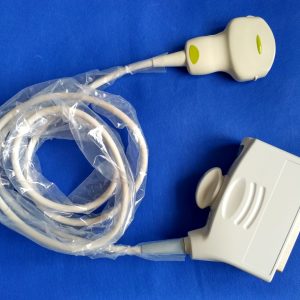
Compatible WELLD 9618C probes are sourced on a request-for-quote basis rather than bought off a public shelf: WELLD is a lower-volume imaging brand, so replacement transducers rarely appear in Western distribution channels, and each enquiry is matched against current supplier inventory before a price is confirmed. The practical route is to send the exact probe model or label text, state the fault if the probe has failed, and compare a replacement quote against a repair assessment before committing. This guide explains how to confirm the probe identity, when repair is the smarter spend, and what evidence to demand before paying.
What the 9618C designation tells you — and what it does not
A probe model string like 9618C identifies a specific transducer build, but it does not by itself prove that another unit carrying a similar label will work on your console.
Where compatible units actually come from
For niche brands, the realistic supply routes are a small set, and each carries different evidence requirements:
- Manufacturer-network sourcing. Compatible transducers are quoted against current availability: you send the model number or label text, and the quote comes back with condition and lead time. There is no public list price because availability and condition vary unit by unit.
- Secondary-market original probes. Used or refurbished OEM units appear sporadically. The burden of proof is higher: ask for the part number, connector photos, and test documentation, and treat missing documentation as a risk you price in or walk away from.
- Repair of your existing probe. When replacement stock is thin — which is common for WELLD — repairing the unit you already own is often the faster and cheaper path.
None of these routes should end in payment before the match is confirmed in writing. The wider discipline of separating a promising listing from verified supply is covered in our guide on how to evaluate ultrasound probe supplier evidence.
Repair versus replacement: the decision in one table
| Situation | Usually favours | Why |
|---|---|---|
| Cable break, damaged strain relief, bent connector pins | Repair | These are among the most common and most repairable probe faults; the array itself is untouched. |
| Dark vertical bands in the image (dead elements) | Repair assessment first | Element or channel faults are often repairable, but the bench must confirm how many elements are affected before quoting. |
| Cracked acoustic lens, membrane wear, fluid ingress | Repair if caught early | Lens and membrane work is routine; long-term fluid ingress can reach the array and change the economics. |
| Whole-probe failure with internal electronic damage | Replacement quote | Bench time and parts can approach replacement cost; compare a firm repair quote against a compatible-unit quote. |
| No replacement unit available for the model | Repair | For niche models, repair may be the only route with a defined lead time. |
Repair pricing and turnaround depend on the fault, the probe model, parts availability, and the agreed test scope — request an assessment before comparing repair with replacement on price alone.
Identify the fault before you request a quote
A clear fault description turns a vague enquiry into a usable quote. Before contacting any supplier, run this check on the suspect probe:
- Look at the image. Dead elements typically show as dark vertical bands; a whole-probe failure shows as no image at all.
- Inspect the cable and strain relief for kinks, cuts, or exposed shielding — cable faults are common and repairable.
- Check the connector pins for bent, corroded, or contaminated contacts.
- Examine the acoustic lens for cracks, delamination, swelling, or fluid ingress.
Send the findings together with the label text and the system model.
Step-by-step sourcing workflow
- Record the identifiers. Photograph the probe label, note the WELLD system model, and write down the part number exactly as printed, including revision letters.
- Document the fault. Run the inspection above and capture example images showing the defect if the probe still produces any image.
- Request a written match. Ask the supplier to confirm in writing that the offered unit matches your part number and host system. A similar model name is not a match.
- Compare both routes. Get a repair assessment at the same time as the replacement quote, so you compare real numbers rather than guesses.
- Confirm terms before paying. Condition, test documentation, lead time, and payment and shipping terms should all be fixed in the quote.
- Verify on arrival. Run the probe on your system and document image quality immediately, while any claim window is open.
Common mistakes when buying for a niche brand
- Buying from a connector photo. Connector shape is necessary but not sufficient — pinout and software support decide whether the probe works.
- Assuming a candidate listing is compatible. A listing is an exact commercial destination only when its title visibly contains the same model string; otherwise treat it as a starting point for a written enquiry.
- Skipping the repair comparison. Departments routinely pay for a replacement when the existing probe had a repairable cable or lens fault.
- Accepting verbal assurances. If the match, condition, or test scope is not in writing, it is not part of the deal.
- Waiting until the probe fails completely. Intermittent dropout is easier to diagnose and often cheaper to fix than a dead probe.
Handling, disinfection, and evidence standards
Whatever route you choose, the probe still has to survive daily clinical use. Reprocessing should follow the probe manufacturer’s instructions and a recognised framework such as the CDC guideline on disinfection and sterilization of healthcare equipment, which scopes how semi-critical devices like endocavity transducers are processed between patients. On verification, the AIUM statement on transducer testing and repair describes how transducers should be evaluated — a useful benchmark when reading a supplier’s test documentation. The BMUS multicentre survey of probe condition found that a substantial share of probes in routine use had faults, many invisible without systematic testing — one more reason to verify a replacement unit on arrival rather than trusting the label.
Commercial next step
Because availability and condition differ for every unit, compatible WELLD 9618C probes are quoted per request rather than listed at a fixed price. Send the probe label text or part number, the fault description, and the quantity, and you will receive a quote covering availability, condition, and lead time — alongside a repair assessment if that route makes sense. Browse the compatible probe catalogue, review our probe repair service, or send the details through our contact page to start the quote.
Frequently asked questions
Are compatible WELLD 9618C probes available at a fixed list price?
No. Availability and condition vary unit by unit for niche brands, so pricing is confirmed per request for quote. Send the probe label text or part number and the quantity needed, and the quote will state availability, condition, and lead time.
How do I prove an offered probe is actually compatible with my system?
Ask the supplier to confirm in writing that the unit matches your exact probe part number, including any revision letters, and your WELLD system model. A connector photograph or a similar model name is not evidence of compatibility.
Should I repair my existing 9618C probe or buy a replacement?
It depends on the fault. Cable, connector-pin, lens, and membrane problems are frequently repairable, and for niche models repair is often the faster route because replacement stock is limited. Request a repair assessment at the same time as the replacement quote and compare firm numbers.
What should I check on the probe before requesting a quote?
Look at the image for dark vertical bands or total dropout, inspect the cable and strain relief for kinks or exposed shielding, check the connector pins for bent or corroded contacts, and examine the acoustic lens for cracks, delamination, or fluid ingress. Send these findings with the model text.
Sources
- AIUM — Transducer Testing and Repair (official statement): aium.org
- CDC — Disinfection and Sterilization of Healthcare Equipment: cdc.gov
- BMUS multicentre survey of ultrasound probe condition: pmc.ncbi.nlm.nih.gov