
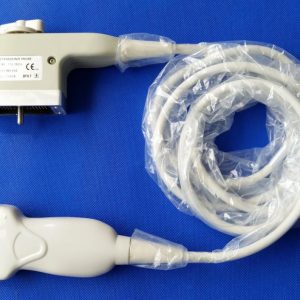
The Ultrasonix SonixTablet uses the standard Ultrasonix transducer family — the same probe line that serves the SonixTouch, SonixMDP, SonixSP, and SonixOP — so keeping one running is a question of sourcing that shared probe family, not hunting for tablet-specific parts. With Ultrasonix long out of production, the practical options are new aftermarket-compatible probes at 40–70% below historical OEM pricing, or repair of your existing probe at 30–60% of replacement cost. This guide covers the compatible models, the discontinued-OEM situation, and how to choose between the two routes.
Transducers compatible with the Ultrasonix SonixTablet
Ultrasonix built one transducer line across its console range, with the frequency band encoded in each model name. The most commonly fitted models are:
| Probe model | Array type | Frequency band | Typical applications | Also fits |
|---|---|---|---|---|
| C5-2/60 | Convex | 2–5 MHz | Abdominal, obstetrics, general imaging | SonixTouch and other Sonix consoles |
| L14-5/38 | Linear | 5–14 MHz | Vascular access, MSK, nerve blocks, small parts | SonixTouch, SonixMDP, SonixSP, SonixOP |
| C7-3/50 | Convex | 3–7 MHz | Abdominal, pediatric abdominal | Sonix console family |
| EC9-5/10 | Endocavity | 5–9 MHz | Transvaginal and transrectal imaging | Sonix console family |
| L9-4/38 | Linear | 4–9 MHz | Vascular, general superficial imaging | Sonix console family |
| PA7-4/12 | Phased array | 4–7 MHz | Cardiac, pediatric cardiac | Sonix console family |
| SA4-2/24 | Phased array | 2–4 MHz | Adult cardiac, transcranial | Sonix console family |
The two linked models are held as new aftermarket-compatible stock; the remainder are quoted on request. Because SonixTablet configurations varied — the console carries two transducer ports and shipped with different software licenses — state your console model and software version when requesting a quotation so port and preset compatibility can be confirmed for your specific unit.
Ultrasonix is gone — the OEM supply situation
Ultrasonix Medical Corporation, the Canadian manufacturer behind the Sonix range, was acquired by Analogic in 2013, and the Sonix product line was subsequently wound down. There is no current OEM channel producing new SonixTablet transducers. What remains on the market is used stock pulled from decommissioned systems — probes with years of accumulated clinical use, unknown disinfection history, and, in most cases, no meaningful warranty.
New aftermarket-compatible probes are the alternative: newly manufactured units built to the Ultrasonix connector and acoustic specification, tested for electrical safety and element performance before dispatch, and sold with a written warranty. For a console family with no OEM successor, this is what keeps working systems in clinical service rather than in storage.
Repair or replace your SonixTablet probe?
Repair suits cable breaks, connector damage, lens wear, and isolated weak elements — typically 30–60% of the cost of a replacement probe, returned in 5–10 working days with a post-repair test report. Given that replacement stock for discontinued platforms is finite, repairing a structurally sound probe is often the rational first move; the process is described on our probe repair page.
Replacement is the answer for cracked arrays, fluid ingress, or element dropout across a wide section of the aperture. A per-element evaluation before committing either way costs little and removes the guesswork.
What to check before ordering
Quote the full model designation from the probe connector — Ultrasonix names include the footprint, so C5-2/60 and L14-5/38 are complete designations while “C5” is not. Confirm the target console (SonixTablet) and its software version. Require unit-specific test evidence: an electrical safety certificate and per-element report for the exact serial number being shipped. Finally, insist on written warranty terms; on a discontinued platform, the warranty is the only recourse you have.
Both stocked models above are quoted individually through their product pages with photographs and test results provided before shipment. For unlisted Ultrasonix models, send the connector label details and availability is normally confirmed within one working day.
Evidence boundary and verification record
For Compatible Ultrasonix SonixTablet Probes: Transducer Guide, a platform-level probe list helps create a shortlist but does not prove that every listed item fits every console revision. Record the full system and probe labels, connector views and the supplier’s written match basis, then attach item-specific condition and verification evidence to the quotation. When the original item is unavailable, state that the search begins from a requirement rather than pretending that a replacement model has already been identified.
Evidence matrix
| Field | What to collect | Why it matters |
|---|---|---|
| System identity | Complete console label and available configuration | Defines the exact platform request |
| Probe identity | Full model, connector and intended array class | Separates candidates from confirmed matches |
| Offered item | Current photos, condition and named verification scope | Connects evidence to one physical unit |
| Quotation | Compatibility basis, exclusions, availability and remedy | States what the supplier commits to |
Use the same matrix for every provider. Mark an unknown field pending instead of borrowing a specification, compatibility statement or condition claim from a similar model. The final record should identify the offered item, the source for each fact and the date on which availability and commercial terms were checked.
AIUM’s official statement supports regular assessment of transducer operation and quality control after repair. The BMUS multicentre survey provides fleet-level evidence that ultrasound probes can have faults requiring structured checks. These sources support the evidence boundary used for Compatible Ultrasonix SonixTablet Probes: Transducer Guide; they do not prove compatibility, current stock or condition for an unidentified item.
Primary sources and limits
- AIUM transducer testing and repair statement — professional guidance on transducer assessment and post-repair quality control.
- CDC healthcare-equipment disinfection and sterilization guidance — a processing framework tied to device use and instructions.
- BMUS multicentre probe-condition survey — published fleet research, not an item-level diagnosis.
Evidence questions
Does this evidence prove the exact compatibility described in Compatible Ultrasonix SonixTablet Probes: Transducer Guide?
No. It defines what should be collected and reviewed. Exact compatibility remains tied to the complete labels, configuration, current documentation and written item-specific decision.
Can the commercial terms for Compatible Ultrasonix SonixTablet Probes: Transducer Guide be assumed from this article?
No. Availability, condition, included work, timing, logistics, exclusions and remedy must be confirmed in the current quotation for the exact request.