
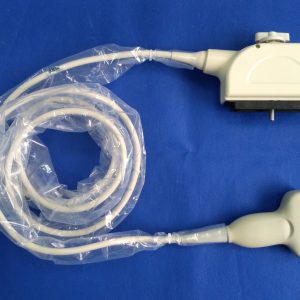
Compatible Ultrasonix SonixMDP probes come from the same transducer family used across the Sonix console line, and since the platform was discontinued after the 2013 Analogic acquisition, they are sourced from independent suppliers rather than the OEM. For the equipment discussed here, compatible or refurbished probe pricing depends on the exact model, condition, test documentation, availability, and order terms; compare a current RFQ with OEM supply. Below is the transducer lineup the SonixMDP supports, followed by guidance on when repairing your existing probe is the cheaper path.
Transducers Compatible with the Ultrasonix SonixMDP
The SonixMDP sat at the top of the Sonix range and was popular in university hospitals and research departments, partly because Ultrasonix offered open access to imaging parameters on this platform. It accepts the standard Ultrasonix connector family:
| Transducer | Array type | Frequency range | Primary clinical use |
|---|---|---|---|
| C5-2/60 | Convex | 2–5 MHz | Abdominal, OB/GYN, general imaging |
| C7-3/50 | Convex | 3–7 MHz | Abdominal, pediatric |
| EC9-5/10 | Endocavity | 5–9 MHz | Transvaginal and transrectal exams |
| L9-4/38 | Linear | 4–9 MHz | Vascular, deeper superficial structures |
| L14-5/38 | Linear | 5–14 MHz | Small parts, MSK, vascular access |
| L14-5W/60 | Wide linear | 5–14 MHz | MSK, breast, wide field of view |
| SA4-2/24 | Phased array | 2–4 MHz | Cardiac, transcranial |
| MC9-5/10 | Microconvex | 5–9 MHz | Pediatric, neonatal |
| 4DC7-3/40 | Motorized 4D convex | 3–7 MHz | 3D/4D obstetric imaging |
| HST15-8/20 | Hockey-stick linear | 8–15 MHz | Intraoperative, superficial MSK |
Reading the code: array letters first, frequency band in MHz second, footprint or radius in millimeters after the slash. Research users most often ask us for the L14-5/38 and C5-2/60, the two workhorses of the platform, and for the SA4-2/24 phased array where cardiac or transcranial protocols are involved. Because the MDP was frequently ordered with the SonixGPS needle-guidance option, GPS-capable variants of the convex and linear probes also appear on the used market and remain interchangeable with the standard versions for ordinary imaging.
Stocked examples from this family include the Ultrasonix L14-5 linear probe and the Ultrasonix C5-2/60 GPS convex probe, both of which connect directly to the SonixMDP without adapters or software changes.
Why the OEM No Longer Sells New SonixMDP Probes
Ultrasonix Medical Corporation of Richmond, British Columbia was acquired by Analogic in 2013 and folded into the BK Ultrasound organization, which today operates as BK Medical. The Sonix console line was subsequently wound down, and factory-new transducers for it are no longer produced. That does not make a working SonixMDP obsolete. Hospitals and clinics keep these consoles in service for years because the image quality remains adequate for routine work and the replacement cost of a new console is difficult to justify.
The practical supply channel is therefore the independent market: tested refurbished OEM transducers and compatible aftermarket transducers built to mate with the Ultrasonix connector. For the equipment discussed here, compatible or refurbished probe pricing depends on the exact model, condition, test documentation, availability, and order terms; compare a current RFQ with OEM supply. Insist on a supplier that provides element-by-element phantom test reports and a warranty of at least six months before purchase.
Repair or Replace a Failing SonixMDP Transducer?
Before ordering a replacement, have the existing probe evaluated. Common faults on Ultrasonix transducers—lens delamination, cable breaks near the strain relief, cracked connector shells and individual dead elements—are all repairable. A professional ultrasound probe repair For the equipment discussed here, repair pricing and turnaround depend on the fault, probe model, parts availability, and agreed test scope; request an assessment before comparing repair with replacement.
Repair is usually the better decision when the fault is mechanical (lens, cable, housing) and the array itself still tests clean. Replacement makes more sense when more than a handful of adjacent elements are dead, when the array has been struck or dropped, or when the same probe has already been repaired twice. For a discontinued platform such as the SonixMDP, many facilities do both: repair the primary probe and keep a tested compatible spare on the shelf to avoid exam downtime.
How to Verify Compatibility Before You Order
Ultrasonix used one connector family across the Sonix consoles, but software licensing still matters. Confirm the following with any supplier before payment:
- Exact model designation. Order by the full Ultrasonix code (for example L14-5/38, not just “L14-5”), because the suffix defines the footprint.
- Software options on your console. A 4D transducer requires the 4D imaging license on the SonixMDP; a probe the system firmware does not list will not be selectable even if it connects.
- Test documentation. Ask for an element-by-element report generated on a probe tester or phantom, not a photograph of an image on screen.
- Return terms. A reputable supplier accepts a return if the probe is not recognized by your specific console.
Send us your console serial number and current probe list and we will confirm compatibility, quote a tested replacement, or advise whether a repair of your existing transducer is the more economical route.
Evidence boundary and verification record
For Compatible Ultrasonix SonixMDP Probes: Full Transducer List and Sourcing Options, a platform-level probe list helps create a shortlist but does not prove that every listed item fits every console revision. Record the full system and probe labels, connector views and the supplier’s written match basis, then attach item-specific condition and verification evidence to the quotation. A second reviewer should reconcile the model characters and every unresolved field before approval.
AIUM’s official statement supports regular assessment of transducer operation and quality control after repair. The BMUS multicentre survey provides fleet-level evidence that ultrasound probes can have faults requiring structured checks. These sources support the evidence boundary used for Compatible Ultrasonix SonixMDP Probes: Full Transducer List and Sourcing Options; they do not prove compatibility, current stock or condition for an unidentified item.
Primary sources and limits
- AIUM transducer testing and repair statement — professional guidance on transducer assessment and post-repair quality control.
- CDC healthcare-equipment disinfection and sterilization guidance — a processing framework tied to device use and instructions.
- BMUS multicentre probe-condition survey — published fleet research, not an item-level diagnosis.
Evidence questions
Does this evidence prove the exact compatibility described in Compatible Ultrasonix SonixMDP Probes: Full Transducer List and Sourcing Options?
No. It defines what should be collected and reviewed. Exact compatibility remains tied to the complete labels, configuration, current documentation and written item-specific decision.
Can the commercial terms for Compatible Ultrasonix SonixMDP Probes: Full Transducer List and Sourcing Options be assumed from this article?
No. Availability, condition, included work, timing, logistics, exclusions and remedy must be confirmed in the current quotation for the exact request.