
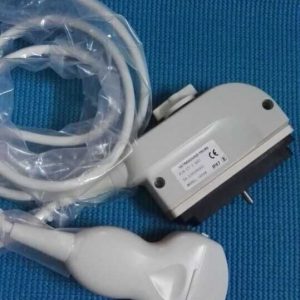
You can source compatible Siemens Acuson NX2 Elite transducers through remaining OEM channels, refurbished OEM units, or independently supplied compatible probes — but the safe buying decision starts with the exact probe part number, not the console badge. The NX2 Elite works with the NX/X-series transducer family: CH5-2, VF12-4, EC9-4w, P4-2, P8-4, and CW2 are the models most often requested for this platform. A third-party compatible probe is not manufactured or endorsed by Siemens, and a catalogue listing is discovery only — written confirmation of the part number, connector, and your console configuration is what makes a purchase defensible.
Transducers associated with the Acuson NX2 Elite
The NX2 Elite is a 64-channel general-imaging system, and Siemens equipped the NX family with a compact transducer set covering abdominal, OB/GYN, vascular, small parts, and cardiac work. The table below is a model shortlist, not a compatibility guarantee. Frequency bands are approximate; always match the part number printed on your existing probe housing before ordering, because configurations within the NX family are not necessarily identical.
| Model | Array type | Primary clinical use | Frequency band |
|---|---|---|---|
| CH5-2 | Curved (convex) array | Abdominal, OB/GYN, general imaging | 2–5 MHz |
| VF12-4 | Linear array | Vascular, small parts, thyroid, breast, MSK | 4–12 MHz |
| EC9-4w | Endocavity | Transvaginal and transrectal OB/GYN, urology | 4–9 MHz |
| P4-2 | Phased array | Adult cardiac, transcranial, abdominal | approx. 2–4 MHz |
| P8-4 | Phased array | Pediatric and neonatal cardiac | 4–8 MHz |
| CW2 | Pencil (CW Doppler) | Continuous-wave cardiac Doppler | 2 MHz |
Model-specific notes for NX2 Elite buyers
CH5-2 curved array
The CH5-2 is the workhorse abdominal and obstetric head for the NX2 Elite. When replacing one, record the full part number and connector style from the housing label — family-name matches such as “a CH5-class probe” are not sufficient, because revision and connector differences matter for the console handshake and preset behaviour.
VF12-4 linear array
The VF12-4 covers vascular access, thyroid, breast, and musculoskeletal imaging. Because linear heads are often moved between rooms, check the cable, strain relief, and lens surface carefully on any offered unit, and ask for photographs of the connector pins before committing.
EC9-4w endocavity
The EC9-4w serves transvaginal and transrectal OB/GYN and urology work. Endocavity probes fall under semi-critical device reprocessing rules: the CDC guidance on disinfection and sterilization of healthcare equipment sets out high-level disinfection expectations for devices that contact mucous membranes. Confirm your facility’s reprocessing workflow supports the unit you buy, and confirm any biopsy-guide requirements separately, since guide, probe, and procedure records must match.
P4-2 and P8-4 phased arrays
The P4-2 covers adult cardiac, transcranial, and deep abdominal windows; the P8-4 addresses pediatric and neonatal cardiac imaging. Phased arrays are sensitive to element dropout, so ask the supplier what functional checks were performed and what the stated limitations of the inspection are.
CW2 pencil probe
The CW2 is a dedicated 2 MHz continuous-wave Doppler pencil probe. Because it is a specialist head, verify that your NX2 Elite configuration supports CW Doppler operation before ordering — a connector that physically fits does not prove the software path is enabled.
Catalogue discovery versus item-specific evidence
Compatible transducers for this platform appear in several places: remaining OEM channels, refurbished OEM stock, and independent suppliers of compatible units. A probe catalogue listing or the Siemens Acuson manufacturer page tells you a model exists on the market; it does not confirm that the specific unit on offer fits your console, its condition, or the commercial terms. A connector photo or a similar model name is not proof of compatibility. Before paying, obtain in writing:
- Identity. Exact model, part number, serial or batch reference, and connector photographs.
- Condition disclosure. Prior repair history, visible cable or lens condition, and any known artifacts.
- Inspection scope. The checks actually performed and their stated limitations, not a generic condition label.
- Compatibility basis. Written confirmation against your console identification and software configuration, framed as evidence rather than a future-performance promise.
The AIUM’s official statement on transducer testing and repair is a useful reference for what structured transducer evaluation involves. Independent field evidence supports caution: the BMUS multicentre survey of ultrasound probe condition found a meaningful share of in-use probes with defects, which is why documented unit-level checks matter more than category labels.
Step-by-step sourcing workflow
- Record the identity of your current probe. Photograph the housing label, part number, and connector. If the probe is missing, pull the part number from the service documentation or console records.
- Document the console. Note the NX2 Elite serial information and software configuration, and capture connector-port photos.
- Describe the fault or need. A symptom description supports review but does not establish whether the fault is probe-side or console-side.
- Request a written quotation stating the proposed unit’s identity, compatibility basis, inspection scope, availability, commercial terms, and dispatch estimate.
- Evaluate repair in parallel. Cable, strain-relief, acoustic-surface, housing, and connector faults deserve a documented assessment and written probe repair quotation before you replace; visible damage alone neither guarantees repairability nor proves replacement is required.
- Verify on receipt. Check the received unit against the quotation identifiers and inspection document before the facility considers clinical use, and stop the acceptance decision if any identifier or document scope differs.
Common mistakes when buying NX2 Elite transducers
- Shopping by console badge alone. Two systems sharing the NX family name can differ in connector options or software enablement; confirm the target probe against console identification and service documentation.
- Treating a catalogue row as evidence. A listing does not confirm stock, exact fit, inspection scope, or terms — see how to evaluate ultrasound probe supplier evidence before committing.
- Skipping written condition disclosure. Undocumented repairs and lens or cable wear show up later as image artifacts and downtime.
- Ignoring reprocessing fit. For endocavity heads, confirm high-level disinfection workflow compatibility per CDC guidance before purchase, not after.
- Accepting verbal compatibility. If a supplier will not put the compatibility basis in writing, treat that as a finding in itself.
Commercial next step
To move from shortlist to quotation, browse the ultrasound probe catalogue for the NX2 Elite family models above, then send the exact probe part number, NX2 Elite serial information, connector photos, and the observed fault or application need. Ask that the reply state the proposed unit, its compatibility basis, inspection scope, availability, and commercial terms in writing. Keep the quotation, identity photos, and inspection document together so the received unit can be checked against what was offered.
Frequently asked questions
Which transducers work with the Siemens Acuson NX2 Elite?
The NX/X-series family models most often requested for the NX2 Elite are the CH5-2 curved array, VF12-4 linear array, EC9-4w endocavity probe, P4-2 and P8-4 phased arrays, and the CW2 pencil CW Doppler probe. Confirm the exact part number, connector, and your console configuration in writing before ordering, because not every NX2 Elite configuration has identical options.
Is a third-party compatible NX2 Elite probe a genuine Siemens product?
No. A third-party compatible transducer is not manufactured or endorsed by Siemens. Judge it on documented identity, written compatibility evidence for your console, and a clearly scoped inspection report rather than on the label “compatible”.
Does a connector photo prove a probe fits my NX2 Elite?
No. A connector photograph shows physical interface style only. Compatibility also depends on part number, console identification, and software enablement, so require written confirmation from the supplier against your specific configuration.
Should I repair my current NX2 Elite probe or buy a replacement?
Get both options in writing: a documented repair assessment with scope and quotation, and a replacement offer with identity, compatibility basis, and inspection scope. Visible cable or housing damage does not by itself guarantee repairability, and image artifacts do not by themselves prove replacement is required — cost, feasibility, and timing vary by unit.
Sources
- AIUM official statement: Transducer Testing and Repair — scope and expectations for structured transducer evaluation and repair.
- CDC: Disinfection and Sterilization of Healthcare Equipment — reprocessing categories, including high-level disinfection for semi-critical devices such as endocavity probes.
- BMUS multicentre survey of ultrasound probe condition — field evidence on the prevalence of probe defects in clinical use.