
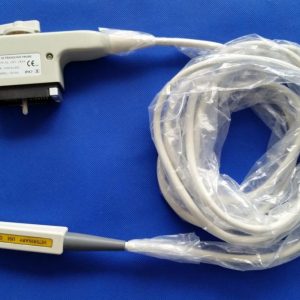
The SonoScape E3 accepts a broader transducer set than any other console in SonoScape’s E-series: convex, micro-convex, linear, high-frequency linear, endocavity and phased array models, which lets one portable system cover abdominal, OB/GYN, vascular, MSK and cardiac work. Compatible E3 probes can be sourced new from SonoScape distributors, as tested compatible units from independent suppliers at 40–70% below OEM pricing, or recovered through repair at 30–60% of replacement cost. This article lists the compatible models, flags the ordering errors that cost buyers the most, and sets out the repair-or-replace decision.
Transducers Compatible With the SonoScape E3
The E3 is a portable color Doppler system positioned for shared-service use — one console rotated between departments. Its probe library reflects that. The models most commonly fitted are:
| Probe model | Array type | Nominal band | Primary clinical use |
|---|---|---|---|
| C362 / C344 | Convex | 2–6 MHz | Abdominal, general OB/GYN |
| C542 | Convex | 2–6 MHz | Obstetrics, abdominal |
| C611 / C612 | Micro-convex | 4–9 MHz | Pediatric, neonatal head |
| L741 / L742 | Linear | 5–10 MHz | Vascular, thyroid, small parts |
| L752 | Linear | 5–12 MHz | MSK, superficial structures |
| 10L1 | Linear, high frequency | 7–12 MHz | Nerve blocks, breast, superficial MSK |
| EC2 / 6V1 / 6V3 | Endocavity | 5–9 MHz | Transvaginal, transrectal |
| 2P1 / 5V1 | Phased array | 2–5 MHz | Adult echocardiography |
Bands are nominal and vary slightly between revisions; the authoritative figure is the one printed on the probe itself. Note that some of these model names — L742 and C612 in particular — also exist in versions for SonoScape’s S-series and older P-series consoles with different connector generations. The model name alone is therefore not a safe ordering criterion. Use the full part number from the connector housing, or have the supplier confirm fit against your console serial number in writing.
The Two Ordering Errors That Cause Most Returns
Error one: buying by model name across console families. A “L742” listed cheaply online may be the variant for a different SonoScape platform. The console will either reject it or load presets that do not match the array, and the imaging result is poor in ways that are hard to diagnose. Always confirm the platform designation, not just the model.
Error two: assuming software support. Probe recognition on the E3 depends on the console’s software version and licensed options. A cardiac phased array is of no use if the cardiac package is not enabled on your unit. Check the installed options list — visible in the system setup menu — before ordering a probe for a new application.
Where to Buy, and What Each Channel Costs
New OEM through SonoScape distributors carries factory warranty and list pricing. It is the default for consoles under service contract and the most expensive route for everyone else.
Tested compatible or refurbished probes from independent suppliers run 40–70% below OEM list. The decisive question is evidence: a per-element acoustic test report showing every element driven and measured individually, photographs of the actual unit, and a warranty measured in months. Without the element report, “tested and working” means someone looked at an image and formed an opinion. Our current SonoScape stock — including the C542 convex and 10L1 high-frequency linear — is listed with per-unit testing on the SonoScape manufacturer page.
Discontinued models are a growing issue as E-series consoles age. When the OEM no longer supplies a transducer, the workable paths are a tested pre-owned unit of the same part number, or a supported successor model in the same band where your software version allows it. Ask the supplier which path applies before assuming the probe is unobtainable.
Repair or Replace
Most E3 probe failures are mechanical rather than acoustic: cable conductor breaks from routine flexing, lens wear from disinfection cycles, damaged strain reliefs, connector pin faults. All of these are repairable at 30–60% of the cost of a replacement probe, with standard turnaround of 5–10 working days. Replacement becomes the right call when dead elements are widespread across the array or fluid has entered the housing. An evaluation-first workflow — the probe is assessed and quoted before any work is authorized — protects you from paying to repair an array that is beyond saving; ours is described on the probe repair service page.
For a shared-service console like the E3, one further recommendation: identify which single probe your schedule cannot function without — usually the convex or the endocavity — and hold a tested spare of that model. It converts every future probe failure from an operational problem into a paperwork problem. Send us your console details and the probe model you need, and we will return a compatibility confirmation and quote the same day.
Evidence boundary and verification record
For Compatible SonoScape E3 Probes: Full Model List and Buying Guide, a platform-level probe list helps create a shortlist but does not prove that every listed item fits every console revision. Record the full system and probe labels, connector views and the supplier’s written match basis, then attach item-specific condition and verification evidence to the quotation. When the original item is unavailable, state that the search begins from a requirement rather than pretending that a replacement model has already been identified.
AIUM’s official statement supports regular assessment of transducer operation and quality control after repair. The BMUS multicentre survey provides fleet-level evidence that ultrasound probes can have faults requiring structured checks. These sources support the evidence boundary used for Compatible SonoScape E3 Probes: Full Model List and Buying Guide; they do not prove compatibility, current stock or condition for an unidentified item.
Primary sources and limits
- AIUM transducer testing and repair statement — professional guidance on transducer assessment and post-repair quality control.
- CDC healthcare-equipment disinfection and sterilization guidance — a processing framework tied to device use and instructions.
- BMUS multicentre probe-condition survey — published fleet research, not an item-level diagnosis.
Evidence questions
Does this evidence prove the exact compatibility described in Compatible SonoScape E3 Probes: Full Model List and Buying Guide?
No. It defines what should be collected and reviewed. Exact compatibility remains tied to the complete labels, configuration, current documentation and written item-specific decision.
Can the commercial terms for Compatible SonoScape E3 Probes: Full Model List and Buying Guide be assumed from this article?
No. Availability, condition, included work, timing, logistics, exclusions and remedy must be confirmed in the current quotation for the exact request.