
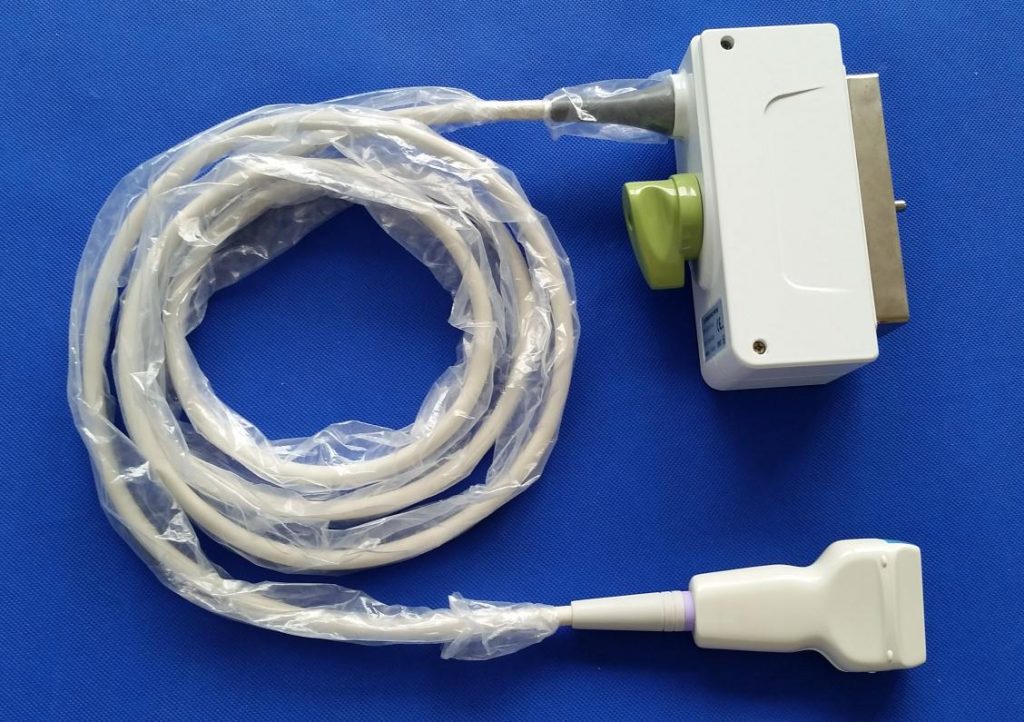
Buying compatible Siemens Acuson X150 probes is straightforward once you separate two questions that are often blurred together: which transducer families the console actually drives, and whether the individual unit you are offered is worth its price. The X150 accepts convex, linear, endocavity, and phased-array heads from the Siemens/Acuson X-series family, and because the console has left active production, the secondary market and repair services are now the primary supply channels. This guide lists the transducers the X150 accepts, the variant traps that cause wrong purchases, and a verification workflow to run before money moves.
Transducers Commonly Fielded on the Acuson X150
The X150 is an entry-level console that Siemens positioned for general imaging, OB/GYN, and shared-service use. The probe families associated with it in the field are:
| Probe | Type | Typical applications |
|---|---|---|
| CH5-2 | Convex | Abdominal, OB/GYN |
| C8-5 | Curved array (tight radius) | Pediatric, neonatal abdominal |
| VF10-5 | Linear | Small parts, vascular, breast |
| VF13-5 | Linear | Superficial, MSK, vascular |
| EC9-4 (X-series variant) | Endocavity | Transvaginal, transrectal |
| EV9-4 | Endovaginal | OB/GYN |
| P4-2 | Phased array | Adult cardiac, abdominal |
| P8-4 | Phased array | Pediatric cardiac |
In practice, most X150 sites run three or four of these rather than the full set: the CH5-2 covers abdominal and obstetric work, the VF10-5 handles small parts and vascular studies, an EC9-4 or EV9-4 serves the women’s health room, and the P4-2 is added where cardiac views are needed. That core group covers most of the system’s clinical work without paying for rarely used heads.
The Variant Trap: Same Name, Different Platform
The single most expensive mistake X150 buyers make is assuming a matching model name equals a matching probe. Several Siemens probe names — EC9-4 among them — exist in multiple platform variants, including X-series, S-series, Antares, and P500 versions. These variants are not electrically interchangeable even when the printed name matches. A connector photo does not settle this, since shells can look alike across generations. The only reliable match is the full part number on the connector housing, confirmed in writing against the console model. Treat any catalogue listing — ours included — as discovery, not proof; the Siemens Acuson catalogue section is a starting point, not a confirmation.
Sourcing Routes Now That the OEM Has Moved On
With the X150 out of Siemens’ current catalogue, buyers have three workable routes, and the right one depends on the probe and the fault:
- Compatible or refurbished probes. The mainstream option. Pricing depends on the exact model, condition, test documentation, availability, and order terms, so compare a current written quotation against what remains of OEM supply rather than relying on list prices.
- Repair of the failed probe. Repair pricing and turnaround depend on the fault, the probe model, parts availability, and the agreed test scope. For an out-of-production platform, repair also preserves a probe body you already know fits. The probe repair service page describes the evaluation process.
- New old stock. Occasionally available and priced accordingly; worth considering mainly when a documented refurbished unit cannot be located.
Step-by-Step Buying Workflow
- Identify the exact requirement. Record the console model, the clinical applications to cover, and the part number from the connector housing of the probe being replaced or supplemented.
- Shortlist candidates by part number, not by console badge. Use catalogue pages to find matching part numbers and note the platform variant (X-series versus S-series or Antares).
- Request unit-specific evidence. Ask for an element-level acoustic test report tied to the serial number you will receive, leak-test confirmation for endocavity probes, and photos of the actual lens, cable, and connector.
- Get compatibility confirmed in writing. Send the part number and console model to the supplier and keep the written confirmation with the purchase record.
- Check the warranty and return path before paying. A written warranty with a defined returns process is part of the product on the secondary market.
- Verify on arrival. Inspect the received unit against the photos and serial number you were quoted, run it on the console across its intended presets, and report discrepancies within the return window.
Common Mistakes to Avoid
- Buying on a name match alone. An EC9-4 for an S-series system will not serve an X150, whatever the listing title says.
- Accepting a quick demo as a condition report. A probe can image acceptably with a block of dead or weak elements. Multicentre surveys of probes in clinical service, such as the BMUS-published survey of probe condition, found that a meaningful share of probes in routine use had defects, which is exactly what element-level testing exists to catch.
- Skipping the leak test on endocavity heads. Fluid ingress is the dominant failure mode for EC9-4 and EV9-4 type probes, and it is invisible in a demo image.
- Ignoring reprocessing fit. Any replacement probe must fit your department’s cleaning and disinfection workflow. The CDC guidance on disinfection and sterilization of healthcare equipment is the reference your infection-control team will apply, so confirm the probe’s reprocessing requirements before purchase, not after.
- Replacing a repairable probe. Cable-jacket damage, lens wear, and bent connector pins are often repairable at lower cost than replacement. The AIUM official statement on transducer testing and repair sets out the professional framework for evaluating this.
Repair or Replace: A Short Decision Rule
Repair when the array is intact and the damage is mechanical — cuts in the cable jacket, a worn or delaminating lens, bent connector pins, or a small number of dropped elements. Replace when the acoustic stack is fractured, elements have failed across a wide band, or an endocavity probe has taken in fluid past the seal line for long enough to corrode internally. When the picture is unclear, a repair evaluation costs far less than guessing wrong.
Commercial Next Step
Browse the ultrasound probe catalogue to shortlist X150-suitable part numbers — for example the VF13-5 X-series linear probe or the EC9-4 X-series endocavity probe — then request a written quotation with serial-specific test documentation. If you would rather keep your existing probe, start with an assessment through the probe repair service. Either way, send your console model, part number, and connector photos, and require written compatibility confirmation before you commit. For a broader framework on judging supplier documentation, see how to evaluate ultrasound probe supplier evidence.
Frequently asked questions
Which probes are compatible with the Siemens Acuson X150?
The X150 drives convex probes such as the CH5-2 and C8-5, linear probes such as the VF10-5 and VF13-5, endocavity probes such as the EC9-4 (X-series variant) and EV9-4, and phased-array probes such as the P4-2 and P8-4. Because several of these model names exist in multiple platform variants, confirm the exact part number against your console in writing before ordering.
Is a compatible or refurbished X150 probe a safe purchase?
It can be, provided the seller supplies unit-specific evidence: an element-level acoustic test report tied to the serial number, leak-test confirmation for endocavity heads, photos of the actual lens and cable, and a written warranty with a defined return path. A model name and a stock photo alone are not evidence.
Should I repair my X150 probe or replace it?
Repair usually makes sense when the array is intact and the damage is mechanical, such as cable-jacket cuts, a worn lens, or bent connector pins. Replacement is usually the better option when the acoustic stack is fractured, elements have failed across a wide band, or an endocavity probe has internal corrosion from fluid ingress. A repair evaluation settles the question before you commit money either way.
What information should I send a supplier to confirm an X150 probe match?
Send the console model (Acuson X150), the full probe part number from the connector housing, clear photos of the connector and label, and the clinical application you need to cover. A reputable supplier will reply with written confirmation of the match rather than a verbal assurance.
Sources
- AIUM official statement: Transducer Testing and Repair — professional guidance on testing and repair of ultrasound transducers.
- CDC: Disinfection and Sterilization of Healthcare Equipment — infection-control framework applicable to probe reprocessing decisions.
- BMUS multicentre survey of ultrasound probe condition — survey evidence on defect rates among probes in clinical service.