
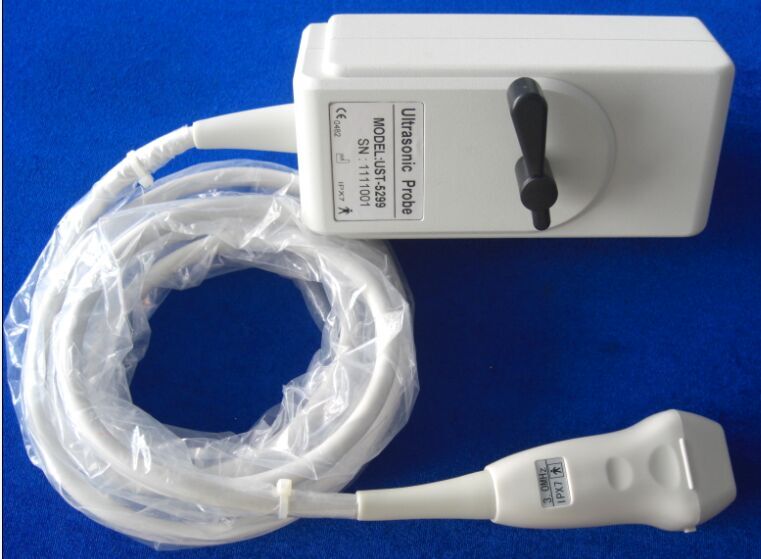
Compatible probes for the Siemens Acuson S2000 are available from the third-party market at 40–70% below OEM-new pricing, and every transducer position on the S2000 — convex, linear, phased array, endocavity, and TEE — has a compatible or refurbished equivalent. Siemens no longer sells the S2000 new, so independent suppliers are now the main source for replacement transducers. Below is the model reference, plus guidance on discontinued-probe substitution and the repair-versus-replace decision.
S2000 Probe Lineup: Models, Frequencies, Applications
The S2000 uses the Siemens S-family transducer interface, shared with the S1000 and S3000. That matters for buyers: a probe listed for the S-family will generally connect across these consoles, which widens your sourcing options considerably. The core lineup:
| Model | Array Type | Frequency Band | Primary Applications |
|---|---|---|---|
| 4C1 | Convex | 1–4 MHz | Abdominal, OB/GYN |
| 6C1 HD | Convex | 1–6 MHz | Abdominal, elastography work |
| 8C3 HD | Convex | 3–8 MHz | Pediatric abdomen |
| 9L4 | Linear | 4–9 MHz | Vascular, thyroid, general superficial |
| 14L5 | Linear | 5–14 MHz | Breast, MSK |
| 14L5 SP | Linear | 5–14 MHz | Small parts, intraoperative |
| 18L6 HD | Linear | 6–18 MHz | High-resolution breast, MSK, vascular |
| 4V1 | Phased | 1–4 MHz | Adult cardiac, abdominal Doppler |
| 8V3 | Phased | 3–8 MHz | Pediatric cardiac |
| EC9-4 | Endocavity | 4–9 MHz | Transvaginal, transrectal |
| MC9-4 | Micro-convex endocavity | 4–9 MHz | OB/GYN, urology |
| V5Ms | TEE | Multiplane | Transesophageal echo |
Frequency bands follow Siemens model naming; confirm the exact specification for your configuration when you inquire. If your S2000 runs an ABVS (Automated Breast Volume Scanner) configuration or a HELX Evolution software level, note the software version as well — probe support tables differ between software releases, and confirming the version up front avoids a probe that connects but does not register.
Sourcing Discontinued S2000 Transducers
With the S2000 out of production, OEM-new stock has dried up and Siemens parts support is winding down. The working alternatives are tested compatible probes and refurbished OEM units. Compatible probes are the more economical route and are appropriate for routine imaging roles; refurbished OEM units are worth the premium where a facility’s service contract or internal policy requires original hardware. In either case the acceptance criteria are the same: an element-by-element test report showing a fully active array, verification on a live S-family system, and a written warranty. A probe sold without a channel-level test report is an unknown quantity regardless of how clean it looks.
Expect price to track probe complexity. Standard convex and linear arrays sit at the low end of the range; endocavity probes price higher because of the handle electronics and the condition-critical acoustic membrane; the V5Ms TEE is the most expensive position in the lineup by a wide margin, since a TEE contains an articulating gastroscope shaft in addition to the array. That ranking also tells you where inspection effort pays off: on any used endocavity or TEE probe, ask specifically for leakage-current test results and photographs of the membrane and shaft, not just the element report.
Repair or Replace: The Cost Logic
For a probe that has failed, request a repair evaluation before ordering a replacement. Cable breaks, lens wear, membrane damage on endocavity probes, and moderate element dropout are all standard repairs, priced 30–60% below replacement cost with a 5–10 business day turnaround. Replacement is the better call when the array is extensively degraded, when the probe is a second-time failure, or when your department needs an additional unit anyway to cover exam volume. Our repair service issues a no-obligation quote after inspection, so the comparison costs you nothing.
How to Order the Right Probe the First Time
Provide three data points with your inquiry: the model printed on the probe housing, your console configuration (standard S2000, ABVS, or HELX), and the system software version from the setup screen. We confirm compatibility against those details before quoting, test every unit on a live system before shipment, and include the acoustic test report and warranty with each probe. Current stock across convex, linear, endocavity, and TEE positions is listed in the Siemens Acuson section of our catalog; if a model is not shown, ask — S-family inventory turns over frequently.
Evidence boundary and verification record
For Compatible Siemens Acuson S2000 Probes: Complete Model Reference, a platform-level probe list helps create a shortlist but does not prove that every listed item fits every console revision. Record the full system and probe labels, connector views and the supplier’s written match basis, then attach item-specific condition and verification evidence to the quotation. When the original item is unavailable, state that the search begins from a requirement rather than pretending that a replacement model has already been identified.
Evidence matrix
| Field | What to collect | Why it matters |
|---|---|---|
| System identity | Complete console label and available configuration | Defines the exact platform request |
| Probe identity | Full model, connector and intended array class | Separates candidates from confirmed matches |
| Offered item | Current photos, condition and named verification scope | Connects evidence to one physical unit |
| Quotation | Compatibility basis, exclusions, availability and remedy | States what the supplier commits to |
Use the same matrix for every provider. Mark an unknown field pending instead of borrowing a specification, compatibility statement or condition claim from a similar model. The final record should identify the offered item, the source for each fact and the date on which availability and commercial terms were checked.
AIUM’s official statement supports regular assessment of transducer operation and quality control after repair. The BMUS multicentre survey provides fleet-level evidence that ultrasound probes can have faults requiring structured checks. These sources support the evidence boundary used for Compatible Siemens Acuson S2000 Probes: Complete Model Reference; they do not prove compatibility, current stock or condition for an unidentified item.
Primary sources and limits
- AIUM transducer testing and repair statement — professional guidance on transducer assessment and post-repair quality control.
- CDC healthcare-equipment disinfection and sterilization guidance — a processing framework tied to device use and instructions.
- BMUS multicentre probe-condition survey — published fleet research, not an item-level diagnosis.
Evidence questions
Does this evidence prove the exact compatibility described in Compatible Siemens Acuson S2000 Probes: Complete Model Reference?
No. It defines what should be collected and reviewed. Exact compatibility remains tied to the complete labels, configuration, current documentation and written item-specific decision.
Can the commercial terms for Compatible Siemens Acuson S2000 Probes: Complete Model Reference be assumed from this article?
No. Availability, condition, included work, timing, logistics, exclusions and remedy must be confirmed in the current quotation for the exact request.