
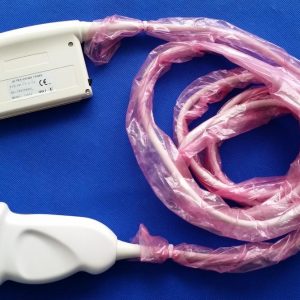
The MEDISON SA8000LV accepts the SonoAce 8000-series family of Medison-connector transducers — convex, linear, and endocavity heads — so a compatible MEDISON SA8000LV probe is a genuine option when an original unit fails or a department needs an additional head. The safe route is not to search by console badge but to match the exact probe part number, connector, and array type to your clinical application, and to get that match confirmed in writing before you pay. This guide covers which probe classes the system drives, how to separate catalogue discovery from item-specific evidence, and the steps to source a compatible transducer without guesswork.
What the SA8000LV name tells you
Medison’s SonoAce-era naming is functional rather than marketing-led. In this line the “SA” prefix marks the SonoAce family, the numeric block identifies the platform tier, and the trailing letters flag the configuration — so the SA8000LV is a specific build within the SonoAce 8000 class. Probes are matched to the platform generation and connector, not to the badge on the front panel. Two machines with different suffixes in the same series can still share transducers if the connector and channel count line up — but that is a hypothesis to verify, and where documentation is ambiguous, written compatibility evidence from the supplier is a hard requirement.
Which probe classes the SA8000LV drives
As a general-purpose colour-Doppler system, the SA8000LV supports the standard Medison transducer set for this platform:
- Convex / curved array — around 3.5 MHz class heads for abdominal and obstetric imaging.
- Linear array — roughly 7.5 MHz and above for small parts, vascular, and superficial work.
- Endocavity — higher-frequency curved heads for transvaginal and transrectal scanning.
A transducer listed as compatible with the SonoAce 8000 platform will normally enumerate on the SA8000LV, but the array type and frequency still have to match your clinical need, and the individual unit still has to be electrically sound. Platform compatibility is only the first filter.
| Probe class | Typical clinical role | What to confirm before ordering |
|---|---|---|
| Convex / curved array | Abdominal, obstetric, general imaging | Part number, frequency range, element test results, connector photo against your port |
| Linear array | Small parts, vascular, superficial structures | Part number, footprint and frequency, cable condition, written platform match |
| Endocavity | Transvaginal and transrectal scanning | Part number, insertion-surface condition, reprocessing compatibility, written platform match |
Catalogue discovery versus item-specific evidence
A catalogue listing tells you a probe model exists and is claimed to fit a platform family. It does not prove that the specific unit being sold works on your SA8000LV. A connector photo is not proof — similar-looking connectors exist across generations — and a similar model name is not proof either, because suffixes often distinguish frequency, footprint, or connector variants. What closes the gap is item-specific evidence: the exact part number from the probe label, the supplier’s written statement that this part number is supported on the SA8000LV, and test documentation for the unit you will receive. When a listing is ambiguous, ask for that evidence in writing and walk away if it is not forthcoming. Our page on evaluating ultrasound probe supplier evidence sets out the full checklist.
Step-by-step sourcing workflow
- Identify the probe, not the console. Read the full part number off the connector label of your existing SA8000LV probe. If the probe is lost or unreadable, record the console model and the clinical application instead.
- Photograph the label and connector. Clear photos let the supplier check the part number and connector variant without a return shipment.
- Request a written match. Ask the supplier to confirm, in writing, that the quoted part number is supported on the SA8000LV — not just on “SonoAce” systems generally.
- Ask for unit-level test documentation. Element continuity across the array, cable and connector inspection, and the condition grade (new-compatible, refurbished, or tested pull) should all be stated for the unit you will receive.
- Check reprocessing fit. For endocavity heads, confirm your department’s disinfection workflow suits the probe. The CDC guideline on disinfection and sterilization of healthcare equipment classifies these devices and the level of processing they require.
- Compare repair against replacement. If your existing head has failed elements or cable damage, a probe repair assessment may cost less than a replacement unit.
- Place the order against the written confirmation. Keep the supplier’s written compatibility statement with the purchase record so any later dispute is resolvable.
Common mistakes when buying an SA8000LV probe
The first is buying by console name alone. “Fits Medison SonoAce” spans multiple generations and connectors; only an exact part-number match protects you. The second is trusting photographs. Housing and connector cosmetics are easy to misread, and a clean-looking probe can still carry dead elements. A multicentre survey of probes in clinical use, published in the BMUS-associated literature, found that a substantial share of transducers in routine service had faults — many invisible without proper testing — which is exactly why unit-level test evidence matters more than appearance. The third mistake is skipping the written confirmation. Verbal assurances are worthless at claim time. The fourth is ignoring the repair option: the AIUM’s official statement on transducer testing and repair describes how transducers can be evaluated and repaired, so a failed probe is not automatically a purchase order.
What good verification looks like
Whether you buy new OEM, compatible, or refurbished, the evidence standard should be the same. Element continuity across the full array shows as uniform B-mode brightness; weak or dead elements appear as dropout bands and degrade Doppler sensitivity on a colour console like the SA8000LV. Cable and connector inspection catches the intermittent faults that bench photos never show. A live image test on a compatible SonoAce system, where the supplier has one, is stronger evidence than continuity checks alone. Each unit should be labelled honestly — new-compatible, refurbished, or tested pull — so price can be weighed against condition. Our probe catalogue is the starting point for discovery; the written evidence above is what turns a listing into a safe purchase.
Commercial next step
For the transducer-by-transducer breakdown of specific convex, linear, and endocavity part numbers for this platform, see our companion article on compatible SA8000LV transducers, and browse the wider Samsung Medison probe range for related models. To get a written match and a quote, send your probe part number and connector photos through our contact page — we will confirm compatibility for your SA8000LV in writing before you commit.
Frequently asked questions
Which probes work with the MEDISON SA8000LV?
The SA8000LV drives the SonoAce 8000-series family of Medison-connector transducers: convex or curved arrays for abdominal and obstetric work, linear arrays for small parts and vascular scanning, and endocavity heads. Confirm the exact part number and connector with the supplier in writing before ordering.
Is a compatible probe as reliable as a new OEM probe?
It depends on the individual unit, not the label. Ask for element-level test results, connector and cable inspection notes, and an honest condition grade. A compatible head with documented array continuity is a reasonable purchase; one sold on a photo and a model name alone is not.
Can my existing SA8000LV probe be repaired instead of replaced?
Often, yes. Dead elements, cable damage, and connector faults are repairable in many cases, and the AIUM has published an official statement covering transducer testing and repair.
What information should I send to get a correct match?
Send the full probe part number from the connector label, a clear photo of the connector and the label, your system model (SA8000LV), and the clinical application you need. A reputable supplier will reply with written confirmation of the match rather than a verbal assurance.
Sources
- AIUM official statement: Transducer Testing and Repair — scope: how ultrasound transducers should be tested and when repair is appropriate.
- CDC: Disinfection and Sterilization of Healthcare Equipment — scope: device classification and required processing levels for reusable medical equipment, including endocavity probes.
- Multicentre survey of ultrasound probe condition in clinical use — scope: prevalence of transducer faults found in probes in routine service.