
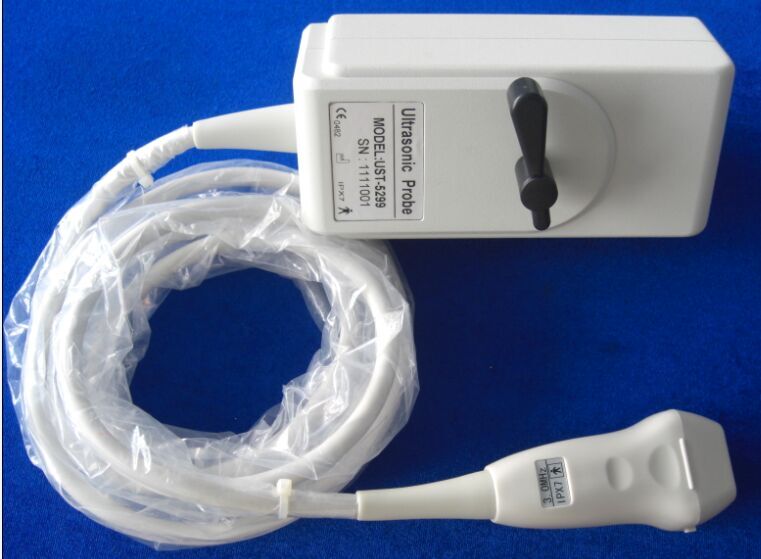
If you need a compatible Emperor 1100 probe, the practical route is to source a compatible transducer by the model number on your existing probe rather than hunting for scarce OEM spares. We supply compatible transducers for the Emperor 1100 through a China-based source network, and we can also repair your current probe when repair is the better value. Send us the model number printed on the transducer housing and we quote against your unit, usually after the request is reviewed.
About the Emperor 1100 system
The Emperor 1100 is a color Doppler ultrasound platform aimed at general diagnostic use. As a lower-volume brand it appears most often in general clinics and screening settings rather than large tertiary hospitals, and units in the field are frequently second-hand. Because it is an uncommon platform, we do not publish invented specifications or part numbers for it. We describe it in general terms and confirm the exact configuration from the marking on your existing transducer before quoting.
This matters for procurement: every compatible probe we quote for an Emperor 1100 is confirmed against the actual model marking on your unit, in writing, before you commit to an order.
Which probe classes the Emperor 1100 typically uses
Color Doppler systems in this class are normally fitted with two or three transducer types, matched to the exams the department runs:
- Convex — 2.5-5.0 MHz for abdominal, obstetric, and general deep-field imaging.
- Linear — 7.5-10 MHz for vascular access and small-parts work.
- Phased array — 2.0-4.0 MHz for cardiac scanning, where the system supports it.
- Endocavity — 5.0-9.0 MHz for transvaginal and other gynecologic exams.
A compatible transducer that matches the Emperor 1100’s connector, array type, and frequency band delivers the same clinical result while avoiding long OEM lead times.
Catalogue listing versus item-specific evidence
Two kinds of information appear when you shop for a probe for an uncommon system, and buyers should treat them differently. A catalogue listing shows that a supplier handles this class of equipment — — useful for discovery, but not proof of fit. Item-specific evidence is written confirmation that a particular transducer, identified by model number, matches your system. A connector photo or a similar-sounding model name does not prove compatibility: connectors are shared across families, and near-identical model strings can differ in array type or pinout.
| Evidence type | What it tells you | What it cannot tell you |
|---|---|---|
| Catalogue listing | The supplier stocks probes in this category | That a specific unit fits your Emperor 1100 |
| Connector or housing photo | Physical family and approximate condition | Electrical or pinout compatibility |
| Model number on the probe label | The exact transducer identity to match against | Condition of the individual unit |
| Written compatibility confirmation | That the quoted probe is matched to your system | Performance of the unit before testing |
| Pre-dispatch test record | That the specific unit passed agreed functional checks | — |
The discipline is simple: use catalogue pages to find a supplier, then require written, model-specific confirmation before ordering. Our page on how to evaluate ultrasound probe supplier evidence sets out the same checklist we apply to our own quotes.
Why source compatible probes from China
For any lower-volume ultrasound brand, OEM probe availability is the real constraint, not image quality. A compatible probe is built to the same electrical and mechanical specification as the original, so it returns the Emperor 1100 to full function at a lower cost. Buyers typically see two advantages:
- Pricing depends on the exact model, condition, test documentation, availability, and order terms; compare a current RFQ with OEM supply rather than relying on list prices.
- Lead times through a source network are usually shorter than waiting on scarce original stock.
Because this is a pure request-for-quote model, we do not post public prices; each probe is priced to your configuration once we confirm the match. You can browse the compatible probe catalogue to see the categories we cover, then request a model-specific quote.
Condition and disinfection of a sourced probe
Used and refurbished probes entering clinical service should be checked and reprocessed before first patient use. The BMUS multicentre probe-condition survey found that a meaningful share of transducers in routine clinical service carry defects that routine visual inspection misses, which is why a documented functional check before dispatch matters. The AIUM official statement on transducer testing and repair describes the testing and repair considerations for diagnostic ultrasound transducers and is the reference point for what a pre-dispatch check should cover.
Step-by-step: request a quote by model
- Read the model or part number printed on your Emperor 1100 probe’s housing or connector.
- Note the array type you need — convex for abdominal and OB work, linear for vascular and small parts, or endocavity for gynecologic exams.
- Send us the model number, plus a photo of the connector and label to speed the match.
- We confirm compatibility in writing, together with condition and current availability.
- You receive a quote and lead time, usually after the request is reviewed.
- On confirmation, the unit is dispatched with its test record.
Repair as an alternative
If your current Emperor 1100 probe has a physical fault rather than end-of-life electronics, repair is often the cheaper path. Repair pricing and turnaround depend on the fault, probe model, parts availability, and agreed test scope; request an assessment before comparing repair with replacement. Repair suits cable breaks, connector-pin faults, and housing damage; a compatible replacement is the better value when several crystals are dead or the array is delaminated. Our probe repair service can evaluate the unit and tell you which route makes sense.
Common mistakes when buying for an uncommon system
- Matching by system name alone. The Emperor 1100 name identifies the console, not the transducer. Always quote the probe model number.
- Treating a connector photo as proof. Connector families are shared across many systems; written confirmation is the evidence that counts.
- Skipping the test record. Ask what functional checks the unit passed before dispatch and get that in writing.
- Replacing when repair would do. A cable or connector fault on an otherwise healthy array is usually cheaper to repair than to replace.
- Ignoring reprocessing requirements. Confirm the disinfection level your procedures require before the probe enters service.
Get a quote for your Emperor 1100 probe
Message us on WhatsApp at +86 136 2236 3037 or use our contact page with your probe’s model number to get a written compatibility confirmation and quote before you commit to anything.
Sources
- AIUM — Transducer Testing and Repair (official statement on testing and repair considerations for diagnostic ultrasound transducers): https://www.aium.org/resources/official-statements/view/transducer-testing-and-repair
- CDC — Disinfection and Sterilization of Healthcare Equipment (Spaulding classification and reprocessing guidance): https://www.cdc.gov/infection-control/hcp/disinfection-sterilization/healthcare-equipment.html
- BMUS multicentre survey of ultrasound probe condition in clinical service: https://pmc.ncbi.nlm.nih.gov/articles/PMC5098704/
Frequently asked questions
How do I confirm a compatible Emperor 1100 probe before ordering?
Send us the model number printed on your transducer’s housing or connector. We confirm the match in writing against your unit before quoting; a connector photo alone is not treated as proof of compatibility.
Which probe types does the Emperor 1100 typically use?
Systems in this class normally run convex heads for abdominal and obstetric work, linear heads for vascular and small-parts exams, and endocavity heads for gynecologic use, with phased array where cardiac scanning is supported. The exact configuration is confirmed from your probe’s marking.
Is repair or replacement the better option for a faulty probe?
Repair usually makes sense for cable breaks, connector-pin faults, and housing damage. A compatible replacement is the better value when several elements are dead or the array is delaminated. An assessment tells you which route fits your unit.
Do compatible probes come with test documentation?
Each unit is checked before dispatch and shipped with its test record, and the agreed functional checks are stated on your quote so you know exactly what was verified.