
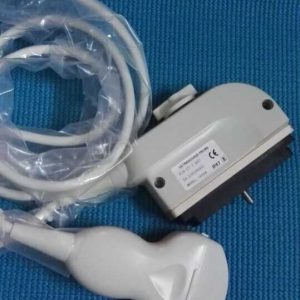
A compatible MEDISON SA6000 transducer is a realistic way to keep an ageing Medison platform in clinical service, but the safe purchase route starts with the exact probe part number and connector — not with the console badge. The SA6000 (Medison, now part of Samsung Medison) drives convex, linear, phased-array, and endocavity heads across the frequencies used in general imaging, women’s health, and cardiac work. This guide covers the probe classes that fit, how to separate catalogue discovery from item-specific proof, the sourcing workflow, and how to request a quote with written compatibility evidence.
Which probe classes the SA6000 drives
The SA6000 is a multi-purpose scanner, so the correct transducer depends on the examination rather than on the brand label alone. The probe classes associated with this platform are:
- Convex / curved array — roughly 2 to 5 MHz heads for abdominal and obstetric imaging.
- Linear array — around 5 to 12 MHz for vascular, small-parts, and superficial work.
- Phased array — near 2 to 4 MHz for cardiac imaging.
- Endocavity — approximately 4 to 8 MHz curved heads for transvaginal and transrectal examinations.
These class ranges describe the family, not a guarantee that any individual probe in the class works in your unit. Connector generation, channel count, and installed software options can all restrict what a particular SA6000 accepts, so a class match still needs part-number-level confirmation before money changes hands.
Catalogue discovery versus item-specific evidence
Search results, catalogue listings, and connector photographs are discovery tools. They tell you a probe might belong to the SA6000 family; they do not prove that a specific unit fits your specific machine. Before approving a purchase, hold the supplier to written confirmation that ties the exact probe part number to the SA6000:
| Signal | What it establishes | What it does not establish |
|---|---|---|
| Catalogue or search listing mentioning the SA6000 | The probe family is worth investigating | That the individual item fits your console build |
| Connector photograph | Physical interface family looks plausible | Electrical and channel-count compatibility |
| Probe part number matched to SA6000 in writing | Item-specific compatibility you can rely on at acceptance | Condition or performance of the individual unit |
| Incoming acceptance test on your console | The delivered unit images correctly on your system | — |
Treat anything short of the last two rows as provisional. Our supplier evidence checklist explains how to score what a seller puts in writing before you commit.
Compatible, OEM, or repair: choosing the route
For an older Korean platform such as the SA6000, genuine new OEM probes can be scarce, so the practical decision is usually between a compatible replacement and repair of the head you already own. A compatible probe keeps the system working without an OEM order, while repair often costs less when the fault is localised — a cable break, connector-pin damage, or lens wear. Neither route should be chosen on price alone; the deciding factors are the fault, parts availability, and the agreed test scope. If repair looks viable, our probe repair service can assess the unit and quote the work before you compare it against replacement. Both routes are priced per request, because condition and availability for this platform move constantly.
Step-by-step sourcing workflow
- Record the probe identity. Note the transducer model or part number printed on the probe housing or connector. This, not the console badge, is the unit of truth.
- Photograph the connector face. A clear image of the connector tells the supplier which physical interface family you are working with.
- State the clinical application. Abdominal, cardiac, vascular, or endocavity work points to the probe class and narrows candidates quickly.
- Note the console configuration if known. Installed software options on the SA6000 can gate which probe classes the slot supports.
- Request written compatibility confirmation. Ask the supplier to confirm, in writing, that the quoted part number matches the SA6000 before any payment.
- Compare repair against replacement. If your existing probe has a repairable fault, get an assessment and quote so the decision is made on like-for-like numbers.
- Plan incoming acceptance testing. Test the delivered probe on your own console before it enters clinical rotation; image uniformity, dropouts, and cable integrity are quick to check.
Common mistakes when buying SA6000 probes
- Buying by console badge alone. Two Medison systems with similar names do not automatically share transducers; the part number and connector decide.
- Accepting a photo as proof. A connector photo supports a hypothesis; it does not confirm channel mapping or electrical compatibility.
- Comparing only headline prices. A cheap probe without written compatibility evidence is expensive once return freight and downtime are counted.
- Skipping the repair comparison. Cable and connector faults are frequently repairable below replacement cost, but only an assessment can tell you.
- No acceptance test on arrival. A probe can still have dead elements or a failing cable; test on your console before clinical use.
Testing, condition, and reprocessing after purchase
Transducer faults are common enough in the used-equipment market that verification is not optional. The BMUS multicentre probe-condition survey of probes in routine clinical use found a substantial share had detectable faults — a finding that applies directly to anyone buying for an older platform like the SA6000. For functional verification, the AIUM statement on transducer testing and repair describes recognised test approaches and the limits of visual inspection; use it when agreeing the test scope for a replacement or repair.
Reprocessing matters as much as electrical condition. Endocavity probes for the SA6000 are semi-critical devices, so high-level disinfection between patients is the baseline; the CDC guidance on disinfection and sterilization of healthcare equipment sets out the Spaulding classification and the processing level each device category requires. Confirm that any probe you buy tolerates your approved disinfectant and cycle.
Requesting a quote
SA6000 transducers are quoted per request rather than from a fixed list price, because condition and availability shift constantly for a platform of this age. Send the probe model or part number, a connector photo, the intended application, and the quantity, and we confirm compatibility in writing and return a firm price and lead time; shipping and payment terms are set out with the quote so the figure you approve is the figure you pay. Start from our probe catalogue to shortlist candidates, see the related guide to compatible Medison SA6000 probes, browse the Samsung Medison range, or reach the team through the contact page.
Sources
- AIUM — Transducer Testing and Repair (official statement)
- CDC — Disinfection and Sterilization: Healthcare Equipment
- BMUS multicentre survey of ultrasound probe condition
Frequently asked questions
Which probes are compatible with the MEDISON SA6000?
The SA6000 drives four probe classes: convex heads around 2 to 5 MHz for abdominal and obstetric work, linear probes around 5 to 12 MHz for vascular and small parts, phased-array probes near 2 to 4 MHz for cardiac imaging, and endocavity probes around 4 to 8 MHz. A probe matching the class is only a candidate — confirm the exact part number against your console in writing before ordering.
How do I confirm a transducer fits my SA6000 before ordering?
Send the supplier the transducer model or part number printed on the probe, a photo of the connector face, the clinical application, and the console software configuration if known. Require written confirmation that the quoted part number matches the SA6000; a catalogue listing or connector photo alone is not compatibility evidence.
Should I repair my SA6000 probe or buy a compatible replacement?
Repair is often cheaper when the fault is localised, such as a cable break, connector-pin damage, or lens wear. The right choice depends on the fault, parts availability, and the agreed test scope, so request a repair assessment and compare its quote against a compatible replacement on like-for-like terms.
Why are SA6000 transducers quoted per request instead of a listed price?
The SA6000 is an older platform, so probe condition and availability change constantly and a fixed list price would be misleading. A per-request quote confirms compatibility first, then gives a firm price and lead time with shipping and payment terms, so the price you approve is the price you pay.