
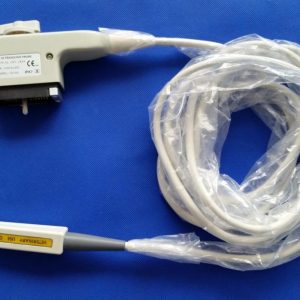
Replacement probes for the GE Logiq 200 are available as compatible (non-OEM) new units or as professionally repaired originals through our China sourcing network. The Logiq 200 is an older shared-service platform, so OEM probes are increasingly hard to buy new; sending us the model number on the probe housing is the fastest way to get accurate availability. This guide covers the transducer models the Logiq 200 accepts, what to check before you order, and when repair beats replacement.
Probes used with the GE Logiq 200
The Logiq 200 series covers routine abdominal, obstetric, small-parts, and cardiac imaging, so its probe set spans convex, linear, and sector arrays. GE model numbers follow a consistent convention: the number is the nominal frequency, the letters describe the array, and the -RS suffix marks the connector family.
- Convex arrays (for example the 3.5C class) — abdominal, OB/GYN, and general imaging in roughly the 2–5 MHz range.
- Linear arrays (for example the 7L / i12L-RS class) — higher-frequency vascular and small-parts work, typically 5–12 MHz.
- Sector arrays (for example the 3S-RS / 7S-RS class) — phased cardiac and pediatric imaging with 2D, M-mode, and color Doppler support.
Not every -RS probe from later Logiq and Vivid consoles maps cleanly onto the Logiq 200, so confirm the connector and console generation before ordering. Our full GE parts list is in the GE probe catalog, and a closely related model is covered in our guide to the compatible GE Logiq 100 probe.
Confirming compatibility before you buy
For a platform this age, model marking matters more than the general description. Before requesting a quote, note three things from the probe you are replacing: the exact model number etched on the housing, the connector type, and the console software generation. A 4C-RS curved array and a 7S-RS sector array, for instance, serve completely different clinical roles even though both physically fit an RS connector. Matching the model number to your imaging need avoids ordering a probe that connects but cannot run the exam you need.
Repair versus compatible replacement
Because new OEM Logiq 200 probes are scarce, most owners choose between two practical routes:
- Compatible new probe — a non-OEM unit built to the original model specification, generally 40–70% below historic OEM pricing because it carries no brand premium.
- Repaired original — the better option when you hold a physically sound probe with a single fault such as a dead element or cracked lens. Repair typically costs about 30–60% of a replacement and turns around in roughly 5–10 working days once the probe reaches our bench.
Full repair scope and the intake process are on our probe repair page. We quote every job individually rather than posting fixed prices, because cost tracks the exact model, fault, and current stock.
What to check on arrival
Before returning any Logiq 200 probe to clinical use, run a short acceptance scan. Connect the probe, load a live image, and sweep a phantom across the full field of view while watching for dark vertical bands that signal dead elements. For sector probes, confirm the color Doppler and M-mode traces render cleanly; for linear probes, check near-field uniformity at the higher frequencies. Inspect the lens and housing for cracks that would compromise disinfection, and flex the cable near the connector to expose any intermittent fault. A probe that images evenly across the aperture and stays connected through cable movement is ready for service.
Request a quote
Send the model number stamped on the probe (for example i12L-RS or 4C-RS), the Logiq 200 console it connects to, and whether you want a compatible new unit or a repair. Reach us on WhatsApp at +86 136 2236 3037 or through our contact page, and we will come back with availability and pricing.
Evidence boundary and verification record
For Compatible GE Logiq 200 Probes: Models and Sourcing, a platform-level probe list helps create a shortlist but does not prove that every listed item fits every console revision. Record the full system and probe labels, connector views and the supplier’s written match basis, then attach item-specific condition and verification evidence to the quotation. Date the source check so later changes in documents or availability do not silently alter the decision.
Evidence matrix
| Field | What to collect | Why it matters |
|---|---|---|
| System identity | Complete console label and available configuration | Defines the exact platform request |
| Probe identity | Full model, connector and intended array class | Separates candidates from confirmed matches |
| Offered item | Current photos, condition and named verification scope | Connects evidence to one physical unit |
| Quotation | Compatibility basis, exclusions, availability and remedy | States what the supplier commits to |
Use the same matrix for every provider. Mark an unknown field pending instead of borrowing a specification, compatibility statement or condition claim from a similar model. The final record should identify the offered item, the source for each fact and the date on which availability and commercial terms were checked.
AIUM’s official statement supports regular assessment of transducer operation and quality control after repair. The BMUS multicentre survey provides fleet-level evidence that ultrasound probes can have faults requiring structured checks. These sources support the evidence boundary used for Compatible GE Logiq 200 Probes: Models and Sourcing; they do not prove compatibility, current stock or condition for an unidentified item.
Primary sources and limits
- AIUM transducer testing and repair statement — professional guidance on transducer assessment and post-repair quality control.
- CDC healthcare-equipment disinfection and sterilization guidance — a processing framework tied to device use and instructions.
- BMUS multicentre probe-condition survey — published fleet research, not an item-level diagnosis.
Evidence questions
Does this evidence prove the exact compatibility described in Compatible GE Logiq 200 Probes: Models and Sourcing?
No. It defines what should be collected and reviewed. Exact compatibility remains tied to the complete labels, configuration, current documentation and written item-specific decision.
Can the commercial terms for Compatible GE Logiq 200 Probes: Models and Sourcing be assumed from this article?
No. Availability, condition, included work, timing, logistics, exclusions and remedy must be confirmed in the current quotation for the exact request.