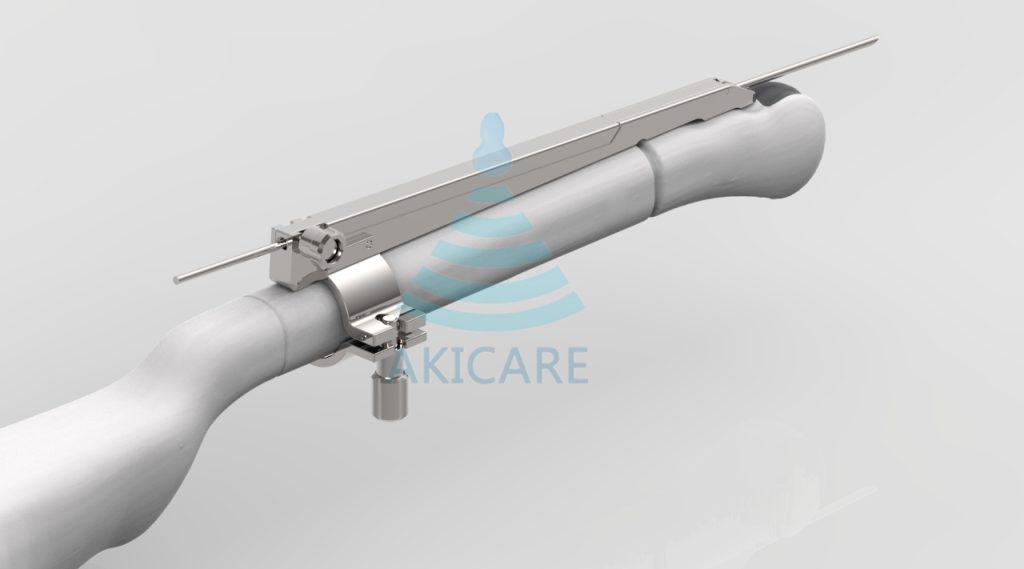
The Esaote EC1123 biopsy guide is a needle-guidance bracket that clamps onto the Esaote EC1123 endocavity transducer, keeping the needle aligned with the on-screen guide line during transrectal and transvaginal procedures such as prostate biopsy. Akicare stocks a compatible EC1123 biopsy needle guide that mounts on the original probe housing without modification. This guide explains what the bracket does, how reusable and disposable formats compare, and what to confirm before you order.
What the EC1123 Biopsy Guide Does
The EC1123 is an endocavity probe used on Esaote ultrasound systems for transvaginal and transrectal imaging. During a biopsy, the bracket locks onto the probe housing and holds the needle in a fixed channel, so the physical needle path matches the guide line projected on the ultrasound display. This matters most in prostate and gynecological sampling, where the target sits close to structures that must not be punctured. A correctly fitted bracket removes freehand angulation error; a poorly fitted one introduces it, which is why the bracket must be machined for this specific probe housing rather than adapted from another model.
Reusable vs Disposable Formats
| Attribute | Reusable guide | Disposable guide |
|---|---|---|
| Material | Medical-grade stainless steel bracket | Sterile single-use polymer kit |
| Needle path | Interchangeable gauge inserts on a fixed bracket | Pre-set channel supplied with the kit |
| Sterilization | Steam autoclave between cases | Supplied sterile; discard after one procedure |
| Cost profile | Higher unit price, low cost per procedure over hundreds of uses | Low unit price, recurring cost every procedure |
| Best fit | Departments running biopsies regularly | Low-volume sites or mobile services without autoclave access |
For endocavity work, both formats are used with a sterile probe cover over the transducer. High-volume urology departments generally standardize on the stainless-steel reusable bracket with autoclavable gauge inserts; screening clinics that run occasional biopsies often prefer sterile single-use kits.
Sterilization and Reprocessing
Reusable stainless-steel brackets are designed for steam autoclaving. After each procedure, detach the guide from the transducer, clean it according to your facility protocol, and autoclave the bracket separately — the transducer itself must never be autoclaved and should be reprocessed per the probe manufacturer’s instructions. Disposable kits arrive sterile-packed and are discarded after a single use, which removes reprocessing workload but adds a per-procedure consumable cost.
Because the bracket clamps directly onto the probe housing, inspect the probe lens and housing for wear whenever you mount a guide. If you find lens delamination, cable damage, or image dropout, a probe repair For EC1123, repair pricing and turnaround depend on the fault, probe model, parts availability, and agreed test scope; request an assessment before comparing repair with replacement.
What to Confirm Before Ordering
- Exact probe model: the bracket is machined to the Esaote EC1123 housing; a guide for a similar-looking probe will not seat correctly.
- Needle gauge: confirm the insert set covers the gauges your clinicians use (commonly 14G–23G for core and fine-needle work).
- Guide-line software: verify your ultrasound system displays the biopsy guide line for this transducer so the on-screen path matches the physical channel.
- Reusable vs disposable: match the format to your case volume and reprocessing capacity, as compared in the table above.
- Documentation: request the compatibility statement and material certificates with your quotation.
Akicare also supports the wider Esaote range — see the Esaote probe catalog for compatible transducers, or browse all biopsy needle guides by brand and probe model.
Request a Quote
Akicare supplies biopsy needle guides compatible with the Esaote EC1123, alongside compatible replacement transducers and probe repair services. For EC1123, compatible or refurbished probe pricing depends on the exact model, condition, test documentation, availability, and order terms; compare a current RFQ with OEM supply. Send us the probe model and your preferred needle gauges through the contact form, and our team will return a quotation with specifications and lead time, usually within one business day.
Evidence boundary and verification record
For Esaote EC1123 Biopsy Guide: Compatibility and Buying Guide, catalogue compatibility is only the discovery layer. The purchase record should keep the exact guide reference, parent probe label, guide format, current instructions and host-system context together. A nearby probe name, similar bracket image or broad family list should not be treated as exact fit evidence. A second reviewer should reconcile the model characters and every unresolved field before approval.
Evidence matrix
| Field | What to collect | Why it matters |
|---|---|---|
| Guide identity | Exact part, reusable or single-use designation and current record | Defines the accessory being quoted |
| Parent probe | Complete probe label and housing photographs | Prevents a bracket for a nearby model from being substituted |
| Instructions | Current guide and probe documents plus facility process | Keeps processing and procedure claims instruction-led |
| Commercial scope | Contents, exclusions, availability check, logistics and remedy | Makes different offers comparable |
Use the same matrix for every provider. Mark an unknown field pending instead of borrowing a specification, compatibility statement or condition claim from a similar model. The final record should identify the offered item, the source for each fact and the date on which availability and commercial terms were checked.
CDC healthcare-equipment guidance explains that processing decisions depend on intended contact and applicable manufacturer instructions; it does not supply a model-specific cycle for Esaote EC1123 Biopsy Guide: Compatibility and Buying Guide. AIUM’s statement supports regular transducer assessment and quality control after repair, while the BMUS survey illustrates why probe condition should be documented. None of these sources proves guide fit or item condition without the exact records.
Primary sources and limits
- AIUM transducer testing and repair statement — professional guidance on transducer assessment and post-repair quality control.
- CDC healthcare-equipment disinfection and sterilization guidance — a processing framework tied to device use and instructions.
- BMUS multicentre probe-condition survey — published fleet research, not an item-level diagnosis.
Evidence questions
Does this evidence prove the exact compatibility described in Esaote EC1123 Biopsy Guide: Compatibility and Buying Guide?
No. It defines what should be collected and reviewed. Exact compatibility remains tied to the complete labels, configuration, current documentation and written item-specific decision.
Can the commercial terms for Esaote EC1123 Biopsy Guide: Compatibility and Buying Guide be assumed from this article?
No. Availability, condition, included work, timing, logistics, exclusions and remedy must be confirmed in the current quotation for the exact request.