
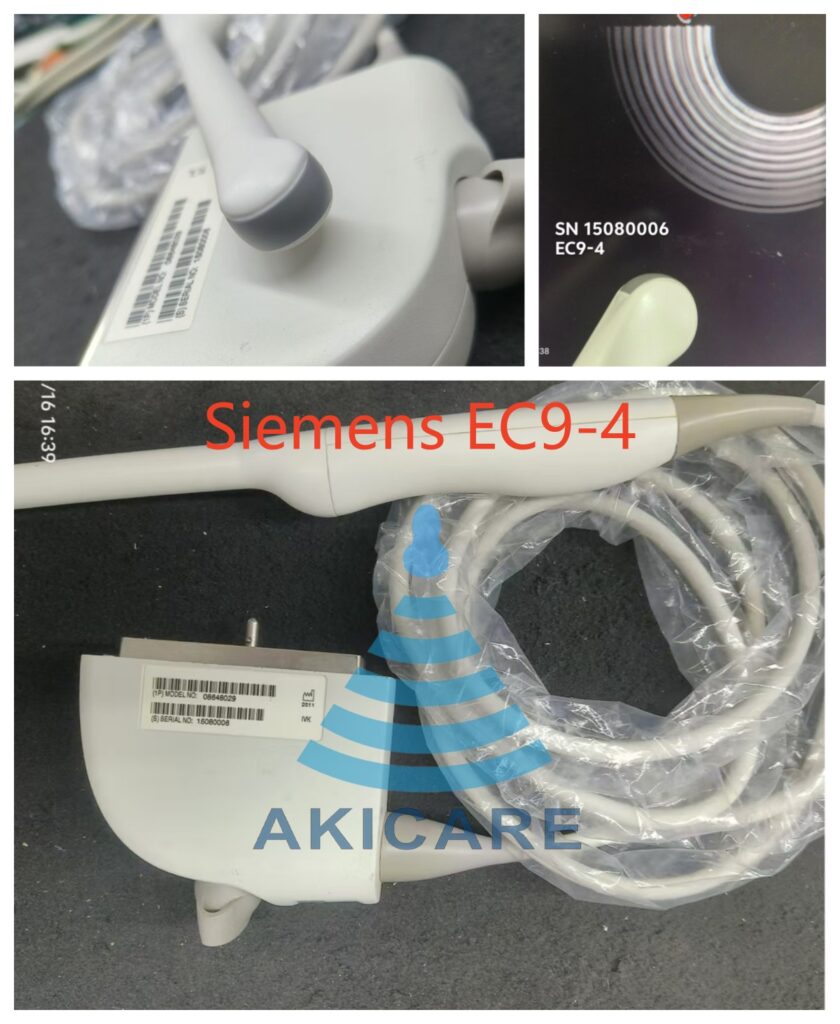
To buy a Siemens EC9-4 ultrasound probe, you have three practical routes: a new OEM unit through Siemens Healthineers, a tested compatible probe from an independent supplier, or a repair of your existing transducer. Which route makes sense depends on the condition of your current probe, the console it runs on, and how quickly you need the endocavity room back in service. This guide covers the specifications, the console-matching step that catches most buyers out, and how the three options compare on cost.
What the Siemens EC9-4 Is and Where It Is Used
The EC9-4 is an endocavity (transvaginal/transrectal) transducer operating in the 4–9 MHz band. It is a curved-array probe used for OB/GYN imaging, early-pregnancy assessment, and urology work such as prostate evaluation. The higher end of its frequency range gives good near-field resolution at the shallow depths typical of endocavity scanning.
The critical detail: “EC9-4” is not one interchangeable part. Siemens produced platform-specific versions with different connectors and identification, and they are not cross-compatible. Before ordering anything, confirm which variant your console requires:
| Variant | Console family |
|---|---|
| EC9-4 (Antares) | Acuson Antares |
| EC9-4 (X series) | Acuson X150 / X300 / X500 |
| EC9-4 (P500) | Acuson P500 |
| EC9-4w | Wide-band version; check part number against your system |
Ordering by model name alone is the most common sourcing error with this probe. Match the part number printed on the connector housing of your current unit, or send your console model and software version to the supplier and have them confirm fit in writing. We stock the EC9-4 for the Antares as well as the X-series and P500 versions as separate listings for exactly this reason.
Three Ways to Source an EC9-4, Compared
Option 1: New OEM from Siemens. This is the highest-cost route and, for probes tied to older consoles such as the Antares, availability can be limited because the platform is past its prime production years. If your service contract already covers probe replacement, use it. If you are paying out of pocket for an aging system, the OEM price is often hard to justify against the remaining life of the console.
Option 2: Compatible or refurbished probe. For EC9-4, compatible or refurbished probe pricing depends on the exact model, condition, test documentation, availability, and order terms; compare a current RFQ with OEM supply. The savings are real, but so is the variation in quality between suppliers, which is why the acceptance test matters more than the price (see the next section). For EC9-4, compatible or refurbished probe pricing depends on the exact model, condition, test documentation, availability, and order terms; compare a current RFQ with OEM supply.
Option 3: Repair the probe you have. For EC9-4, repair pricing and turnaround depend on the fault, probe model, parts availability, and agreed test scope; request an assessment before comparing repair with replacement. Repair is generally the right call when the acoustic array is mostly intact and the failure is mechanical. It stops being economical when a large portion of the array is dead or the probe has fluid invasion deep into the housing. Details on the process are on our probe repair service page.
How to Verify Quality Before You Accept the Probe
Whether you buy compatible or repaired, ask for a per-element test report before shipment. Electronic probe testing drives each transducer element individually and records its sensitivity and capacitance, so weak or dead elements show up as objective numbers rather than a subjective “image looks fine.” A supplier who cannot produce this report is asking you to take image quality on faith.
On arrival, run your own checks before putting the probe into clinical rotation:
- Inspect the insertion tube and lens for cuts or delamination — on an endocavity probe these are infection-control failures, not cosmetic flaws.
- Connect to your console and confirm the system recognizes the probe and loads the correct presets.
- Scan a uniform target (a phantom, or tissue-mimicking material) and look for vertical dropout lines, which indicate dead elements.
- Check the cable along its full length while scanning; intermittent image flicker when the cable is flexed points to conductor damage.
Also confirm the warranty terms in writing. A reasonable standard for a tested compatible or repaired probe is a warranty measured in months, not weeks, covering the array and the repair work performed.
Practical Recommendation
For EC9-4, repair pricing and turnaround depend on the fault, probe model, parts availability, and agreed test scope; request an assessment before comparing repair with replacement. For EC9-4, compatible or refurbished probe pricing depends on the exact model, condition, test documentation, availability, and order terms; compare a current RFQ with OEM supply. Reserve the new OEM purchase for facilities under service contracts or those with procurement rules that require it. You can browse all available Siemens Acuson probes by console family, or send us your console model and probe part number for a same-day compatibility check and quote.
Evidence boundary and verification record
For Siemens EC9-4 Ultrasound Probe: Buying and Repair Guide, the complete label, connector, host-system record and physical item must remain linked. Similar model stems can describe different probes, and representative photographs do not establish the condition of a used or refurbished unit. Keep discovery, item and commercial evidence in separate rows. When the original item is unavailable, state that the search begins from a requirement rather than pretending that a replacement model has already been identified.
AIUM describes why transducer operation and repair quality control require structured assessment. The published BMUS multicentre survey supports documenting physical and performance condition across a probe fleet. Applied to Siemens EC9-4 Ultrasound Probe: Buying and Repair Guide, these sources justify item-level checks but do not diagnose a probe or establish a system match remotely.
Primary sources and limits
- AIUM transducer testing and repair statement — professional guidance on transducer assessment and post-repair quality control.
- CDC healthcare-equipment disinfection and sterilization guidance — a processing framework tied to device use and instructions.
- BMUS multicentre probe-condition survey — published fleet research, not an item-level diagnosis.
Evidence questions
Does this evidence prove the exact compatibility described in Siemens EC9-4 Ultrasound Probe: Buying and Repair Guide?
No. It defines what should be collected and reviewed. Exact compatibility remains tied to the complete labels, configuration, current documentation and written item-specific decision.
Can the commercial terms for Siemens EC9-4 Ultrasound Probe: Buying and Repair Guide be assumed from this article?
No. Availability, condition, included work, timing, logistics, exclusions and remedy must be confirmed in the current quotation for the exact request.