
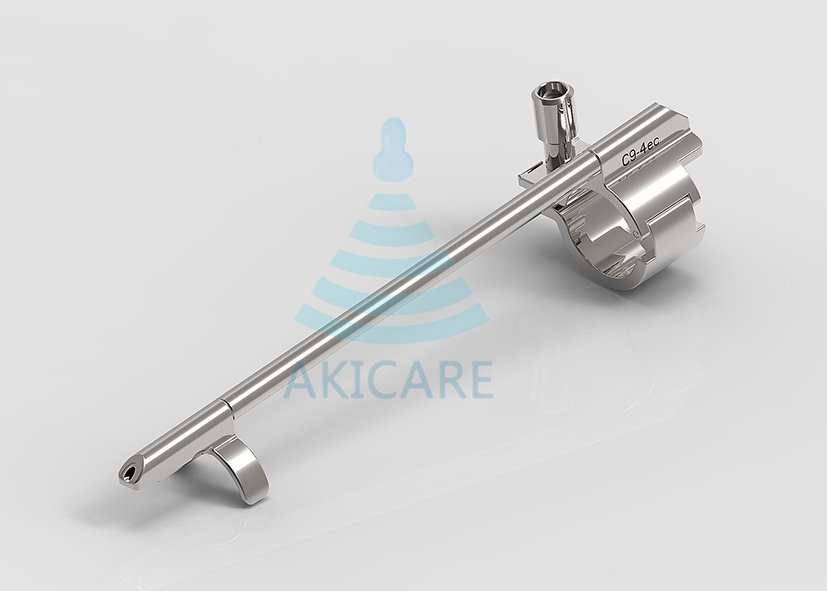
To source a biopsy guide for a Philips C9-4ec probe, start with the exact model and part number on the probe and compare them with the supplier’s written compatibility information. The existing Akicare guide list associates the identifier XEM-022 with C9-4ec, but that listing is only a starting reference for an individual order. An independently supplied compatible guide is not represented as manufactured, endorsed, or approved by Philips.
Confirm the exact accessory identity
Ask the supplier to identify the offered guide by product name, part number, revision, and clear photographs. Compare those details with the probe label and the facility’s existing accessory records. Similar-looking guide brackets can differ in fit, needle path, and locking geometry, so a model name or catalog photo alone is not enough.
The Akicare biopsy-guide list can help locate the XEM-022 reference. The document does not replace written confirmation for the exact probe revision and intended procedure.
Information the quotation should state
- The offered guide name, part number, revision, and condition.
- The exact probe model and revision used as the compatibility basis.
- What components are included in the package.
- Whether the item is described as reusable, single-use, supplied clean, or supplied sterile, supported by the applicable product instructions rather than an assumption.
- The available inspection document and its stated scope.
- Current availability, dispatch estimate, return terms, and after-sale contact path.
Do not accept general statements about materials, dimensions, accuracy, or clinical performance unless the seller provides product-specific documentation that can be reviewed by the buyer’s qualified staff.
Fit must be checked before clinical use
Before the guide is used, qualified personnel should verify that it seats correctly on the intended C9-4ec probe, locks as designed, and does not damage the probe housing or acoustic surface. Any needle-path or alignment check must follow the guide and ultrasound-system instructions accepted by the facility. This guide does not state a needle angle, gauge range, dimensional tolerance, or performance result because those facts are not established by the frozen evidence.
Cleaning and reprocessing questions
Do not infer cleaning, disinfection, sterilization, or reuse instructions from the product category. Request the instructions supplied for the exact guide and have the facility review them against its own infection-control process. If the documentation is missing or does not clearly identify the offered revision, stop the purchase or clinical-use decision until the gap is resolved.
Independent-supply boundary
The title of this article identifies the target Philips probe model; it does not mean that the compatible accessory is an original Philips product. The quotation and packaging should describe the actual manufacturer or supplier and should not use Philips branding in a way that implies affiliation. Compatibility must be stated for use with the identified probe and confirmed for the individual unit.
Compare offers without unsupported promises
Compare quotations by exact identity, documented compatibility, included components, instructions, inspection scope, availability, return terms, and dispatch estimate. Do not choose from a claimed certification, fixed warranty period, price saving, or performance guarantee unless the supporting evidence has been reviewed for the exact offered product. None of those claims is made here.
Stop conditions before purchase or use
Pause the transaction if the seller cannot identify the offered part, if the probe revision is missing, if photographs do not match the quotation, or if the instructions refer to a different accessory. Pause clinical use if the guide does not seat and lock as documented, if it contacts the probe incorrectly, or if the cleaning and reuse status is unclear. Record the discrepancy and obtain a written resolution reviewed through the facility’s procurement and clinical process; do not bridge an evidence gap with a verbal assurance.
Where to review the existing materials
The site’s product listings and the existing biopsy-guide video can provide visual context. They do not replace unit-specific documentation or the facility’s approval process. Send the probe-label photo, connector-side photo, required procedure, and the XEM-022 reference with the inquiry so the written quotation can address the exact request.
Philips C9-4EC biopsy guide: current evidence update
Answer first: A Philips C9-4EC biopsy guide should be selected only after the exact probe label and suffix are matched to the guide manufacturer and reference, current compatibility document, attachment method, documented needle range, included parts, single-use or reusable status, and written quotation. A similar photograph or shortened title is not proof of fit.
| Field | Evidence | Control |
|---|---|---|
| Probe label | Full model, suffix and part number | Keep this field tied to the exact Philips C9-4EC biopsy guide request. |
| Guide reference | Manufacturer and every visible marking | Keep this field tied to the exact Philips C9-4EC biopsy guide request. |
| Fit evidence | Current compatibility chart or IFU | Keep this field tied to the exact Philips C9-4EC biopsy guide request. |
| Needle field | Documented range, angle or path for the exact guide | Keep this field tied to the exact Philips C9-4EC biopsy guide request. |
| Use status | Single-use, sterile or reusable from labeling | Keep this field tied to the exact Philips C9-4EC biopsy guide request. |
| Reprocessing | Current validated instructions when reusable | Keep this field tied to the exact Philips C9-4EC biopsy guide request. |
Why this page is different from a product listing
The article explains how to evaluate the request and routes readers to current catalogue records. A product or category page owns the commercial inventory intent. This article should not compete by repeating a long list of unverified models; it adds decision evidence, limitations and an RFQ workflow that a product card cannot provide.
Model and configuration boundaries
This is a purchasing and documentation guide, not a clinical procedure. Do not infer needle choice, insertion, angle or patient suitability from the supplier page. Those decisions belong to the approved labeling, facility process and qualified users.
Keep general documentation separate from item-level proof. A source can explain terminology or testing boundaries, while the physical label, current photos, inspection record and quotation establish facts about the exact item. Mark unresolved fields pending instead of copying a specification or compatibility statement from a similar model.
Four-step review
- Capture complete labels and all relevant physical interfaces.
- Check the exact current document or written match basis.
- Separate catalogue discovery from item condition and test evidence.
- Approve only a quotation that repeats the identity, scope, exclusions and terms.
Related catalogue and service links
Frequently asked questions
Does the model phrase alone prove the correct Philips C9-4EC biopsy guide?
No. Verify the complete labels, physical interface and current configuration-specific evidence.
Can a catalogue image prove condition?
No. Request current photos tied to the quoted item or service record.
What should the written quote identify?
Exact identity, compatibility basis, condition, evidence, included items, availability basis, shipping responsibility and remedy terms.
Sources
Evidence update checked 3 August 2026. Use current exact documentation for the device and jurisdiction involved.