
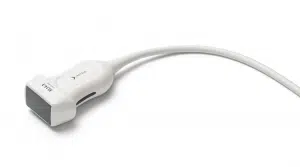
Philips XL14-3 xMATRIX: 4D Linear Vascular Ultrasound Probe
What Philips documents confirm about the XL14-3
The Philips XL14-3 is an xMATRIX linear-array transducer developed for vascular imaging. Philips product-era material describes it as the company’s first xMATRIX linear transducer and documents a 56,000-element architecture in which each element connects to a separate micro-channel. That same material lists multidimensional electronic focusing, 3D/4D volume acquisition, Live xPlane imaging, xPlane pulsed Doppler, and an icon-driven workflow among the model’s capabilities.
Those are manufacturer-documented product features, not a promise that every feature is enabled on every console. Philips adds an availability qualification to its material, and its education resources place the XL14-3 within specific EPIQ and Affiniti software-release training. A buyer therefore needs to verify the console family, country configuration, installed software release, licensed options, and transducer support list before treating an XL14-3 as compatible.
This page is a model-identification and procurement guide. It does not state that a particular XL14-3 is currently in stock, that it is approved for every EPIQ or Affiniti system, or that a used unit has passed a specific test. Those facts must be attached to the exact unit being quoted.
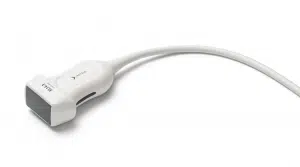
How to interpret the 3D/4D vascular features
A conventional linear probe presents a two-dimensional imaging plane. The XL14-3’s matrix architecture supports electronic acquisition and manipulation across more than one plane. Philips describes Live xPlane as showing longitudinal and transverse views at the same time, while electronic 3D/4D acquisition provides volume information for vascular anatomy. The manufacturer also describes multidimensional focusing for thin-slice imaging and tools for viewing vessel casts with 3D flow data.
These features may change how a vascular team acquires and reviews information, but the presence of the transducer alone does not establish a clinical outcome. Image quality and available modes depend on the system, software, presets, operator, patient, and enabled options. A procurement record should separate three things that are often blurred together: what Philips documents for the model family, what the buyer’s console supports, and what the individual used or refurbished probe demonstrates during testing.
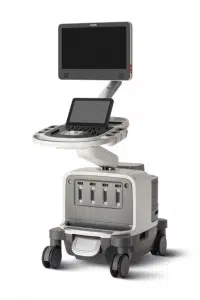
Compatibility must be checked by system and software release
Do not approve an XL14-3 from the model name alone. Ask for the complete console model, software or release level, market or country configuration, connector type, and any required licensed feature. Philips training resources for release 4.0 and 5.0 reference the XL14-3 in material for EPIQ and Affiniti systems, but that is not a blanket compatibility statement for every hardware and software combination in either family.
The safe workflow is to compare the console’s current transducer support documentation with the label and part information on the exact probe. If either side is incomplete, obtain confirmation before shipment. This matters especially when a console has been upgraded, imported from another market, or configured with a different software package. It also prevents a visually similar connector from being treated as proof of electrical and software compatibility.
Evidence to request for the exact XL14-3 unit
- Clear photographs of the full probe, lens, label, cable, strain relief, connector, and connector pins.
- The exact model, part or material number, serial number where appropriate, and stated condition.
- A compatibility statement tied to the buyer’s console and software release, not only the brand name.
- A recent functional or image-uniformity test record tied to the quoted unit.
- Disclosure of lens, housing, cable, connector, or repair history that affects condition.
- Written warranty, return, shipping, and inspection terms before payment.
A representative catalogue image can help identify a model, but it cannot prove the condition or availability of the unit a buyer will receive. The quote should make that distinction explicit. If exact photos or test evidence are not yet available, the item should be described as a sourcing request rather than presented as ready stock.
Request a model-specific compatibility assessment
To assess an XL14-3, send the console model, software release, country configuration, and a photograph of the existing connector or transducer label. Akicare can then check the request against the available documentation and any exact unit offered. Use the Philips probe catalogue to compare model records or the contact page to submit the system details. A response should identify what is documented, what was physically tested, and what still requires confirmation.
Primary references: Philips XL14-3 release material and Philips EPIQ and Affiniti release 4.0 education resources. Product availability and supported features vary by system and release.
Evidence boundary and verification record
For Philips XL14-3 xMATRIX: 4D Linear Vascular Ultrasound Probe, the complete label, connector, host-system record and physical item must remain linked. Similar model stems can describe different probes, and representative photographs do not establish the condition of a used or refurbished unit. Keep discovery, item and commercial evidence in separate rows.
AIUM describes why transducer operation and repair quality control require structured assessment. The published BMUS multicentre survey supports documenting physical and performance condition across a probe fleet. Applied to Philips XL14-3 xMATRIX: 4D Linear Vascular Ultrasound Probe, these sources justify item-level checks but do not diagnose a probe or establish a system match remotely.
Primary sources and limits
- AIUM transducer testing and repair statement — professional guidance on transducer assessment and post-repair quality control.
- CDC healthcare-equipment disinfection and sterilization guidance — a processing framework tied to device use and instructions.
- BMUS multicentre probe-condition survey — published fleet research, not an item-level diagnosis.
Evidence questions
Does this evidence prove the exact compatibility described in Philips XL14-3 xMATRIX: 4D Linear Vascular Ultrasound Probe?
No. It defines what should be collected and reviewed. Exact compatibility remains tied to the complete labels, configuration, current documentation and written item-specific decision.
Can the commercial terms for Philips XL14-3 xMATRIX: 4D Linear Vascular Ultrasound Probe be assumed from this article?
No. Availability, condition, included work, timing, logistics, exclusions and remedy must be confirmed in the current quotation for the exact request.