
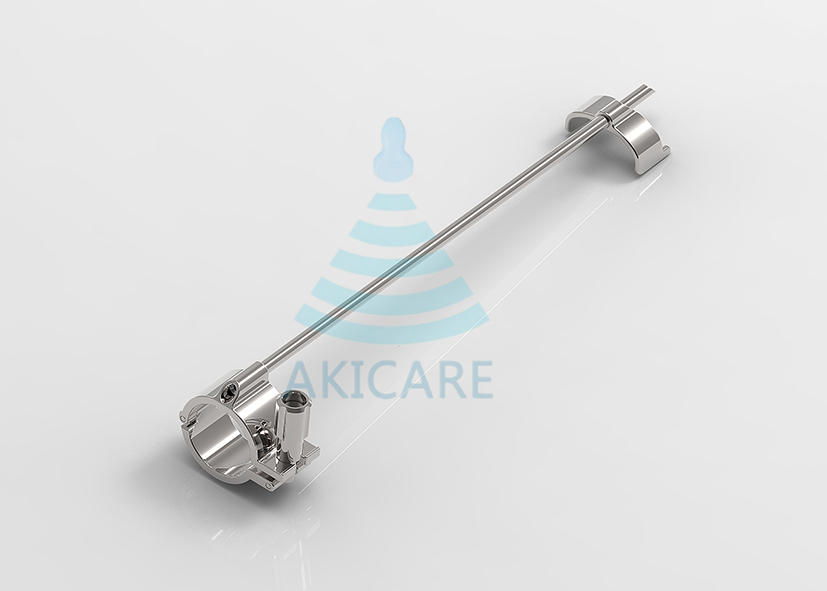
A Philips C10-3v biopsy guide is a needle-guidance bracket that clamps onto the C10-3v endocavity transducer and holds the biopsy needle on a fixed path aligned with the needle line displayed on the ultrasound screen.
What the C10-3v guide is used for
The C10-3v is a 3–10 MHz endocavity transducer used on Philips iU22, iE33, HD11 and HD15 systems, so its biopsy guide serves transvaginal and transrectal procedures: ovarian cyst aspiration, oocyte retrieval in fertility clinics, and prostate sampling.
The matching logic is probe-first, not console-first. If your department runs the Philips C10-3V endocavity probe on an iU22 or iE33, the correct guide is the C10-3v-specific bracket regardless of console generation. A console model name on its own is not compatibility evidence.
Reusable vs disposable: which format to order
Both formats exist for the C10-3v, and the right choice depends on procedure volume and your reprocessing capacity.
| Factor | Reusable guide | Disposable guide |
|---|---|---|
| Per-procedure cost profile | Spread across many uses, subject to reprocessing cost | One unit per procedure, no reprocessing step |
| Reprocessing burden | Cleaning and disinfection/sterilization after every use, per policy | None; single-use disposal |
| Fit risk | Wear over time can affect needle-channel alignment; inspect regularly | New unit each time, consistent out of the package |
| Best fit for | Steady procedure volumes with validated reprocessing in place | Low volumes, satellite sites, or no reprocessing capacity |
Akicare supplies reusable stainless-steel guides for Philips endocavity probes; the current model list is in the reusable biopsy guide catalogue (PDF). For disposable options, the listings that visibly name the C10-3v include the Akicare AKD-003 disposable guide for Philips C8-4V / C10-3V / C9-3V and the Akicare DE-003 disposable guide for Philips C8-4v / C9-3v / C10-3v. Reusable listings that name the model include the Akicare AKR-101 reusable guide for Philips C8-4V / C10-3V / C9-3V and the Akicare JEM-023 reusable guide for Philips C8-4v / C9-3v / C10-3v. Note that these multi-model listings cover several Philips endocavity heads; a listing title is a starting point, and you should still confirm the C10-3v fit in writing before ordering. Guides whose listings do not visibly name the C10-3v should not be treated as compatible without written confirmation.
Evidence to request before ordering
For a biopsy guide, four records must agree: the guide model, the probe model, the intended procedure, and your reprocessing records. Ask the supplier to confirm each of the following in writing:
- Probe fit. Written confirmation that the guide seats on the Philips C10-3v head specifically — not just “fits Philips endocavity probes.”
- Needle path. Confirmation that the guide’s needle channel matches the biopsy line the console displays for the C10-3v. Do not assume a gauge or angle unless the supplier states it for this guide and probe combination.
- Processing instructions. For reusable guides, the manufacturer’s cleaning and disinfection or sterilization method. Your facility’s reprocessing records must match the guide’s instructions for use.
- Condition and traceability. For reusable guides, the condition of the unit you will receive and any lot or part identification your department needs for tracking.
On reprocessing generally, the CDC’s guidance on disinfection and sterilization of healthcare equipment sets out the risk-based framework (critical, semicritical, noncritical) that determines how endocavity accessories must be processed. Endocavity probes and their guides contact mucous membranes, so they are semicritical at minimum, and many departments sterilize reusable brackets. The guide’s stated processing method must be one your facility can actually perform and document.
Step-by-step verification workflow
- Identify the probe. Read the model string off the probe housing or connector collar. It must read C10-3v — C8-4v and C9-3v are different heads even where a guide covers all three.
- Note the clinical use. Record the procedures the guide will support (for example, oocyte retrieval or prostate sampling), since this drives the reusable-versus-disposable decision and the reprocessing requirement.
- Choose the format. Use the table above: reusable where validated reprocessing exists and volume justifies it; disposable where it does not.
- Shortlist exact-model listings. Only consider listings whose title visibly names the C10-3v. Otherwise start from the biopsy guides category and request a match.
- Get written confirmation. Ask the supplier to confirm C10-3v fit, needle-path alignment with the console’s displayed line, and processing instructions, in writing, before payment.
- Verify on receipt. Seat the guide on the probe, confirm it locks without play, and check the needle channel is smooth and undamaged before first clinical use.
- File the records. Keep the confirmation, the guide’s instructions for use, and your reprocessing log together so an auditor can trace guide, probe, and procedure.
Probe condition matters too
A guide only performs if the probe underneath it is sound. The BMUS multicentre survey of ultrasound probe condition (published results) found that a meaningful share of probes in routine clinical use had defects, including physical damage to housings and cables — accessories should not be fitted to equipment whose condition is unknown. The AIUM’s official statement on transducer testing and repair recommends routine transducer inspection and testing. If the C10-3v head or lens is damaged, sort that out first; our probe repair service can assess whether repair is viable before you invest in accessories.
Common mistakes when buying a C10-3v guide
- Ordering by console name. The console (iU22, iE33, HD11, HD15) does not determine guide fit — the probe head geometry does.
- Assuming a family listing proves fit. A listing that names C8-4v / C9-3v / C10-3v covers all three, but confirm the C10-3v fit and needle-path match in writing anyway; a listing title is not a test certificate.
- Buying a guide for a different endocavity head. Guides machined for other Philips endocavity probes will not seat correctly on the C10-3v, and a poorly seated guide puts the needle off the displayed line.
- Ignoring reprocessing capacity. A reusable guide is only economical if your facility can process it per its instructions and document each cycle.
- Skipping the on-receipt check. Fit, locking, and channel condition take two minutes to verify and catch shipping damage before a procedure depends on the part.
Next step
Send your probe model (C10-3v), your console, and whether you prefer reusable or disposable, and we will confirm which current guide options match and provide the written fit confirmation your records need. Start with the listings above, browse the product catalogue, or review our guide on how to evaluate supplier evidence before you commit.
Sources
- AIUM official statement, transducer testing and repair: aium.org — recommendations on routine transducer inspection, testing, and repair practice.
- CDC, disinfection and sterilization of healthcare equipment: cdc.gov — the risk-based reprocessing framework applied to endocavity accessories.
- BMUS multicentre probe-condition survey: pmc.ncbi.nlm.nih.gov — survey data on the prevalence of probe defects in clinical use.
Frequently asked questions
Will a Philips C10-3v biopsy guide fit other Philips endocavity probes?
No. A C10-3v-specific guide is machined for the C10-3v head geometry. Some guides are manufactured to cover the C8-4v, C9-3v and C10-3v together, and those listings say so explicitly; a guide built only for another model will not seat correctly on the C10-3v.
Does the console model determine which guide I need?
No. The C10-3v probe is used on Philips iU22, iE33, HD11 and HD15 systems, but the guide fits the probe head, not the console. Confirm the probe model string on the housing first, then match the guide to that.
Should I choose a reusable or a disposable C10-3v guide?
It depends on procedure volume and reprocessing capacity. Reusable guides suit departments with validated cleaning and disinfection or sterilization processes and steady volumes; disposable guides suit low-volume sites or facilities without reprocessing capacity.
What confirmation should I get before ordering a C10-3v biopsy guide?
Get written confirmation of C10-3v head fit, alignment of the needle channel with the biopsy line the console displays, and the processing instructions for the guide. Guide, probe, procedure, and reprocessing records must all match.