
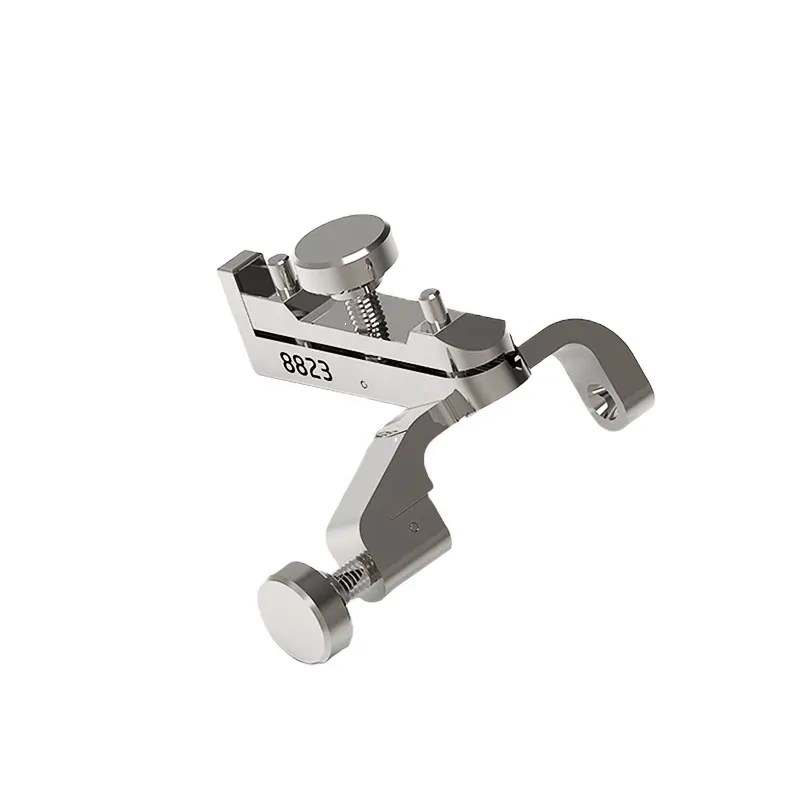
The BK 8823 biopsy guide is a needle-guidance bracket made for the BK Medical 8823 convex transducer. Akicare stocks a compatible BK 8823 needle guide (BSM-005) that clamps onto the original probe housing and aligns the needle with the system’s on-screen guide line. This article covers what the bracket does, reusable versus disposable formats, and how to order the correct configuration.
What the BK 8823 Biopsy Guide Does
The 8823 is a curved-array probe used on BK Medical systems for abdominal and general imaging. In ultrasound-guided biopsy of the liver, kidney, and other deep targets, the bracket holds the needle in a fixed channel relative to the scan plane, so the needle follows the guide line displayed by the system. For deep targets this is the main advantage over freehand technique: the longer the needle path, the more a small angulation error grows by the time the tip reaches the lesion. The BSM-005 bracket is machined to the 8823 housing geometry — brackets from other convex probes will not seat securely and should not be substituted.
Reusable vs Disposable Formats
| Attribute | Reusable guide | Disposable guide |
|---|---|---|
| Material | Medical-grade stainless steel bracket | Sterile single-use polymer kit |
| Needle path | Interchangeable gauge inserts on a fixed bracket | Pre-set channel supplied with the kit |
| Sterilization | Steam autoclave between cases | Supplied sterile; discard after one procedure |
| Cost profile | Higher unit price, low cost per procedure over hundreds of uses | Low unit price, recurring cost every procedure |
| Best fit | Departments running biopsies regularly | Low-volume sites or mobile services without autoclave access |
Abdominal core biopsies commonly use 16G–18G needles, while fine-needle aspiration runs 21G–23G; the reusable bracket covers both through interchangeable inserts.
Sterilization and Reprocessing
Reusable stainless-steel brackets are designed for steam autoclaving. After each procedure, detach the guide from the transducer, clean it according to your facility protocol, and autoclave the bracket separately — the transducer itself must never be autoclaved and should be reprocessed per the probe manufacturer’s instructions. Disposable kits arrive sterile-packed and are discarded after a single use, which removes reprocessing workload but adds a per-procedure consumable cost.
Because the bracket clamps directly onto the probe housing, inspect the probe lens and housing for wear whenever you mount a guide. If you find lens delamination, cable damage, or image dropout, a probe repair For the equipment discussed here, repair pricing and turnaround depend on the fault, probe model, parts availability, and agreed test scope; request an assessment before comparing repair with replacement.
What to Confirm Before Ordering
- Exact probe model: the bracket is machined to the BK Medical 8823 housing; a guide for a similar-looking probe will not seat correctly.
- Needle gauge: confirm the insert set covers the gauges your clinicians use (commonly 14G–23G for core and fine-needle work).
- Guide-line software: verify your ultrasound system displays the biopsy guide line for this transducer so the on-screen path matches the physical channel.
- Reusable vs disposable: match the format to your case volume and reprocessing capacity, as compared in the table above.
- Documentation: request the compatibility statement and material certificates with your quotation.
If the 8823 probe itself is showing image dropout or physical damage, Akicare also offers a dedicated BK 8823 probe repair service. Browse all biopsy needle guides or the BK Medical probe catalog for related models.
Request a Quote
Akicare supplies biopsy needle guides compatible with the BK Medical 8823, alongside compatible replacement transducers and probe repair services. For the equipment discussed here, compatible or refurbished probe pricing depends on the exact model, condition, test documentation, availability, and order terms; compare a current RFQ with OEM supply. Send us the probe model and your preferred needle gauges through the contact form, and our team will return a quotation with specifications and lead time, usually within one business day.
Evidence boundary and verification record
For BK 8823 Biopsy Guide: Compatibility and Buying Guide, catalogue compatibility is only the discovery layer. The purchase record should keep the exact guide reference, parent probe label, guide format, current instructions and host-system context together. A nearby probe name, similar bracket image or broad family list should not be treated as exact fit evidence. When the original item is unavailable, state that the search begins from a requirement rather than pretending that a replacement model has already been identified.
Evidence matrix
| Field | What to collect | Why it matters |
|---|---|---|
| Guide identity | Exact part, reusable or single-use designation and current record | Defines the accessory being quoted |
| Parent probe | Complete probe label and housing photographs | Prevents a bracket for a nearby model from being substituted |
| Instructions | Current guide and probe documents plus facility process | Keeps processing and procedure claims instruction-led |
| Commercial scope | Contents, exclusions, availability check, logistics and remedy | Makes different offers comparable |
Use the same matrix for every provider. Mark an unknown field pending instead of borrowing a specification, compatibility statement or condition claim from a similar model. The final record should identify the offered item, the source for each fact and the date on which availability and commercial terms were checked.
CDC healthcare-equipment guidance explains that processing decisions depend on intended contact and applicable manufacturer instructions; it does not supply a model-specific cycle for BK 8823 Biopsy Guide: Compatibility and Buying Guide. AIUM’s statement supports regular transducer assessment and quality control after repair, while the BMUS survey illustrates why probe condition should be documented. None of these sources proves guide fit or item condition without the exact records.
Primary sources and limits
- AIUM transducer testing and repair statement — professional guidance on transducer assessment and post-repair quality control.
- CDC healthcare-equipment disinfection and sterilization guidance — a processing framework tied to device use and instructions.
- BMUS multicentre probe-condition survey — published fleet research, not an item-level diagnosis.
Evidence questions
Does this evidence prove the exact compatibility described in BK 8823 Biopsy Guide: Compatibility and Buying Guide?
No. It defines what should be collected and reviewed. Exact compatibility remains tied to the complete labels, configuration, current documentation and written item-specific decision.
Can the commercial terms for BK 8823 Biopsy Guide: Compatibility and Buying Guide be assumed from this article?
No. Availability, condition, included work, timing, logistics, exclusions and remedy must be confirmed in the current quotation for the exact request.