
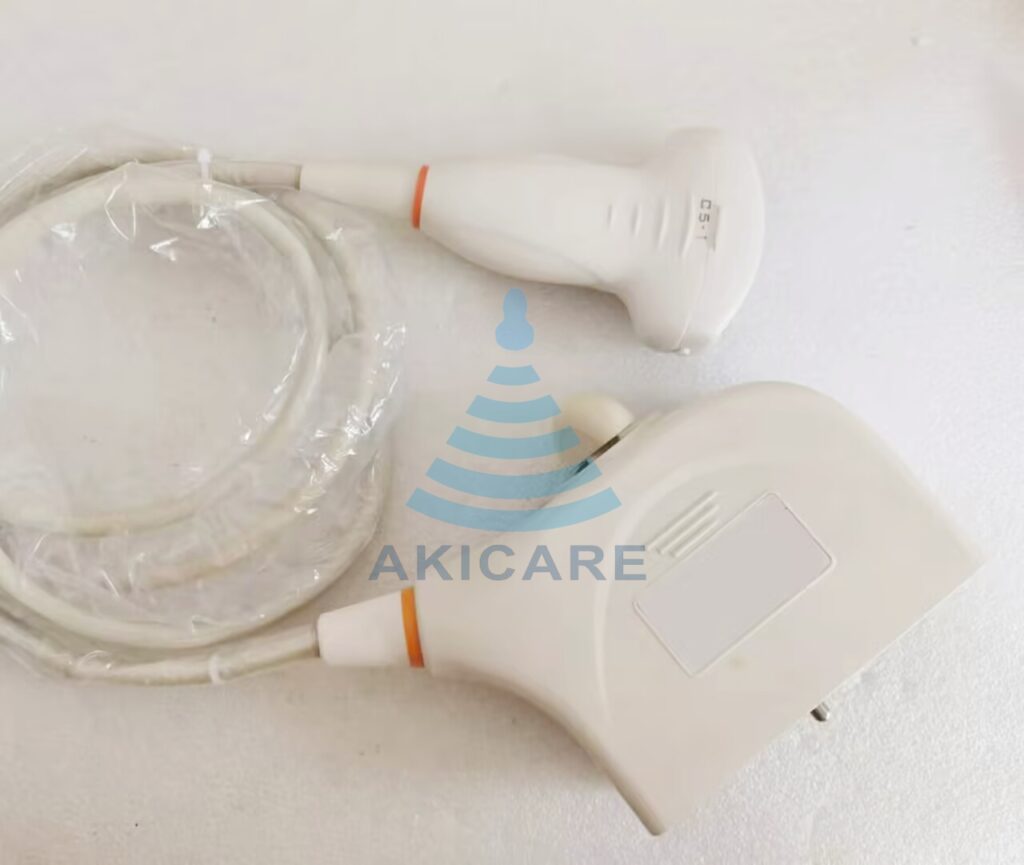
Replace a Mindray C5-1E ultrasound probe when element testing shows significant array failure — typically a dead block of elements producing a persistent dark band in the image. If the fault is mechanical (cable, lens, connector, housing) and the array is healthy, repair at 30–60% of replacement cost is normally the better spend. This article explains how to tell the two situations apart and what a compatible C5-1E costs relative to OEM.
What the C5-1E Is and Which Systems Use It
The C5-1E is a convex (curved-array) transducer used for abdominal and general imaging on Mindray’s DC-series consoles. As the general-purpose abdominal probe on these systems, it usually logs more scan hours than any other transducer in the room, which is why lens wear and cable fatigue show up on it first.
| Probe | Array type | Compatible systems |
|---|---|---|
| C5-1E (compatible) | Convex | Mindray DC-70, DC-80, DC-80A |
Note that Mindray also makes an SC5-1e single-crystal convex probe for the same console family; it is a different transducer with a different price point, so confirm which one your system currently uses before ordering.
Repairable Faults vs. Replacement Faults
Usually repairable
- Cut, crushed, or intermittent cable — the classic fault after a cart runs over the cord
- Lens delamination or membrane wear from disinfection cycles
- Cracked housing or damaged strain relief
- Connector pin damage
Usually replacement
- A contiguous block of dead elements (dark band across the image that stays fixed when you swap ports)
- Widespread weak elements causing overall sensitivity loss
- Internal delamination after a drop, where the acoustic stack itself has separated
The deciding evidence is an element-by-element scan, not the on-screen image alone. We run this scan on every probe that arrives for repair assessment and send you the report with the quote, so the repair-or-replace call is made on measured data.
What Replacement Costs: OEM vs. Compatible
| Option | Typical cost | Lead time | Best suited for |
|---|---|---|---|
| New OEM probe | Highest — Mindray dealer list price | Varies by dealer and region | Sites required to buy OEM |
| New compatible probe | Typically 40–70% below OEM list | About one week after payment (in stock) | DC-70/DC-80 owners replacing a failed array |
| Repair of your original C5-1E | Usually 30–60% of replacement cost | Around 5–10 business days | Mechanical faults with a healthy array |
Every compatible C5-1E ships new and fully tested with worldwide shipping. It is an aftermarket product built to work with the listed Mindray systems; it is not manufactured by or affiliated with Mindray.
How We Verify Every C5-1E Probe Before Shipment
Whether you order a compatible C5-1E or send an original unit in for repair, the probe goes through the same acceptance process before dispatch. Each transducer is tested element by element: every channel in the array is measured individually for sensitivity, capacitance, and dead or weak elements. You receive the test report with the probe, so your biomedical team can file it as objective acceptance evidence rather than relying on a visual check at the console.
The report also matters at the other end of the probe’s life. If image quality degrades later, a follow-up element scan tells you whether the array itself has failed or whether the fault sits in the cable or connector, which is the difference between a repair quote and a replacement quote.
Request a Quote
To get current pricing and stock for the compatible C5-1E, send the probe model and your ultrasound system model through the product page or the contact form. If your current C5-1E is damaged rather than dead, describe the fault and we will tell you honestly whether repair or replacement is the more economical route. Quotes normally go out within one business day, and standard delivery for in-stock compatible probes is about one week after payment.
Akicare supplies compatible (aftermarket) probes and independent repair services. We are not affiliated with the original equipment manufacturer; brand and model names are used for compatibility reference only. See all models we cover for this brand.
Evidence boundary and verification record
For When Should You Replace a Mindray C5-1E Ultrasound Probe — and When Is Repair Enough?, the complete label, connector, host-system record and physical item must remain linked. Similar model stems can describe different probes, and representative photographs do not establish the condition of a used or refurbished unit. Keep discovery, item and commercial evidence in separate rows. Date the source check so later changes in documents or availability do not silently alter the decision.
Evidence matrix
| Field | What to collect | Why it matters |
|---|---|---|
| Exact identity | Full probe and system labels with connector views | Prevents nearby models from being merged |
| Condition | Current lens, housing, cable, strain-relief and connector evidence | Documents the offered or existing unit |
| Verification | Named checks, item reference, date and result format | Replaces a broad quality label |
| Terms | Offer type, availability check, exclusions, logistics and remedy | Defines the commercial boundary |
Use the same matrix for every provider. Mark an unknown field pending instead of borrowing a specification, compatibility statement or condition claim from a similar model. The final record should identify the offered item, the source for each fact and the date on which availability and commercial terms were checked.
AIUM describes why transducer operation and repair quality control require structured assessment. The published BMUS multicentre survey supports documenting physical and performance condition across a probe fleet. Applied to When Should You Replace a Mindray C5-1E Ultrasound Probe — and When Is Repair Enough?, these sources justify item-level checks but do not diagnose a probe or establish a system match remotely.
Primary sources and limits
- AIUM transducer testing and repair statement — professional guidance on transducer assessment and post-repair quality control.
- CDC healthcare-equipment disinfection and sterilization guidance — a processing framework tied to device use and instructions.
- BMUS multicentre probe-condition survey — published fleet research, not an item-level diagnosis.
Evidence questions
Does this evidence prove the exact compatibility described in When Should You Replace a Mindray C5-1E Ultrasound Probe — and When Is Repair Enough??
No. It defines what should be collected and reviewed. Exact compatibility remains tied to the complete labels, configuration, current documentation and written item-specific decision.
Can the commercial terms for When Should You Replace a Mindray C5-1E Ultrasound Probe — and When Is Repair Enough? be assumed from this article?
No. Availability, condition, included work, timing, logistics, exclusions and remedy must be confirmed in the current quotation for the exact request.