
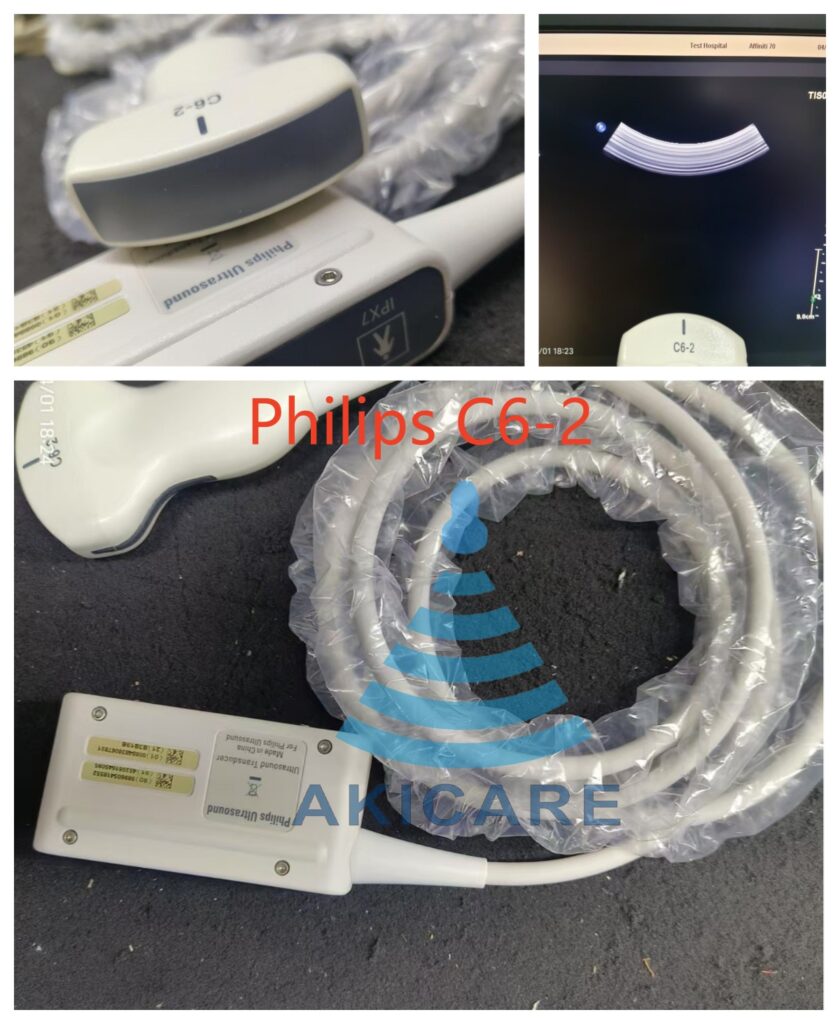
If your Philips C6-2 ultrasound probe has failed or your department needs an additional curved-array head, you have three realistic options: a new OEM transducer from Philips, a compatible replacement sourced from an independent supplier, or a repair of the probe you already own.
The Philips C6-2 at a glance
The C6-2 is a broadband curved array transducer with a 2–6 MHz operating range, which gives it a useful balance of penetration and near-field resolution. On compatible consoles it supports B-mode, M-mode, and color Doppler imaging. Typical applications include:
- Abdominal imaging — liver, kidneys, gallbladder, and general upper-abdomen surveys.
- Obstetrics and gynecology — routine OB scanning across trimesters.
- Guided procedures — with the matching bracket, such as the Philips C6-2 biopsy needle guide (PSM-060). For any guided work, the guide, probe, procedure, and processing records must match each other; do not assume a bracket fits because the model name looks similar.
Which Philips consoles pair with the C6-2
Existing documentation for this probe lists the following platform families:
| Platform family | Representative models |
|---|---|
| Philips HD series | HD6, HD7, HD11 XE, HD15 |
| Philips EnVisor | EnVisor C / C HD |
Connector type and software revision determine final compatibility, so treat this table as a starting point, not proof. A catalogue listing or a connector photograph does not confirm that a specific C6-2 unit will run on your specific console. Confirm the probe against your console’s transducer list, and where documentation is ambiguous, require current written compatibility evidence from the supplier before purchase. Our full range of probes for this brand is listed on the Philips catalogue page.
Option 1: Buy a new OEM C6-2
A new OEM transducer from Philips is the lowest-risk route on paper: the probe arrives with factory documentation and a clear support channel. The trade-offs are cost and lead time, which for a probe of this generation can be substantial relative to the remaining service life of the console it plugs into. OEM purchase makes most sense when the host system is still under a service contract, when your quality system requires manufacturer-sourced parts, or when the probe failed early in its expected life and you want a like-for-like reset.
Option 2: Buy a compatible C6-2 replacement
A compatible replacement from an independent supplier is often the practical middle route, but it is also the route where evidence discipline matters most. Catalogue discovery — finding a listing titled “C6-2” — is only the first step. Item-specific evidence is what protects you:
- The listing should state the exact model string, not a family name or a “fits various” description.
- Ask for the probe’s part number, serial, and connector details in writing, and match them to your console’s transducer list.
- Request the agreed test scope in writing: which imaging modes were exercised and on which console.
- Confirm return and evaluation terms before payment, so a mismatch discovered on arrival is recoverable.
Note that similar model strings across brands are not interchangeable. A Mindray C6-2 or a SonoScape VC6-2 is a different probe from the Philips C6-2, and a biopsy guide labeled for one brand’s C6-2 does not fit another’s. Match the brand and the exact model string together.
Option 3: Repair the C6-2 you already own
Repair pricing and turnaround depend on the fault, the probe model, parts availability, and the agreed test scope, so request an assessment before comparing repair with replacement. Many common probe failures — cable wear near the strain relief, connector pin damage, lens and membrane deterioration, and intermittent dropouts from flexed wiring — are repairable in principle, and repairing keeps a probe you already know matches your console in service. The AIUM official statement on transducer testing and repair recommends that transducers showing physical damage or image artifacts be evaluated, and that repairs be performed with appropriate testing afterward — use that framing when you scope a repair quotation. A structured evaluation of probe repair options will tell you whether your unit’s fault sits in the repairable category before you spend on a replacement.
Comparing the three routes
| Factor | New OEM | Compatible replacement | Repair of existing unit |
|---|---|---|---|
| Compatibility risk | Lowest — factory documentation | Managed by written evidence and return terms | Lowest — the unit already works on your console |
| Cost position | Highest of the three | Typically below OEM; confirm by quotation | Fault-dependent; request assessment first |
| Lead time | Manufacturer-dependent | Supplier-dependent; confirm in writing | Fault- and parts-dependent; confirm in writing |
| Best fit when | Console under contract; quality rules require OEM | Budget-constrained; console still has service life | Fault is localized; probe otherwise sound |
Step-by-step decision workflow
- Confirm the fault. Document the symptom — dropout lines, artifacts, connection errors, physical damage — with images from your console.
- Verify the model. Record the exact probe model string, part number, and serial from the probe label, and your console model and software revision.
- Get a repair assessment. Ask whether the fault is repairable and at what scope before comparing against replacement prices.
- Source replacement quotations. Collect written offers that state the exact model, test scope, and return terms — not verbal assurances.
- Check supplier evidence. Work through a structured supplier evidence evaluation before committing.
- Verify on arrival. Run the probe through its clinical modes on your console and document acceptance before the evaluation window closes.
Common mistakes to avoid
- Buying on the model string alone. A listing that says “C6-2” without brand, part number, and connector detail is a starting point, not a match.
- Cross-brand confusion. Mindray, SonoScape, and Neusoft all use similar C6-2-family names; none of those probes is a Philips C6-2.
- Skipping the repair assessment. Departments often replace probes whose faults were economically repairable, or repair probes whose array damage made repair uneconomic. Assess first.
- Ignoring reprocessing requirements. Probe handling between patients must follow your facility’s infection-control policy and the manufacturer’s instructions; the CDC guidance on disinfection and sterilization of healthcare equipment sets out the risk-based framework for semi-critical devices such as endocavity transducers.
- Assuming condition from appearance. The BMUS multicentre survey of probe condition found that a significant share of probes in routine clinical use had defects, many not obvious without systematic testing — another reason to verify on arrival and to test periodically in service.
Commercial next step
Whether you land on replacement or repair, start with evidence. Browse the ultrasound probe catalogue for current Philips-compatible listings, tell us your console model and software revision, and we will verify the match in writing before quoting. If your existing C6-2 may be repairable, request an assessment through our probe repair page so you can compare both routes on real numbers.
Frequently asked questions
Which ultrasound systems is the Philips C6-2 compatible with?
Existing documentation lists the Philips HD6, HD7, HD11 XE, and HD15, plus the EnVisor C and C HD. Connector type and console software revision decide the final match, so confirm against your console’s transducer list and get written compatibility confirmation before purchase.
Should I repair my C6-2 or replace it?
It depends on the fault. Cable, connector, and lens problems are often repairable, while array or internal electronics damage may not be economic to fix. Request a repair assessment with an agreed test scope first, then compare that figure against replacement quotations on equal evidence terms.
Can I use a biopsy guide with the Philips C6-2?
Yes, with the matching bracket — for example the Philips C6-2 biopsy needle guide (PSM-060). The guide, probe, procedure, and processing records must all match; do not assume a guide fits because its title contains a similar model string.
What evidence should I request before buying a compatible C6-2?
Ask for the exact model string and part number in writing, the connector details, the test scope the unit passed and on which console, and the return terms if the probe does not match on arrival. A catalogue listing or connector photo alone is not proof of compatibility.