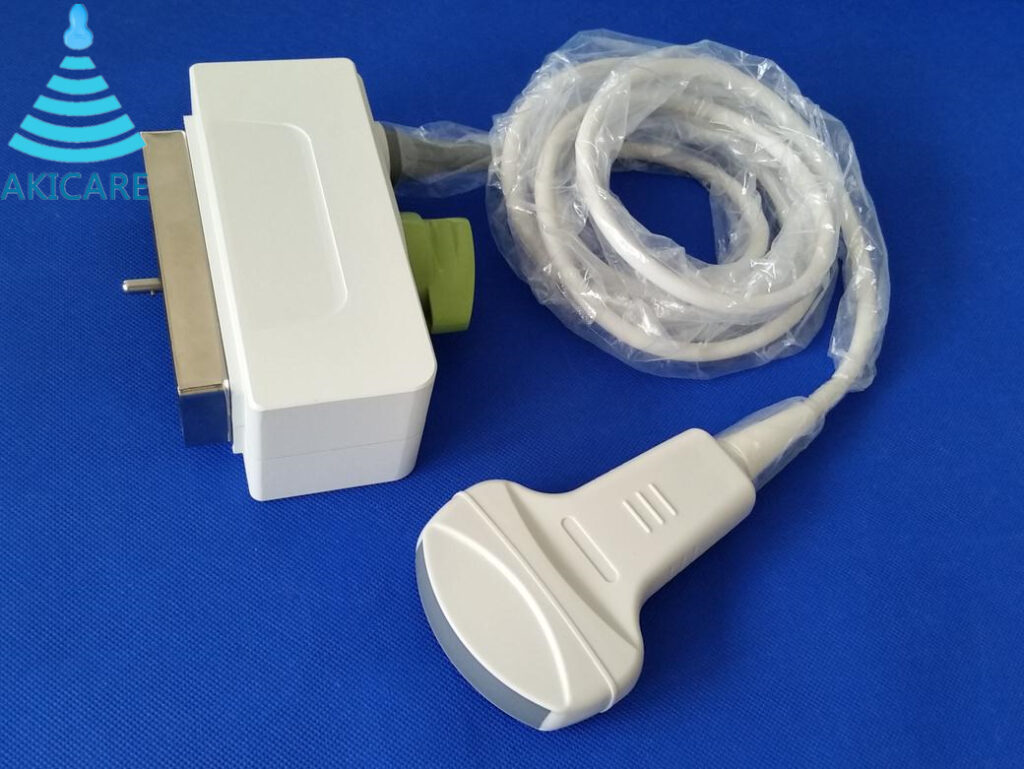
Akicare supports the Aloka UST-9123 two ways: we supply replacement UST-9123 probes with a six-month warranty, and we repair original units at 30–60% of replacement cost. Every probe leaves our lab with an element-by-element test report rather than a bare “tested working” claim. This guide covers which Aloka systems the UST-9123 fits, what each sourcing option costs, and how to judge whether your probe is worth repairing.
UST-9123 Applications and Compatible Aloka Systems
The UST-9123 is an endocavity transducer used for obstetric, gynecological, and urological examinations. It remains in wide circulation because the Aloka consoles it pairs with had long service lives and many are still scanning daily in OB/GYN clinics.
| Item | Detail |
|---|---|
| Probe model | Aloka UST-9123 |
| Type | Endocavity (transvaginal) |
| Clinical use | OB/GYN and urological exams |
| Compatible systems | Aloka SSD-3500, SSD-4000, ProSound Alpha 6, ProSound F31, ProSound F37 |
| Warranty | Six months |
| Delivery | Around one week after payment |
Confirm your console model before ordering. Aloka (now merged into Hitachi, later Fujifilm) used similar model numbering across generations, and a probe that fits an SSD-4000 is not guaranteed to fit every ProSound console. Our Hitachi-Aloka probe listing covers the related models if your system uses a different transducer.
Replace or Repair: Cost Comparison for the UST-9123
Because Aloka consoles of this generation are discontinued, OEM replacement probes are scarce and expensive where they can be found at all. That leaves two realistic paths for most facilities.
| Option | Typical cost | Turnaround | When it fits |
|---|---|---|---|
| Replacement UST-9123 from Akicare | 40–70% below OEM pricing | About one week after payment | Probe lost, dropped, or array failed |
| Repair of your original probe | 30–60% of replacement cost | 5–10 business days in the lab | Lens wear, cable faults, connector damage, limited element loss |
Endocavity probes fail in predictable ways: the acoustic lens wears from repeated high-level disinfection, the cable fatigues near the handle, or a few elements drop out. All of these are repairable. Our repair service quotes after inspection, and if the damage is beyond economic repair we say so instead of charging for a marginal fix.
Why the Element-Level Test Report Matters
Used and refurbished Aloka probes circulate widely online, and the most common defect is partial element failure — the probe images, but with dropout bands that a quick demo scan will not reveal. Akicare tests each element in the array individually and ships the numbered report with the probe. On a transvaginal probe used for early-pregnancy and endometrial assessment, dropout in the central aperture is a diagnostic problem, not a cosmetic one, which is why we treat the per-element report as standard paperwork on every shipment.
Replacement units are aftermarket-compatible products: not manufactured by or affiliated with Aloka, Hitachi, or Fujifilm, with model names used for compatibility reference only. For facilities running discontinued SSD and ProSound consoles, this is normally the only supported route left, since the OEM no longer stocks new UST-9123 probes.
Extending the Service Life of a UST-9123
Most UST-9123 failures we see in the lab trace back to handling rather than age. Three habits prevent the bulk of them. First, follow the disinfectant manufacturer’s soak times exactly — extended immersion in high-level disinfectant is the leading cause of lens delamination on endocavity probes. Second, hang the cable on a proper hook instead of coiling it tightly around the probe body; the sharp bend at the strain relief is where conductors break. Third, inspect the sheath and lens weekly for nicks, because a small breach lets fluid migrate toward the array, and fluid invasion turns a cheap mechanical repair into an uneconomical one. A probe treated this way routinely outlasts the console it is plugged into.
How to Order or Send a Probe for Assessment
For a replacement quote, tell us your console model and required delivery country; quotes include worldwide shipping. For repair, describe the symptom — image dropout, error code, visible cable or lens damage — and we will confirm whether it is repairable before you ship the probe. Repairs carry the same testing standard as replacement units: the probe goes back with a full element response report you can keep on file for your next equipment audit.
Evidence boundary and verification record
For Aloka UST-9123 Ultrasound Probe: Supply and Repair Options Explained, the complete label, connector, host-system record and physical item must remain linked. Similar model stems can describe different probes, and representative photographs do not establish the condition of a used or refurbished unit. Keep discovery, item and commercial evidence in separate rows.
Evidence matrix
| Field | What to collect | Why it matters |
|---|---|---|
| Exact identity | Full probe and system labels with connector views | Prevents nearby models from being merged |
| Condition | Current lens, housing, cable, strain-relief and connector evidence | Documents the offered or existing unit |
| Verification | Named checks, item reference, date and result format | Replaces a broad quality label |
| Terms | Offer type, availability check, exclusions, logistics and remedy | Defines the commercial boundary |
Use the same matrix for every provider. Mark an unknown field pending instead of borrowing a specification, compatibility statement or condition claim from a similar model. The final record should identify the offered item, the source for each fact and the date on which availability and commercial terms were checked.
AIUM describes why transducer operation and repair quality control require structured assessment. The published BMUS multicentre survey supports documenting physical and performance condition across a probe fleet. Applied to Aloka UST-9123 Ultrasound Probe: Supply and Repair Options Explained, these sources justify item-level checks but do not diagnose a probe or establish a system match remotely.
Primary sources and limits
- AIUM transducer testing and repair statement — professional guidance on transducer assessment and post-repair quality control.
- CDC healthcare-equipment disinfection and sterilization guidance — a processing framework tied to device use and instructions.
- BMUS multicentre probe-condition survey — published fleet research, not an item-level diagnosis.
Evidence questions
Does this evidence prove the exact compatibility described in Aloka UST-9123 Ultrasound Probe: Supply and Repair Options Explained?
No. It defines what should be collected and reviewed. Exact compatibility remains tied to the complete labels, configuration, current documentation and written item-specific decision.
Can the commercial terms for Aloka UST-9123 Ultrasound Probe: Supply and Repair Options Explained be assumed from this article?
No. Availability, condition, included work, timing, logistics, exclusions and remedy must be confirmed in the current quotation for the exact request.