
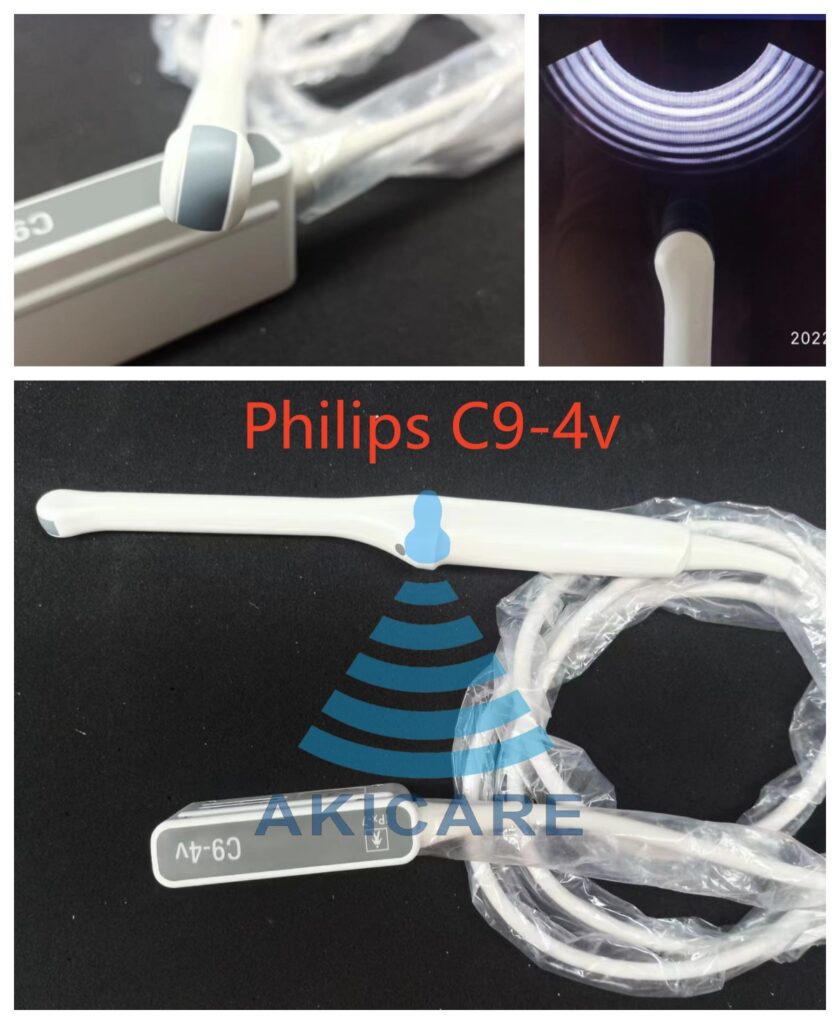
You should buy a new Philips C9-4v when the transducer array itself has failed — widespread dead elements, deep fluid invasion, or a crushed head — because at that point repair no longer makes economic sense. For C9-4v, repair pricing and turnaround depend on the fault, probe model, parts availability, and agreed test scope; request an assessment before comparing repair with replacement. This article sets out the failure signs, the compatibility facts, and the cost math so you can make that call with your own probe in hand.
C9-4v Specifications and Compatible Consoles
The Philips C9-4v is an endocavity curved-array transducer operating in the 4–9 MHz range, used for transvaginal OB/GYN imaging: early pregnancy, endometrial and ovarian assessment, and follicle monitoring. Its microconvex tip and higher frequencies give the near-field resolution that endocavity work demands.
The C9-4v is designed for the Philips ClearVue platform — ClearVue 350, 550, and 650 consoles are the common hosts. It is not interchangeable with the C9-4 or C10-3v used on other Philips families, and it will not connect to HD or EPIQ systems. If you run a mixed Philips fleet, check the part number on the connector before ordering; a probe that physically resembles the C9-4v but carries a different model code will be rejected by the console or, worse, load incorrect presets. Our C9-4v product page lists the exact console compatibility for the units we test and stock.
Signs Your C9-4v Needs Attention — and Which Ones Mean Replacement
Endocavity probes fail earlier than surface probes because of constant high-level disinfection and handling stress on the insertion tube. Watch for these symptoms:
| Symptom | Likely cause | Usual remedy |
|---|---|---|
| Vertical dropout lines in image | Dead elements | Repair if few; replace if widespread |
| Image flicker when cable moves | Broken cable conductors | Repair (cable replacement) |
| Cuts or bubbling on lens | Lens delamination from disinfectant exposure | Repair (lens recast) |
| Torn insertion-tube sheath | Handling damage | Repair — urgent, this is an infection-control failure |
| Console no longer recognizes probe | Connector or board fault | Repair evaluation |
| Whole-image noise, heavy sensitivity loss | Fluid invasion into the array | Usually replacement |
The dividing line is the acoustic array. For C9-4v, repair pricing and turnaround depend on the fault, probe model, parts availability, and agreed test scope; request an assessment before comparing repair with replacement. Once a large share of the array is dead or flooded, the repair quote approaches the price of a tested replacement, and replacement wins. Our probe repair service evaluates the probe first and quotes before any work, so you see which side of that line you are on.
Replacement Options and What They Cost
New OEM from Philips is the reference point on quality and the highest price. For a ClearVue console several years into service, an OEM probe purchase can amount to a significant share of the console’s remaining value, which is why many facilities look at alternatives.
A tested compatible or refurbished C9-4v For C9-4v, compatible or refurbished probe pricing depends on the exact model, condition, test documentation, availability, and order terms; compare a current RFQ with OEM supply. The decisive question is verification: require a per-element test report, in which every element of the array is individually driven and measured, before the probe ships. This report turns “refurbished” from a marketing word into a set of numbers you can compare against acceptance criteria. Pair it with a written warranty of several months covering the array.
Repair of your existing probeFor C9-4v, compatible or refurbished probe pricing depends on the exact model, condition, test documentation, availability, and order terms; compare a current RFQ with OEM supply. For a busy OB/GYN department, the practical pattern is to hold one spare endocavity probe so that repairs never take a room offline.
The Decision in Brief
Buy new (OEM or tested compatible) when the array is gone, when the probe has been lost or crushed, or when you need a second probe to cover repair rotations. Repair when the damage is mechanical and the array still tests well — that is the majority of real-world C9-4v failures. For C9-4v, repair pricing and turnaround depend on the fault, probe model, parts availability, and agreed test scope; request an assessment before comparing repair with replacement. Browse our tested Philips probe inventory or send us your probe’s symptoms and console model for a same-day assessment.
Evidence boundary and verification record
For Philips C9-4v Ultrasound Probe: When to Replace and When to Repair, the complete label, connector, host-system record and physical item must remain linked. Similar model stems can describe different probes, and representative photographs do not establish the condition of a used or refurbished unit. Keep discovery, item and commercial evidence in separate rows. Date the source check so later changes in documents or availability do not silently alter the decision.
AIUM describes why transducer operation and repair quality control require structured assessment. The published BMUS multicentre survey supports documenting physical and performance condition across a probe fleet. Applied to Philips C9-4v Ultrasound Probe: When to Replace and When to Repair, these sources justify item-level checks but do not diagnose a probe or establish a system match remotely.
Primary sources and limits
- AIUM transducer testing and repair statement — professional guidance on transducer assessment and post-repair quality control.
- CDC healthcare-equipment disinfection and sterilization guidance — a processing framework tied to device use and instructions.
- BMUS multicentre probe-condition survey — published fleet research, not an item-level diagnosis.
Evidence questions
Does this evidence prove the exact compatibility described in Philips C9-4v Ultrasound Probe: When to Replace and When to Repair?
No. It defines what should be collected and reviewed. Exact compatibility remains tied to the complete labels, configuration, current documentation and written item-specific decision.
Can the commercial terms for Philips C9-4v Ultrasound Probe: When to Replace and When to Repair be assumed from this article?
No. Availability, condition, included work, timing, logistics, exclusions and remedy must be confirmed in the current quotation for the exact request.