
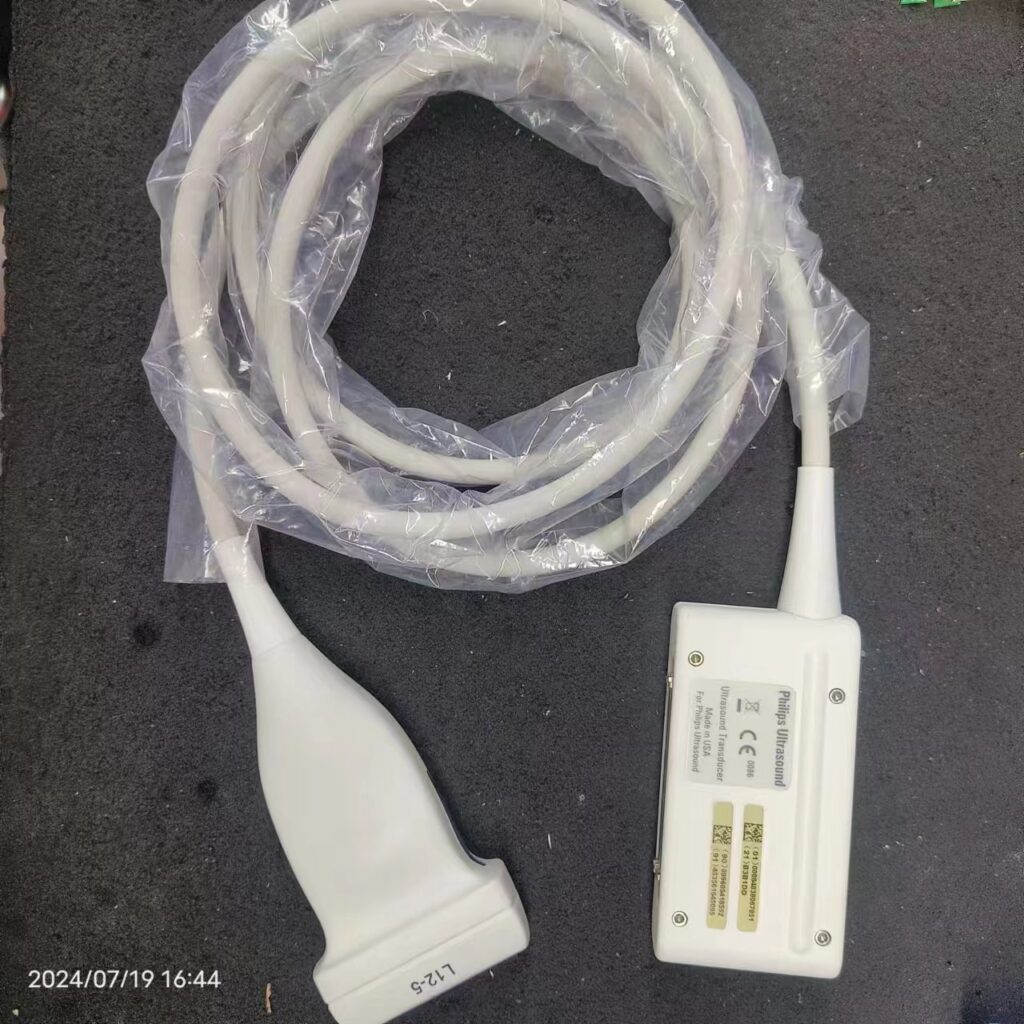
Replace a Philips L12-5 ultrasound probe when the array itself has failed — widespread dead elements, internal delamination, or crush damage. For L12-5, repair pricing and turnaround depend on the fault, probe model, parts availability, and agreed test scope; request an assessment before comparing repair with replacement. For L12-5, compatible or refurbished probe pricing depends on the exact model, condition, test documentation, availability, and order terms; compare a current RFQ with OEM supply.
Know Which L12-5 You Actually Have
The L12-5 is a broadband linear transducer working in the 5–12 MHz range, used for small parts, breast, vascular, and musculoskeletal imaging. Philips has shipped it in more than one physical form, and they are not interchangeable. The L12-5 50 mm version is the variant familiar from iU22 and iE33 installations and is also listed for HD-series consoles; a 38 mm footprint version exists alongside it, and later EPIQ-generation systems use their own probe interface. Before ordering anything, match three data points: the footprint width, the part number on the probe label, and the console model with its software revision. A connector photo attached to your inquiry settles compatibility questions immediately.
The Repair-First Test
Most L12-5 failures we see are mechanical and external rather than array-level. Run through this sequence before budgeting for a replacement:
- Image shows dark vertical bands: element dropout or a cable conductor break. Both are repairable; the distinction is made on a phantom and element test at the workshop.
- Lens is worn, cut, or lifting at the edge: lens replacement is a routine repair, and delaying it risks fluid ingress that converts a minor job into an array loss.
- Intermittent image when the cable is flexed: classic strain-relief conductor break; repairable.
- Probe dropped, housing cracked, large image regions blank: likely array or acoustic stack damage. This is where repair stops being economical and replacement takes over.
For L12-5, repair pricing and turnaround depend on the fault, probe model, parts availability, and agreed test scope; request an assessment before comparing repair with replacement. The full scope of what can and cannot be repaired is described on the probe repair service page. Sending the probe in for evaluation costs you freight and a few days; buying a replacement that was not needed costs considerably more.
The economics scale with fleet size. A department running several Philips consoles usually has more than one L12-5 in circulation, which means a single spare probe can cover the scanner while a faulty unit is in the workshop. For L12-5, repair pricing and turnaround depend on the fault, probe model, parts availability, and agreed test scope; request an assessment before comparing repair with replacement.
If You Do Replace: OEM Versus Compatible
| Criterion | New OEM L12-5 | New Compatible L12-5 |
|---|---|---|
| Price | Reference (highest) | For L12-5, compatible or refurbished probe pricing depends on the exact model, condition, test documentation, availability, and order terms; compare a current RFQ with OEM supply. |
| Channel | Philips dealer network | Independent suppliers; quality varies by vendor |
| Fit for older consoles | Subject to availability for legacy platforms | Built specifically for the installed base |
| Proof of quality | OEM brand | Must be demonstrated per unit — demand test data |
The compatible route is only as good as the evidence behind the specific unit you receive. The document to insist on is an element-by-element acoustic test report for that serial number: per-element sensitivity across the full array, with any weak or dead elements identified. A probe can look fine on a quick tissue scan while failing this test, and measurement-critical work such as vascular studies is where hidden weak elements do the most damage. The same report should accompany a repaired probe on its way back to you, together with written warranty and dead-on-arrival terms.
What to Send With Your Inquiry
Quotations are prepared case by case. Include the part number and footprint of your current probe, the console model and software version, a description of the fault with a screenshot of the image artifact if available, and whether you want a repair quote, a replacement quote, or both for comparison. If you run mixed Philips inventory, the Philips probe overview lists the other transducers we supply and repair for the same platforms, which makes it straightforward to combine several probes into one shipment and one evaluation cycle.
Philips L12-5 ultrasound probe: current evidence update
Answer first: A Philips L12-5 ultrasound probe request should preserve the complete probe and host-system labels, connector photographs, supply path, current condition, item-specific photos, named test scope and written compatibility basis. A catalogue record is a shortlist; it does not prove the condition or support of every revision.
| Field | Evidence | Control |
|---|---|---|
| Probe identity | Brand, full model, suffix and label | Keep this field tied to the exact Philips L12-5 ultrasound probe request. |
| Host system | Console model and configuration context | Keep this field tied to the exact Philips L12-5 ultrasound probe request. |
| Connector | Contact face, housing, latch and cable entry | Keep this field tied to the exact Philips L12-5 ultrasound probe request. |
| Offer type | OEM-brand, compatible, used, refurbished or repair | Keep this field tied to the exact Philips L12-5 ultrasound probe request. |
| Condition | Current lens, housing, cable and connector photos | Keep this field tied to the exact Philips L12-5 ultrasound probe request. |
| Test evidence | Named checks, conditions, result format and exclusions | Keep this field tied to the exact Philips L12-5 ultrasound probe request. |
Why this page is different from a product listing
The article explains how to evaluate the request and routes readers to current catalogue records. A product or category page owns the commercial inventory intent. This article should not compete by repeating a long list of unverified models; it adds decision evidence, limitations and an RFQ workflow that a product card cannot provide.
Model and configuration boundaries
For repair, describe what appears, when it appears and whether movement changes the symptom; do not assign an internal cause remotely. For purchase, ask the quotation to identify the offered item, current condition and availability at the time of the request.
Keep general documentation separate from item-level proof. A source can explain terminology or testing boundaries, while the physical label, current photos, inspection record and quotation establish facts about the exact item. Mark unresolved fields pending instead of copying a specification or compatibility statement from a similar model.
Four-step review
- Capture complete labels and all relevant physical interfaces.
- Check the exact current document or written match basis.
- Separate catalogue discovery from item condition and test evidence.
- Approve only a quotation that repeats the identity, scope, exclusions and terms.
Related catalogue and service links
Frequently asked questions
Does the model phrase alone prove the correct Philips L12-5 ultrasound probe?
No. Verify the complete labels, physical interface and current configuration-specific evidence.
Can a catalogue image prove condition?
No. Request current photos tied to the quoted item or service record.
What should the written quote identify?
Exact identity, compatibility basis, condition, evidence, included items, availability basis, shipping responsibility and remedy terms.
Sources
Evidence update checked 3 August 2026. Use current exact documentation for the device and jurisdiction involved.