
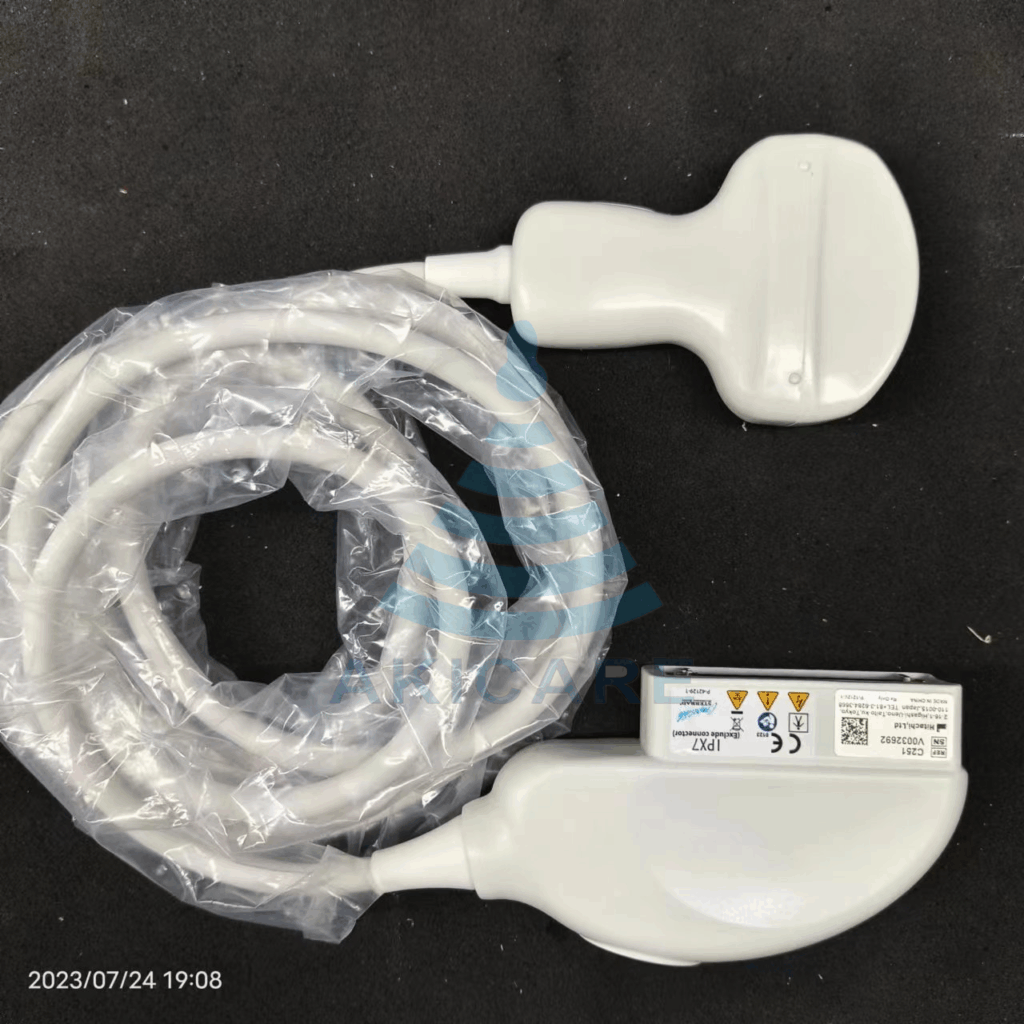
To buy a Hitachi C251 ultrasound probe, first confirm the probe fits your console — the C251 is used across the Hitachi Aloka Arietta family and the Noblus — then choose between a new OEM unit, a tested compatible probe, or a repair of the C251 you already own. For C251, repair pricing and turnaround depend on the fault, probe model, parts availability, and agreed test scope; request an assessment before comparing repair with replacement. The steps below walk through that decision in order.
What the Hitachi C251 Is Used For
The C251 is a convex (curved array) transducer for Hitachi Aloka consoles. Convex probes in this class are the default choice for general abdominal imaging, with wide use in OB/GYN and urology, where the curved footprint provides a broad field of view from a single acoustic window.
Because a convex probe is often the most-used transducer on the cart, the C251 wears in predictable places: lens erosion from gel and repeated disinfection, element dropout from knocks against the cart rail, and cable damage near the strain relief. Knowing which of these you have determines whether repair or replacement is the cheaper path.
Step 1: Confirm System Compatibility
The C251 is used on the following Hitachi Aloka platforms:
| Hitachi Aloka console | Notes |
|---|---|
| Arietta Precision / Arietta Prologue | Compact Arietta platforms |
| Arietta V60 / Arietta V70 | Mid-range and premium cart systems |
| Arietta 850 | Current premium platform |
| Noblus | Hybrid compact/cart system |
Hitachi shipped multiple software revisions across the Arietta line, so the reliable procedure is: note your console model and software version, photograph the label and part number on your current probe, and get written confirmation of fit from the supplier before paying. We perform this check on every C251 order at no charge.
Step 2: Choose Your Sourcing Channel
| Option | Typical cost | Lead time | Best for |
|---|---|---|---|
| New OEM probe via Hitachi distributor | Highest (list price) | Varies by region | Facilities under OEM service contracts |
| Compatible probe (Akicare) | For C251, compatible or refurbished probe pricing depends on the exact model, condition, test documentation, availability, and order terms; compare a current RFQ with OEM supply. | In-stock units ship promptly | Replacing a failed probe on a fixed budget |
| Repair of your existing C251 | For C251, compatible or refurbished probe pricing depends on the exact model, condition, test documentation, availability, and order terms; compare a current RFQ with OEM supply. | For C251, compatible or refurbished probe pricing depends on the exact model, condition, test documentation, availability, and order terms; compare a current RFQ with OEM supply. | Lens, cable, housing, or limited element damage |
Our compatible C251 probes are engineered and tested to work with the listed Hitachi Aloka systems. They are not manufactured by Hitachi and we never present them as OEM parts — the value case rests on documented test results and price.
Step 3: Demand Test Evidence, Not Assurances
Whichever channel you use, ask for objective acoustic data before the probe ships. Every compatible C251 we dispatch, and every repaired probe we return, includes an element-by-element test report: each transducer element is measured individually for sensitivity, so dead or weak elements are recorded as numbers rather than concealed in a cosmetic phantom photo. Your biomedical team keeps the report as a baseline for future performance checks.
Step 4: Consider Repair Before You Spend on Replacement
- Repair For C251, compatible or refurbished probe pricing depends on the exact model, condition, test documentation, availability, and order terms; compare a current RFQ with OEM supply.
- Replace when the array shows widespread element failure, liquid has entered the housing, or a previous repair attempt failed. At that point a compatible unit is normally more economical than further repair work.
An evaluation with element testing answers the question definitively before you commit to either path.
How to Order
To buy: see the Hitachi Aloka C251 compatible probe product page or browse all Hitachi Aloka-compatible probes. For a failing probe, start with our probe repair service. Send your console model and a photo of the probe label, and we will reply with a compatibility-confirmed quote.
Hitachi C251 ultrasound probe: current evidence update
Answer first: A Hitachi C251 ultrasound probe request should preserve the complete probe and host-system labels, connector photographs, supply path, current condition, item-specific photos, named test scope and written compatibility basis. A catalogue record is a shortlist; it does not prove the condition or support of every revision.
| Field | Evidence | Control |
|---|---|---|
| Probe identity | Brand, full model, suffix and label | Keep this field tied to the exact Hitachi C251 ultrasound probe request. |
| Host system | Console model and configuration context | Keep this field tied to the exact Hitachi C251 ultrasound probe request. |
| Connector | Contact face, housing, latch and cable entry | Keep this field tied to the exact Hitachi C251 ultrasound probe request. |
| Offer type | OEM-brand, compatible, used, refurbished or repair | Keep this field tied to the exact Hitachi C251 ultrasound probe request. |
| Condition | Current lens, housing, cable and connector photos | Keep this field tied to the exact Hitachi C251 ultrasound probe request. |
| Test evidence | Named checks, conditions, result format and exclusions | Keep this field tied to the exact Hitachi C251 ultrasound probe request. |
Why this page is different from a product listing
The article explains how to evaluate the request and routes readers to current catalogue records. A product or category page owns the commercial inventory intent. This article should not compete by repeating a long list of unverified models; it adds decision evidence, limitations and an RFQ workflow that a product card cannot provide.
Model and configuration boundaries
For repair, describe what appears, when it appears and whether movement changes the symptom; do not assign an internal cause remotely. For purchase, ask the quotation to identify the offered item, current condition and availability at the time of the request.
Keep general documentation separate from item-level proof. A source can explain terminology or testing boundaries, while the physical label, current photos, inspection record and quotation establish facts about the exact item. Mark unresolved fields pending instead of copying a specification or compatibility statement from a similar model.
Four-step review
- Capture complete labels and all relevant physical interfaces.
- Check the exact current document or written match basis.
- Separate catalogue discovery from item condition and test evidence.
- Approve only a quotation that repeats the identity, scope, exclusions and terms.
Related catalogue and service links
Frequently asked questions
Does the model phrase alone prove the correct Hitachi C251 ultrasound probe?
No. Verify the complete labels, physical interface and current configuration-specific evidence.
Can a catalogue image prove condition?
No. Request current photos tied to the quoted item or service record.
What should the written quote identify?
Exact identity, compatibility basis, condition, evidence, included items, availability basis, shipping responsibility and remedy terms.
Sources
Evidence update checked 3 August 2026. Use current exact documentation for the device and jurisdiction involved.