
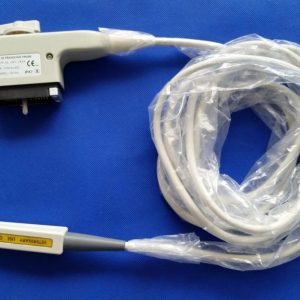
You can source a compatible SIUI CTS-3500 probe through a specialist supply channel with direct access to SIUI’s home market — but the model name alone is never enough to buy on. The CTS-3500 is a portable phased-array unit from SIUI (Shantou Institute of Ultrasonic Instruments), and because SIUI transducers are uncommon in Western spare-parts inventories, the practical route is to identify the exact probe part number, connector, and array type, then have the match confirmed in writing before you pay. This guide explains what the CTS-3500 is, how probe compatibility works, and how to source a transducer without guesswork.
What the SIUI CTS-3500 is
The CTS-3500 is a compact portable phased-array instrument built for imaging work where a full-size system would be impractical. It uses bipolar square-wave transmission with adjustable pulse width and combines linear scan and sector imaging in one lightweight body. The platform supports multi-frequency broadband probes with automatic switch-over, so one unit can cover several imaging tasks by switching probe heads.
Most buyers are either replacing a worn transducer or expanding the probe set for a new application, and SIUI parts are most reliably reached at the source rather than through Western OEM channels — so sourcing discipline matters.
How probe compatibility works on the CTS-3500
Matching a probe to the CTS-3500 comes down to three factors:
- Connector type — the plug must mate with the CTS-3500 socket.
- Frequency range — broadband multi-frequency probes give the widest coverage; pick a band suited to your imaging depth.
- Array geometry — phased-array, linear, and convex heads each suit different scan patterns; the unit supports linear scan and sector imaging.
All three have to line up at once: the right geometry on the wrong connector variant will not seat, and the right connector with the wrong geometry will not serve the application. Because SIUI has shipped multiple variants across its portable lines, a socket photo from one CTS-series machine does not prove a probe fits yours.
| Sourcing factor | Why it matters on the CTS-3500 | Evidence to request |
|---|---|---|
| Connector type | Plug must mate with the CTS-3500 socket; SIUI variants differ across lines | Photo of your socket and the candidate plug; written connector match |
| Frequency range | Platform uses multi-frequency broadband probes with automatic switch-over | Probe label or datasheet showing the band, matched to your imaging depth |
| Array geometry | Unit supports linear scan and sector imaging; geometry defines the scan pattern | Part number identifying linear, convex, or phased-array head |
| Unit condition | A worn probe degrades image quality regardless of model match | Element-level test results and cable/connector notes for the actual unit |
Catalogue discovery versus item-specific evidence
A catalogue listing tells you a probe model exists and is claimed to fit a SIUI platform. It does not prove the specific unit being sold works on your CTS-3500. A connector photo is not proof — similar-looking connectors exist across SIUI generations — and a similar model name is not proof either, because suffixes often distinguish frequency or connector variants. What closes the gap is item-specific evidence: the exact part number from the probe label, the supplier’s written statement that this part number is supported on the CTS-3500, and test documentation for the unit you will receive. When a listing is ambiguous, treat that evidence as a hard requirement. Our page on evaluating ultrasound probe supplier evidence sets out the full checklist; the probe catalogue is the discovery starting point, not the final proof.
Step-by-step sourcing workflow
- Identify the probe, not just the console. Read the full part number off the connector label of your existing transducer; if unreadable, record the console model, connector style, and application.
- Photograph the label and connector. Photos let the supplier check the part number and connector variant without a return shipment.
- Rule out simple faults first. Reseat the plug, check for bent or corroded pins, and flex the cable — dropout that moves with cable position points to a repairable break, not a dead array.
- Request a written match. Ask the supplier to confirm, in writing, that the quoted part number is supported on the CTS-3500 — not on SIUI portable systems generally.
- Ask for unit-level test documentation. Element continuity plus cable and connector inspection should be stated for the unit you will receive, with an honest condition grade.
- Compare repair against replacement. If your existing head has failed elements or cable damage, a probe repair assessment may resolve the fault without a full replacement.
- Confirm reprocessing fit. The CDC guideline on disinfection and sterilization of healthcare equipment sets required processing levels — make sure your workflow suits the probe you buy.
- Order against the written confirmation. Keep the supplier’s written compatibility statement with the purchase record so any dispute is resolvable.
Replacement versus repair
Repair is worth considering before you replace. Cable faults, connector damage, and individual dead elements are often repairable, and the AIUM’s official statement on transducer testing and repair describes how transducers should be evaluated and when repair is appropriate. A multicentre survey of probes in clinical use, published in the BMUS-associated literature, found that a substantial share of transducers in routine service carried faults — many invisible without testing — which cuts both ways: test your existing probe before condemning it, and demand test evidence on any replacement. Exact pricing and turnaround depend on the part and fault, so treat any pre-inspection figure as provisional and get it confirmed in writing.
Common mistakes when sourcing a CTS-3500 probe
The first mistake is buying by console name alone: “fits SIUI portable” spans multiple product lines and connector styles, and only an exact part-number match protects you. The second is trusting photographs — a clean-looking probe can still carry dead elements. The third is skipping the written confirmation; verbal assurances are hard to enforce if the probe does not enumerate. The fourth is assuming a failed probe means a mandatory purchase, when element-level or cable repair may resolve it. The fifth is treating a catalogue listing as a condition statement — confirm testing, condition, and terms for the actual unit in the quote.
Commercial next step
For the SIUI CTS-3500, compatible transducers are sourced through our China-based supply network and confirmed per request: send the probe part number, the connector type, or clear photos of the transducer housing and your socket, and we will confirm the match in writing before quoting. Start with the ultrasound probe catalogue, then reach us through our contact page or on WhatsApp at +86 136 2236 3037.
Frequently asked questions
Where can I buy a compatible SIUI CTS-3500 probe?
Through a specialist channel with direct China sourcing, since SIUI transducers are uncommon in Western spare-parts inventories. Send the probe part number or connector photos, and have compatibility with the CTS-3500 confirmed in writing before you pay.
How do I know a probe is really compatible with the CTS-3500?
Three factors must all match: connector type, frequency range, and array geometry. A connector photo or a similar model name is not proof — ask for the supplier’s written statement that the exact part number is supported on the CTS-3500, plus test documentation for the unit you will receive.
Can my existing CTS-3500 probe be repaired instead of replaced?
Often, yes. Cable faults, connector damage, and individual dead elements are frequently repairable. Reseat the plug and flex-test the cable first, and the AIUM’s official statement on transducer testing and repair explains how transducers are evaluated for repair.
What information should I send to get a correct match and quote?
Send the full probe part number from the connector label, clear photos of the connector and label, your system model (SIUI CTS-3500), and the application you need. A reputable supplier will reply with written confirmation of the match rather than a verbal assurance.
Sources
- AIUM official statement: Transducer Testing and Repair — scope: how transducers should be tested and when repair is appropriate.
- CDC: Disinfection and Sterilization of Healthcare Equipment — scope: device classification and processing levels for reusable medical equipment.
- Multicentre survey of ultrasound probe condition in clinical use — scope: prevalence of transducer faults in probes in routine service.