
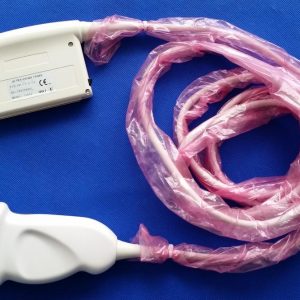
If you are searching for a compatible Siemens Acuson G50 ultrasound probe, the short answer is that replacement transducers for the Sonoline G50 platform come from independent suppliers as refurbished OEM units or third-party compatible alternatives, and the right route depends on the exact model you need and the written evidence a supplier can provide. This guide lists the transducers most often requested for G50 installations, separates catalogue listings from real compatibility evidence, and gives a sourcing workflow to run before issuing a purchase order.
Sourcing options for a G50 transducer
The G50 is a discontinued general-imaging platform, so new OEM transducers are no longer the normal supply channel. Buyers typically choose among four routes:
| Option | What it is | Evidence to request before buying |
|---|---|---|
| Refurbished OEM transducer | An original Siemens/Acuson probe inspected and reconditioned by an independent supplier | Model and serial number, connector photos, recent image-quality or element-test documentation, stated condition |
| Compatible aftermarket transducer | A third-party probe built to operate with the G50; not manufactured or endorsed by Siemens | Written host-system compatibility statement naming the Sonoline/Acuson G50, plus return terms if it fails on your system |
| Repair of your existing probe | Your current transducer is diagnosed and repaired (cable, elements, lens, housing, connector) | Written fault assessment, repair scope, and post-repair test documentation |
| Unit from a decommissioned system | A probe recovered with a retired G50 | The same item-specific evidence as a refurbished unit; removal from a working system proves nothing about current condition |
Probe models commonly supplied for the G50
Because the G50 is a shared-service system, its transducer set is broader than the cardiovascular systems of the same generation. Treat this table as a shortlist, not proof of fit: confirm the exact model against the part number on your current probe and your system’s configuration before ordering.
| Model | Array type | Primary clinical use | Frequency band |
|---|---|---|---|
| 3.5C40S | Curved (convex) array | General abdominal, OB | 3.5 MHz-centered |
| C6F3 | Curved (convex) array | Abdominal, OB/GYN, multi-frequency work | approx. 2.5–6 MHz |
| 7.5L40 | Linear array | Small parts, thyroid, superficial structures | 7.5 MHz-centered |
| VF10-5 | Linear array | Vascular, carotid, small parts | 5–10 MHz |
| P4-2 | Phased (sector) array | Cardiac, transcranial and deep abdominal windows | Confirm exact band in writing |
| EC9-4 | Endocavity curved array | Transvaginal and transrectal imaging | Confirm exact band in writing |
Convex probes: 3.5C40S and C6F3
The 3.5C40S is the routine abdominal and obstetric workhorse for the platform, centered around 3.5 MHz for deeper penetration. The C6F3 covers a wider multi-frequency band (approximately 2.5–6 MHz), which suits departments that want one convex probe for mixed abdominal and OB/GYN lists. When requesting either model, quote the full string including suffixes, because similar Sonoline-era convex models exist with different connectors and system mappings.
Linear probes: 7.5L40 and VF10-5
The 7.5L40 handles thyroid, breast, musculoskeletal and other superficial work at a 7.5 MHz-centered band. The VF10-5 is the wider-band vascular option (5–10 MHz) used for carotid and peripheral vascular studies as well as small parts. If your workload is primarily vascular, ask the supplier to state in writing which bandwidth variant is being offered, since linear models of this era are easy to confuse by name alone.
Cardiac and endocavity probes: P4-2 and EC9-4
The P4-2 phased array provides the sector format needed for cardiac windows. The EC9-4 endocavity probe supports transvaginal and transrectal examinations and is one of the most frequently replaced G50 transducers because of its handling and reprocessing load. For endocavity probes, reprocessing must follow recognized guidance such as the CDC recommendations for disinfection and sterilization of healthcare equipment, which classify endocavity transducers as semi-critical devices requiring at least high-level disinfection between patients. If a biopsy guide is used with the EC9-4, the guide, probe, procedure, and reprocessing records must all refer to the same model combination; do not assume a guide fits because the probe name is similar.
Catalogue listings versus item-specific evidence
A product listing that mentions the G50, or a photo showing a familiar connector, does not prove that a specific unit will work on your system. Compatibility depends on the exact probe model, connector, and your system’s software option configuration. A BMUS multicentre survey of probe condition in clinical practice found that a substantial share of transducers in routine use had defects affecting image quality, which is why cosmetic appearance and a power-on check are not enough. The AIUM’s official statement on transducer testing and repair likewise recommends documented functional testing rather than visual inspection alone. Ask for recent, item-specific test documentation tied to the serial number of the unit being offered.
Step-by-step sourcing workflow
- Record the full model string and part number from your existing probe’s label, plus your system’s software version and installed options.
- Decide whether you need a refurbished OEM unit, a compatible aftermarket probe, or a repair of the probe you already own.
- Shortlist suppliers and request written confirmation that the offered unit supports the Sonoline/Acuson G50 specifically.
- Request item-specific evidence: serial number, connector photos, and recent image-quality or element-test results for the actual unit.
- Confirm commercial terms in writing: price, condition, warranty scope, return terms if the probe fails on your system, and delivery timing.
- On receipt, verify the probe on your system before accepting it, and keep the documentation with the asset record.
Common mistakes when buying G50 probes
- Ordering by system name only, without the exact probe model and part number from the existing unit.
- Treating a connector photo or a similar model name as proof of compatibility.
- Accepting a probe with no serial-number-linked test documentation, then discovering element dropouts during the first clinic.
- Assuming a third-party compatible probe is manufactured or endorsed by Siemens; it is not.
- For endocavity probes, pairing the EC9-4 with a biopsy guide whose stated fit list does not include that exact probe model.
Commercial next step
You can browse current availability in the ultrasound probe catalogue and open the individual model pages linked above for the 3.5C40S, C6F3, 7.5L40, VF10-5, P4-2, and EC9-4. If repair is the better route for your existing transducer, see the probe repair service. For a structured way to compare suppliers before you commit, our guide on evaluating ultrasound probe supplier evidence lists the documents worth requesting. Availability, condition, and pricing vary by unit, so confirm all three in writing for the specific serial number offered.
Frequently asked questions
Which probes are compatible with the Siemens Acuson G50?
The Sonoline-platform transducers most commonly supplied for the G50 include the 3.5C40S and C6F3 convex probes, the 7.5L40 and VF10-5 linear probes, the P4-2 phased array, and the EC9-4 endocavity probe. Confirm the exact model and part number against your system’s configuration in writing before ordering.
Does a connector photo prove a probe will work on my G50?
No. A matching connector shows physical fit only. Compatibility also depends on the exact probe model and your system’s software option configuration, so request a written compatibility statement naming the Sonoline/Acuson G50 and item-specific test documentation for the unit offered.
Is a third-party compatible probe made by Siemens?
No. A third-party compatible probe is an independently manufactured transducer built to operate with the system; it is not manufactured or endorsed by Siemens. Ask the supplier to state this clearly and to provide written compatibility and return terms.
What should I ask a supplier before ordering a G50 probe?
Ask for the full model and serial number, connector photos, recent image-quality or element-test documentation for the actual unit, a written statement that it supports the Sonoline/Acuson G50, and written confirmation of price, condition, warranty scope, and return terms if it fails on your system.
Sources
- AIUM official statement: Transducer Testing and Repair — recommends documented functional testing of transducers rather than visual inspection alone.
- BMUS multicentre survey of ultrasound probe condition — found defects affecting image quality in a notable share of probes in routine clinical use.
- CDC: Disinfection and Sterilization of Healthcare Equipment — classifies endocavity transducers as semi-critical devices requiring at least high-level disinfection between patients.