
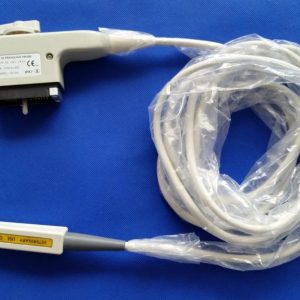
The Siemens Acuson X700 runs X-family transducers and, unusually for a mid-range console, shares several probe models with the premium S1000/S2000/S3000 series. The routinely needed models — VF12-4 and VF16-5 linear, C6F2 and C8F3 convex, EC9-4w and EV9F3 endocavity, the CW2 pencil probe, and the V5Ms TEE — are all available as new aftermarket-compatible units at roughly 40–70% below new OEM pricing. This guide sets out the full compatibility table, the crossover with other Siemens consoles, and when repair beats replacement.
Transducers compatible with the Siemens Acuson X700
| Probe model | Array type | Frequency band | Typical applications | Also fits |
|---|---|---|---|---|
| VF12-4 | Linear | 4–12 MHz | Vascular, small parts, MSK, breast, thyroid | Acuson X600, Acuson NX3 |
| VF16-5 | Linear | 5–16 MHz | High-resolution MSK, superficial structures, nerve | Acuson X700 dedicated |
| C6F2 | Convex | 2–6 MHz | Abdominal, obstetrics, general imaging | Acuson X600 |
| C8F3 | Convex | 3–8 MHz | Pediatric and higher-resolution abdominal | Acuson X600, Acuson NX2 |
| EC9-4w | Endocavity | 4–9 MHz | Transvaginal and transrectal imaging | Acuson X600 |
| EV9F3 | Endocavity | 3–9 MHz | Transvaginal OB/GYN | Acuson X600 |
| CW2 | Pencil / CW Doppler | 2 MHz | Continuous-wave cardiac Doppler | Acuson X300, S1000, S2000, S3000, SC2000 |
| V5Ms | TEE | Multiplane | Transesophageal echocardiography | S1000, S2000, S3000, SC2000, Sequoia 512 |
The CW2 and V5Ms illustrate the X700’s position in the Siemens lineup: both also serve the premium S family, so hospitals running mixed fleets can hold one spare against several consoles. The complete brand range is on the Siemens Acuson probe catalog.
Sourcing options now the X700 is off the current price list
As the X700 ages out of Siemens’ active portfolio, new OEM transducers become harder and more expensive to obtain through official channels, and much of what circulates is used stock of uncertain history. Bench-testing used probes routinely reveals weak or dead elements that a visual inspection cannot catch.
New aftermarket-compatible probes avoid that uncertainty. Each unit is newly built to the OEM connector and acoustic specification, tested for electrical safety and per-element performance before dispatch, and covered by a written warranty. Pricing typically lands 40–70% below new OEM equivalents — a significant figure on a TEE probe, where OEM replacement cost can approach the residual value of the console itself.
Repair or replace a failing X700 probe?
Choose repair for cable and strain-relief damage, connector faults, lens wear or delamination, and a small number of weak elements. Typical cost is 30–60% of a replacement probe, with a 5–10 working day turnaround including post-repair verification. TEE probes are a special case — bite damage to the insertion tube and articulation faults on the V5Ms are established repair procedures and far cheaper than replacement. See the probe repair service for scope and process.
Choose replacement for cracked arrays, fluid ingress, or element dropout spread across the aperture. On high-density probes like the VF16-5, degraded elements translate directly into lost near-field resolution — the very reason the probe was purchased.
When the fault is ambiguous, commission an evaluation first; a per-element report costs little and settles the question with data.
One pattern worth planning around: the endocavity models (EC9-4w, EV9F3) fail earlier than the rest of the fleet because they pass through high-level disinfection after every examination. Chemical attack on the lens and membrane is the usual route, and it is repairable if the probe is pulled from service before fluid reaches the array. A quarterly visual check of lens condition across the department costs nothing and routinely converts what would have been replacements into repairs.
Ordering checklist
Before requesting a quotation, note the exact model from the connector label, the console designation (Acuson X700), and the installed software version if accessible. Ask the supplier for unit-specific documentation: electrical safety certificate, per-element acoustic test, and photographs of the actual serial number you will receive. Written warranty terms separate genuinely new compatible stock from refurbished units sold under vague descriptions.
All eight models in the table are quoted individually through their product pages, with test evidence supplied before shipment. If your model is not listed — the X700 range includes further variants — send the connector label details and availability is normally confirmed within one working day.
Siemens X700 ultrasound probes: current evidence update
Answer first: A Siemens X700 ultrasound probes request should preserve the complete probe and host-system labels, connector photographs, supply path, current condition, item-specific photos, named test scope and written compatibility basis. A catalogue record is a shortlist; it does not prove the condition or support of every revision.
| Field | Evidence | Control |
|---|---|---|
| Probe identity | Brand, full model, suffix and label | Keep this field tied to the exact Siemens X700 ultrasound probes request. |
| Host system | Console model and configuration context | Keep this field tied to the exact Siemens X700 ultrasound probes request. |
| Connector | Contact face, housing, latch and cable entry | Keep this field tied to the exact Siemens X700 ultrasound probes request. |
| Offer type | OEM-brand, compatible, used, refurbished or repair | Keep this field tied to the exact Siemens X700 ultrasound probes request. |
| Condition | Current lens, housing, cable and connector photos | Keep this field tied to the exact Siemens X700 ultrasound probes request. |
| Test evidence | Named checks, conditions, result format and exclusions | Keep this field tied to the exact Siemens X700 ultrasound probes request. |
Why this page is different from a product listing
The article explains how to evaluate the request and routes readers to current catalogue records. A product or category page owns the commercial inventory intent. This article should not compete by repeating a long list of unverified models; it adds decision evidence, limitations and an RFQ workflow that a product card cannot provide.
Model and configuration boundaries
For repair, describe what appears, when it appears and whether movement changes the symptom; do not assign an internal cause remotely. For purchase, ask the quotation to identify the offered item, current condition and availability at the time of the request.
Keep general documentation separate from item-level proof. A source can explain terminology or testing boundaries, while the physical label, current photos, inspection record and quotation establish facts about the exact item. Mark unresolved fields pending instead of copying a specification or compatibility statement from a similar model.
Four-step review
- Capture complete labels and all relevant physical interfaces.
- Check the exact current document or written match basis.
- Separate catalogue discovery from item condition and test evidence.
- Approve only a quotation that repeats the identity, scope, exclusions and terms.
Related catalogue and service links
Frequently asked questions
Does the model phrase alone prove the correct Siemens X700 ultrasound probes?
No. Verify the complete labels, physical interface and current configuration-specific evidence.
Can a catalogue image prove condition?
No. Request current photos tied to the quoted item or service record.
What should the written quote identify?
Exact identity, compatibility basis, condition, evidence, included items, availability basis, shipping responsibility and remedy terms.
Sources
Evidence update checked 3 August 2026. Use current exact documentation for the device and jurisdiction involved.