
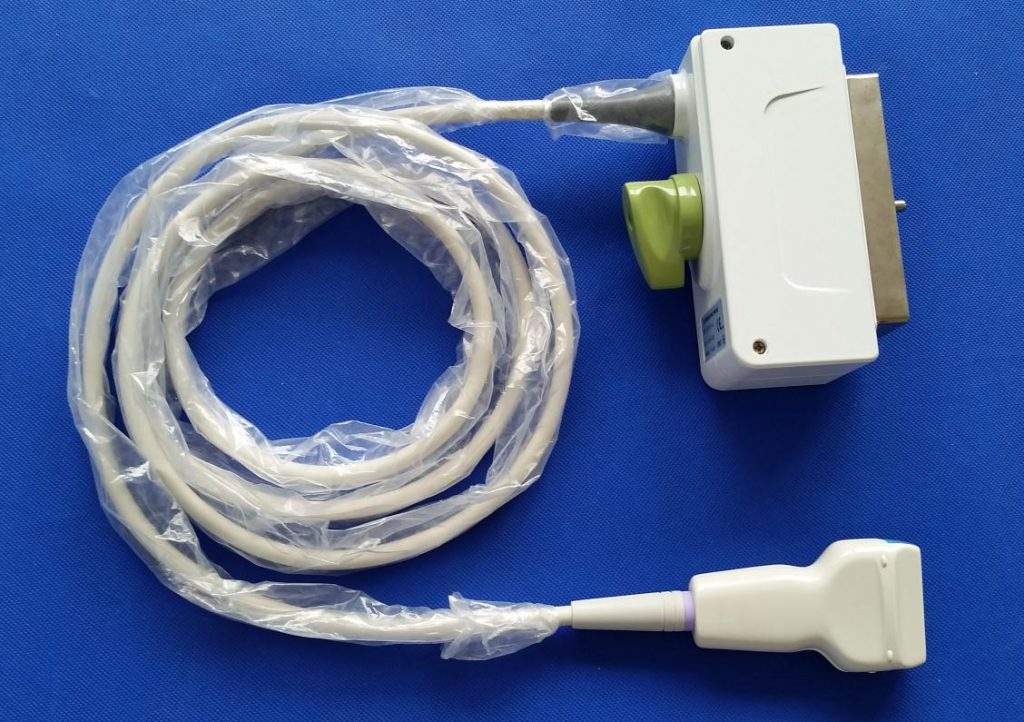
Compatible probes for the Siemens Acuson Sequoia are sold by independent suppliers as tested compatible and refurbished units, typically at 40–70% below OEM pricing. The first step is identifying which Sequoia you own: the classic Sequoia 512/C256 platform from the late 1990s and 2000s, or the current Sequoia platform Siemens launched in 2018. The two use entirely different transducer families, and a probe for one will not connect to the other. This guide covers both, with the full classic-Sequoia model table.
Classic Sequoia 512 / C256 Probe Models
The classic Sequoia was Siemens’ premium shared-service system for over a decade, and many units remain in clinical use. Its transducer family (frequency bands per Siemens model naming):
| Model | Array Type | Frequency Band | Primary Applications |
|---|---|---|---|
| 4C1 | Convex | 1–4 MHz | Abdominal, OB/GYN |
| 6C2 | Convex | 2–6 MHz | Abdominal, renal |
| 8C4 | Convex | 4–8 MHz | Pediatric abdomen |
| 15L8 | Linear | 8–15 MHz | Breast, MSK, small parts |
| 8L5 | Linear | 5–8 MHz | Vascular, carotid |
| 3V2c | Phased | 2–3 MHz | Adult cardiac |
| 7V3c | Phased | 3–7 MHz | Pediatric cardiac |
| 8V5c | Phased | 5–8 MHz | Neonatal cardiac |
| 10V4c | Phased | 4–10 MHz | Pediatric and neonatal cardiac |
| EC10C5 | Endocavity | 5–10 MHz | Transvaginal, transrectal |
| V5M | TEE | Multiplane | Transesophageal echo |
| 4CW / 8CW | Pencil CW | 4 / 8 MHz | Continuous-wave Doppler |
The lowercase “c” suffix on the cardiac models (3V2c, 7V3c, 8V5c, 10V4c) is part of the model designation — quote it exactly, because Siemens used similar numbering on other platforms with different connectors.
The 2018 Sequoia Is a Different Platform
The current Sequoia introduced a new transducer generation, including the DAX deep abdominal transducer, which Siemens specifies for imaging at depths beyond 40 cm in high-BMI patients, alongside new convex, linear, and phased models. None of these connect to a classic Sequoia 512, and classic probes do not connect to the new console. Check the console itself: the 512/C256 is a large CRT-era cart, while the 2018 platform has a modern flat touchscreen control panel. If you are unsure, send us the system serial number and we will identify the platform before you order anything.
Sourcing Probes for a Discontinued Platform
The classic Sequoia has been out of production since around 2010, and Siemens ended OEM support for it years ago. That leaves three supply channels: tested compatible probes built for the Sequoia interface, refurbished OEM probes recovered from decommissioned systems, and repair of your existing unit. Compatible and refurbished units typically price 40–70% below the last OEM figures. Because remaining classic-Sequoia probes are all aging stock, testing documentation matters more here than on newer platforms — require an element-by-element acoustic report with the probe, not just photographs. Units we supply are verified on a live system before shipment and covered by warranty.
When you inspect an incoming Sequoia-era probe yourself, three quick checks catch most problems. Flex the cable gently along its length while scanning a uniform target; flickering or banding indicates broken conductors. Examine the lens for cuts, bubbles, or separation at the edges, which admit gel and fluid into the acoustic stack. Finally, run a simple uniformity check by sweeping a thin reflective object across the face of the array — a dark vertical band that follows one spot on the lens marks dead elements at that position. Any of these findings on arrival is grounds to invoke the warranty immediately rather than putting the probe into clinical rotation.
Repair or Replace an Aging Sequoia Probe?
Repair first, in most cases. Typical failures on these probes — cable fatigue near the strain relief, worn lenses, cracked housings, and scattered dead elements — are repairable at 30–60% below the cost of a replacement, with a 5–10 business day turnaround. Replacement is justified when element dropout is widespread across the array or the acoustic stack is delaminating, since those conditions make repair uneconomical. Given the finite supply of classic Sequoia transducers, many facilities repair the failed unit and buy one tested spare, which covers them until the eventual console replacement. Start with a free evaluation through our probe repair service, and see current Sequoia-compatible stock in the Siemens Acuson catalog.
Evidence boundary and verification record
For Compatible Siemens Acuson Sequoia Probes: Model Guide, a platform-level probe list helps create a shortlist but does not prove that every listed item fits every console revision. Record the full system and probe labels, connector views and the supplier’s written match basis, then attach item-specific condition and verification evidence to the quotation. When the original item is unavailable, state that the search begins from a requirement rather than pretending that a replacement model has already been identified.
Evidence matrix
| Field | What to collect | Why it matters |
|---|---|---|
| System identity | Complete console label and available configuration | Defines the exact platform request |
| Probe identity | Full model, connector and intended array class | Separates candidates from confirmed matches |
| Offered item | Current photos, condition and named verification scope | Connects evidence to one physical unit |
| Quotation | Compatibility basis, exclusions, availability and remedy | States what the supplier commits to |
Use the same matrix for every provider. Mark an unknown field pending instead of borrowing a specification, compatibility statement or condition claim from a similar model. The final record should identify the offered item, the source for each fact and the date on which availability and commercial terms were checked.
AIUM’s official statement supports regular assessment of transducer operation and quality control after repair. The BMUS multicentre survey provides fleet-level evidence that ultrasound probes can have faults requiring structured checks. These sources support the evidence boundary used for Compatible Siemens Acuson Sequoia Probes: Model Guide; they do not prove compatibility, current stock or condition for an unidentified item.
Primary sources and limits
- AIUM transducer testing and repair statement — professional guidance on transducer assessment and post-repair quality control.
- CDC healthcare-equipment disinfection and sterilization guidance — a processing framework tied to device use and instructions.
- BMUS multicentre probe-condition survey — published fleet research, not an item-level diagnosis.
Evidence questions
Does this evidence prove the exact compatibility described in Compatible Siemens Acuson Sequoia Probes: Model Guide?
No. It defines what should be collected and reviewed. Exact compatibility remains tied to the complete labels, configuration, current documentation and written item-specific decision.
Can the commercial terms for Compatible Siemens Acuson Sequoia Probes: Model Guide be assumed from this article?
No. Availability, condition, included work, timing, logistics, exclusions and remedy must be confirmed in the current quotation for the exact request.