
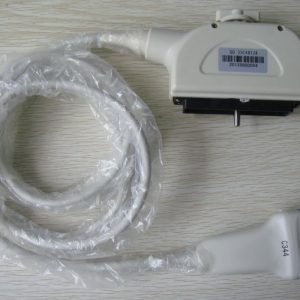
Independent suppliers may offer Sonosite MicroMaxx probes as refurbished OEM units or third-party compatible transducers. The MicroMaxx uses its own transducer generation, including models such as C60e/5-2, L38/10-5, and P17/5-1. A third-party compatible probe is not represented as manufactured or endorsed by Sonosite. Use the model table as a sourcing shortlist, then confirm the exact part number, connector, price, and current availability in writing before ordering.
Sonosite MicroMaxx Compatible Probe List
MicroMaxx transducers are identified by model designations without the “x” suffix used by the later M-Turbo generation. An L25x or C60x should not be ordered for a MicroMaxx solely because the base model name looks similar. Some listings also reference Titan compatibility, but the label, part number, connector, and target console must all be matched for the individual unit.
| Model | Type | Primary applications | Frequency range |
|---|---|---|---|
| C60e/5-2 | Convex | Abdominal, OB/GYN | 2–5 MHz |
| C15/4-2 | Convex | Cardiac, deep abdominal | 2–4 MHz |
| C11/8-5 | Micro-convex | Pediatric, vascular | 5–8 MHz |
| C8/8-5 | Endocavity | Transrectal, prostate | 5–8 MHz |
| ICT/8-5 | Endocavity | Transvaginal OB/GYN | 5–8 MHz |
| L25/10-5 | Linear | Vascular access, superficial | 5–10 MHz |
| HFL38/13-6 | Linear | Nerve, breast, small parts | 6–13 MHz |
| SLA/13-6 | Linear (compact) | Intraoperative, surgical | 6–13 MHz |
| SLT/10-5 | Linear (compact) | Intraoperative | 5–10 MHz |
| P10/8-4 | Phased array | Pediatric and neonatal cardiac | 4–8 MHz |
| P17/5-1 | Phased array | Adult cardiac, abdominal | 1–5 MHz |
| TEE/8-3 | TEE | Transesophageal echo | 3–8 MHz |
The L38/10-5 general vascular probe and the D2 CW pencil probe are also associated with this generation. The Sonosite transducer catalog separates MicroMaxx, M-Turbo, and Edge listings; treat it as a navigation aid, not as confirmation that a listed unit is currently available or fits a specific console.
What Discontinuation Means for MicroMaxx Owners
MicroMaxx is a legacy platform, so buyers may encounter refurbished OEM units and independently manufactured compatible alternatives. The exact condition, prior service history, commercial terms, and any remaining OEM support vary by unit and region. Compare written quotations and documentation for the exact probe rather than relying on a general price or support claim.
Age-related lens, cable, connector, housing, or imaging problems can occur on legacy probes. Ask the seller to state exactly what inspection was performed and request the available simple inspection report. That report should be read only within its stated scope; it must not be described as a crystal-by-crystal assessment, a regulatory certificate, or a guarantee of future service life. Endocavity devices also require the buyer to verify the applicable facility safety and reprocessing requirements before use.
If your MicroMaxx console itself is failing, weigh the total position before buying more probes: probes hold their value across a system swap poorly here, because the next Sonosite generation up (M-Turbo) cannot use them.
Repair or Replace a MicroMaxx Probe?
For a failed MicroMaxx probe, request a documented evaluation and a written quote from the probe repair service, then compare that scope with a replacement quotation. Cost, feasibility, and turnaround depend on the unit and failure mode; no fixed saving or delivery-time promise is made here.
- Repair favors: a probe you know is acoustically sound — cable damage, connector faults, worn lenses, and cracked housings on a probe whose image quality was good before the failure. Repairing keeps a known-good array in service instead of trading it for an unknown one.
- Replacement review: persistent image degradation, visible damage after a drop, or a repair scope that cannot be supported by the written evaluation may justify comparing replacement options.
- Either way: begin with an inspection whose methods and limits are stated in writing, then make the decision from the documented findings and quotation.
How to Order
Give the supplier the model designation exactly as printed on the probe label, the part number on the connector, a connector photo, and confirmation that the target system is a MicroMaxx or Titan. Ask the quotation to state compatibility, actual availability, inspection scope, the simple report supplied, commercial terms, and expected dispatch timing. Plan clinical backup coverage separately; do not assume that a temporary replacement service is included.
Evidence boundary and verification record
For Compatible Sonosite MicroMaxx Probes: Transducer List and Buying Guide, a platform-level probe list helps create a shortlist but does not prove that every listed item fits every console revision. Record the full system and probe labels, connector views and the supplier’s written match basis, then attach item-specific condition and verification evidence to the quotation. When the original item is unavailable, state that the search begins from a requirement rather than pretending that a replacement model has already been identified.
Evidence matrix
| Field | What to collect | Why it matters |
|---|---|---|
| System identity | Complete console label and available configuration | Defines the exact platform request |
| Probe identity | Full model, connector and intended array class | Separates candidates from confirmed matches |
| Offered item | Current photos, condition and named verification scope | Connects evidence to one physical unit |
| Quotation | Compatibility basis, exclusions, availability and remedy | States what the supplier commits to |
Use the same matrix for every provider. Mark an unknown field pending instead of borrowing a specification, compatibility statement or condition claim from a similar model. The final record should identify the offered item, the source for each fact and the date on which availability and commercial terms were checked.
AIUM’s official statement supports regular assessment of transducer operation and quality control after repair. The BMUS multicentre survey provides fleet-level evidence that ultrasound probes can have faults requiring structured checks. These sources support the evidence boundary used for Compatible Sonosite MicroMaxx Probes: Transducer List and Buying Guide; they do not prove compatibility, current stock or condition for an unidentified item.
Primary sources and limits
- AIUM transducer testing and repair statement — professional guidance on transducer assessment and post-repair quality control.
- CDC healthcare-equipment disinfection and sterilization guidance — a processing framework tied to device use and instructions.
- BMUS multicentre probe-condition survey — published fleet research, not an item-level diagnosis.
Evidence questions
Does this evidence prove the exact compatibility described in Compatible Sonosite MicroMaxx Probes: Transducer List and Buying Guide?
No. It defines what should be collected and reviewed. Exact compatibility remains tied to the complete labels, configuration, current documentation and written item-specific decision.
Can the commercial terms for Compatible Sonosite MicroMaxx Probes: Transducer List and Buying Guide be assumed from this article?
No. Availability, condition, included work, timing, logistics, exclusions and remedy must be confirmed in the current quotation for the exact request.