
Four Reasons to Buy Refurbished Ultrasound Equipment
Four reasons to consider refurbished ultrasound equipment
Refurbished ultrasound equipment can be a sensible procurement route, but only when the condition, compatibility, test evidence, warranty, and return terms are defined for the exact unit. Refurbished, remanufactured, repaired, and used-as-is are not interchangeable descriptions. A supplier should explain what work was performed, what was tested, which accessories and software are included, and which limitations remain.
That distinction corrects a common sales shortcut: a lower price does not by itself prove equivalent image quality, clinical performance, reliability, or regulatory status. Those conclusions require evidence tied to the console or transducer being offered. The four reasons below describe why buyers consider refurbished equipment and the controls that keep each reason commercially sound.
1. Lower acquisition cost without hiding total cost
A previous-generation console or probe may cost less than a current new model because it is further along in its product lifecycle, has prior use, or is available through a secondary market. The useful comparison is not a generic discount percentage. Compare the delivered configuration: console, probes, licenses, options, carts, manuals, accessories, installation, freight, taxes, inspection, warranty, and any service or training needed before use.
Ask for a written condition grade and a list of replaced or repaired parts. For a console, confirm software version, enabled applications, storage media, peripherals, and whether passwords or licenses transfer. For a transducer, request exact photos and a recent test tied to the serial or item being quoted. A lower purchase price is only a saving when the equipment arrives compatible, complete, and usable for the intended workflow.
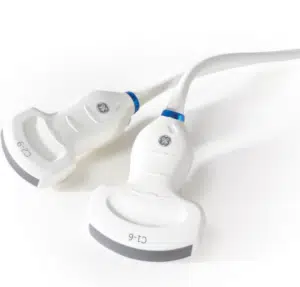
2. Keep a proven platform in service
Many departments already have staff training, presets, accessories, reporting workflows, and service routines built around an installed ultrasound platform. A compatible refurbished console or probe may extend that platform without forcing an immediate change of system family. This can be valuable for a second room, a backup unit, a temporary capacity need, or replacement of a failed probe on a system that still meets the facility’s requirements.
Compatibility must still be checked at release level. A shared brand or connector shape is not enough. Confirm the full model, hardware generation, software release, country configuration, supported transducer list, licensed modes, and any required adapters. Also confirm that parts and qualified service remain available for the expected ownership period. Extending a platform is useful only when supportability is visible rather than assumed.
3. Add capability without overcommitting
A facility evaluating a new application, mobile service, satellite location, teaching environment, or short-term capacity increase may not need a brand-new flagship system. Refurbished equipment can provide a controlled way to add a probe class or console configuration while demand and workflow are being evaluated. The decision should be based on intended use, documented capabilities, clinical governance, and a defined exit or upgrade plan, not simply on the availability of a low-priced machine.
Before purchase, identify the examinations, users, room constraints, network requirements, accessories, cleaning process, and service response the project needs. Verify that the quoted configuration supports them. A trial should not rely on an unsupported probe, missing software option, unverified electrical condition, or uncertain infection-control compatibility. A smaller initial commitment works only when the acceptance criteria are as explicit as they would be for a new system.
4. Choose repair, replacement, or retirement with evidence
Refurbished sourcing adds another option when a probe or console fails: repair the existing unit, replace only the failed component, source a compatible refurbished unit, or retire the platform. The correct choice depends on fault scope, equipment age, support status, clinical need, downtime, available evidence, warranty, and total landed cost. There is no responsible universal claim that repair always costs a fixed fraction of replacement or always finishes within a set number of days.
For a probe decision, document the model and serial number, host system and release, visible condition, image artifact, intermittent behavior, cable and connector state, and any previous repair. For a console, add error logs, software and option status, peripherals, service history, and electrical-safety results. Send those details through the probe repair assessment or compare brand records in the ultrasound probe catalogue.
Before payment, require exact-unit photos, a written functional test or inspection report, compatibility confirmation, included accessories and licenses, cosmetic and functional defect disclosure, warranty duration and exclusions, return conditions, shipping responsibility, and inspection timing after delivery. If a supplier only has a representative image, that should be stated plainly. These controls are what turn a refurbished purchase from a price claim into a defensible procurement decision.
Evidence boundary and verification record
The claims in Four Reasons to Buy Refurbished Ultrasound Equipment should be used as a decision framework, not as a substitute for an exact quotation or device record. Separate manufacturer documentation, observations about a physical item, supplier evidence and commercial terms so readers can see what is established and what remains pending. A second reviewer should reconcile the model characters and every unresolved field before approval.
AIUM and CDC provide authoritative boundaries for transducer assessment and equipment processing, while the BMUS survey supplies published fleet-level condition evidence. They support careful verification in Four Reasons to Buy Refurbished Ultrasound Equipment; they do not establish the condition, compatibility, price or availability of a particular item.
Primary sources and limits
- AIUM transducer testing and repair statement — professional guidance on transducer assessment and post-repair quality control.
- CDC healthcare-equipment disinfection and sterilization guidance — a processing framework tied to device use and instructions.
- BMUS multicentre probe-condition survey — published fleet research, not an item-level diagnosis.
Evidence questions
Does this evidence prove the exact compatibility described in Four Reasons to Buy Refurbished Ultrasound Equipment?
No. It defines what should be collected and reviewed. Exact compatibility remains tied to the complete labels, configuration, current documentation and written item-specific decision.
Can the commercial terms for Four Reasons to Buy Refurbished Ultrasound Equipment be assumed from this article?
No. Availability, condition, included work, timing, logistics, exclusions and remedy must be confirmed in the current quotation for the exact request.