
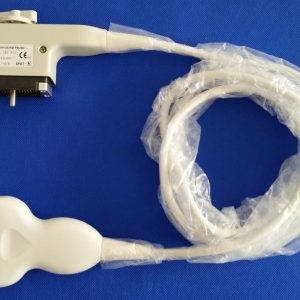
Compatible probes for the United Imaging uMii/iuStar 300 are sourced through China-based supply networks rather than bought at full OEM list price. If you need a replacement transducer for this platform, send us the probe model number and connector type from your current head, and we quote against matching inventory. There is no fixed price list because the right probe — and its cost — depends on the exact array, frequency and connector your system uses.
United Imaging systems are common in the Chinese market and increasingly seen elsewhere, but their probes are rarely stocked on general ultrasound marketplaces. That is why model-based sourcing from the source region is usually the fastest route to a working replacement.
Identifying the probe you need
A biomedical engineer or purchasing lead can pull together everything a supplier needs in a couple of minutes. Have these ready before requesting a quote:
- Model number — printed on the transducer body or the connector collar.
- Array type — convex for abdominal and OB scans, linear for small parts and vascular, phased array for cardiac.
- Frequency band — convex heads commonly sit around 2–5 MHz, linear heads around 5–12 MHz.
- Connector format — this determines whether a probe will physically and electrically mate with your console.
Sourcing a compatible transducer this way typically comes in 40–70% below the OEM price for an equivalent head, without giving up the array specification the clinical application requires.
Repair or replace?
Before ordering a new probe, it is worth checking whether the failed one can be repaired. Cracked lenses, delaminated matching layers, damaged strain reliefs and a limited number of dead elements are frequently fixable. A repair generally costs about 30–60% of a like-for-like replacement, with a turnaround of roughly 5–10 working days.
Replacement is the better call when the array is shattered, a large fraction of elements are dead, or fluid has entered the acoustic stack. Tell us the symptom — dropout lines, complete image loss, or an intermittent connection — and we will advise which route is more economical. Our probe repair service covers the common failure modes.
Acceptance testing a compatible probe
When a compatible or repaired probe arrives, run a short check before clinical use:
- Seat the probe and confirm the console recognises it with no error.
- Scan a uniform phantom and look for vertical dropout lines that signal dead elements.
- Check that near-field and far-field brightness is even.
- Flex the cable at the strain relief while scanning to catch an intermittent break.
These steps catch the faults that most affect image quality and take only a few minutes to complete.
Why compatible probes make sense on regional platforms
For systems that are not backed by a dense local service network, keeping a probe running through OEM channels can mean long lead times and premium pricing. A compatible transducer sourced from the manufacturing region closes that gap: the same array geometry and frequency, matched to your connector, at a fraction of the OEM cost. For a busy department, that difference in lead time and price is often what keeps a room in service instead of idle.
Requesting a quote for less-common systems
Because United Imaging probes are not widely carried, we supply them from our China source network based on the exact model you send, not from a fixed catalogue. The same model-based approach lets us support mainstream platforms too — see our Philips-compatible probe range for a sense of how the sourcing works across brands.
To get a quote, read the model number and connector off your existing probe, note the clinical application, and send those details over. A photo of the connector and label speeds up matching. Message us on WhatsApp at +86 136 2236 3037 or use our contact page with your iuStar 300 probe model, and we confirm compatibility and pricing before you commit.
Evidence boundary and verification record
For Compatible United Imaging iuStar 300 Probe, the complete label, connector, host-system record and physical item must remain linked. Similar model stems can describe different probes, and representative photographs do not establish the condition of a used or refurbished unit. Keep discovery, item and commercial evidence in separate rows. Date the source check so later changes in documents or availability do not silently alter the decision.
Evidence matrix
| Field | What to collect | Why it matters |
|---|---|---|
| Exact identity | Full probe and system labels with connector views | Prevents nearby models from being merged |
| Condition | Current lens, housing, cable, strain-relief and connector evidence | Documents the offered or existing unit |
| Verification | Named checks, item reference, date and result format | Replaces a broad quality label |
| Terms | Offer type, availability check, exclusions, logistics and remedy | Defines the commercial boundary |
Use the same matrix for every provider. Mark an unknown field pending instead of borrowing a specification, compatibility statement or condition claim from a similar model. The final record should identify the offered item, the source for each fact and the date on which availability and commercial terms were checked.
AIUM describes why transducer operation and repair quality control require structured assessment. The published BMUS multicentre survey supports documenting physical and performance condition across a probe fleet. Applied to Compatible United Imaging iuStar 300 Probe, these sources justify item-level checks but do not diagnose a probe or establish a system match remotely.
Primary sources and limits
- AIUM transducer testing and repair statement — professional guidance on transducer assessment and post-repair quality control.
- CDC healthcare-equipment disinfection and sterilization guidance — a processing framework tied to device use and instructions.
- BMUS multicentre probe-condition survey — published fleet research, not an item-level diagnosis.
Evidence questions
Does this evidence prove the exact compatibility described in Compatible United Imaging iuStar 300 Probe?
No. It defines what should be collected and reviewed. Exact compatibility remains tied to the complete labels, configuration, current documentation and written item-specific decision.
Can the commercial terms for Compatible United Imaging iuStar 300 Probe be assumed from this article?
No. Availability, condition, included work, timing, logistics, exclusions and remedy must be confirmed in the current quotation for the exact request.