1.Understanding the GE 4C-RS Ultrasound Probe: Key Features & Applications
1.1 Technical Specifications and Design
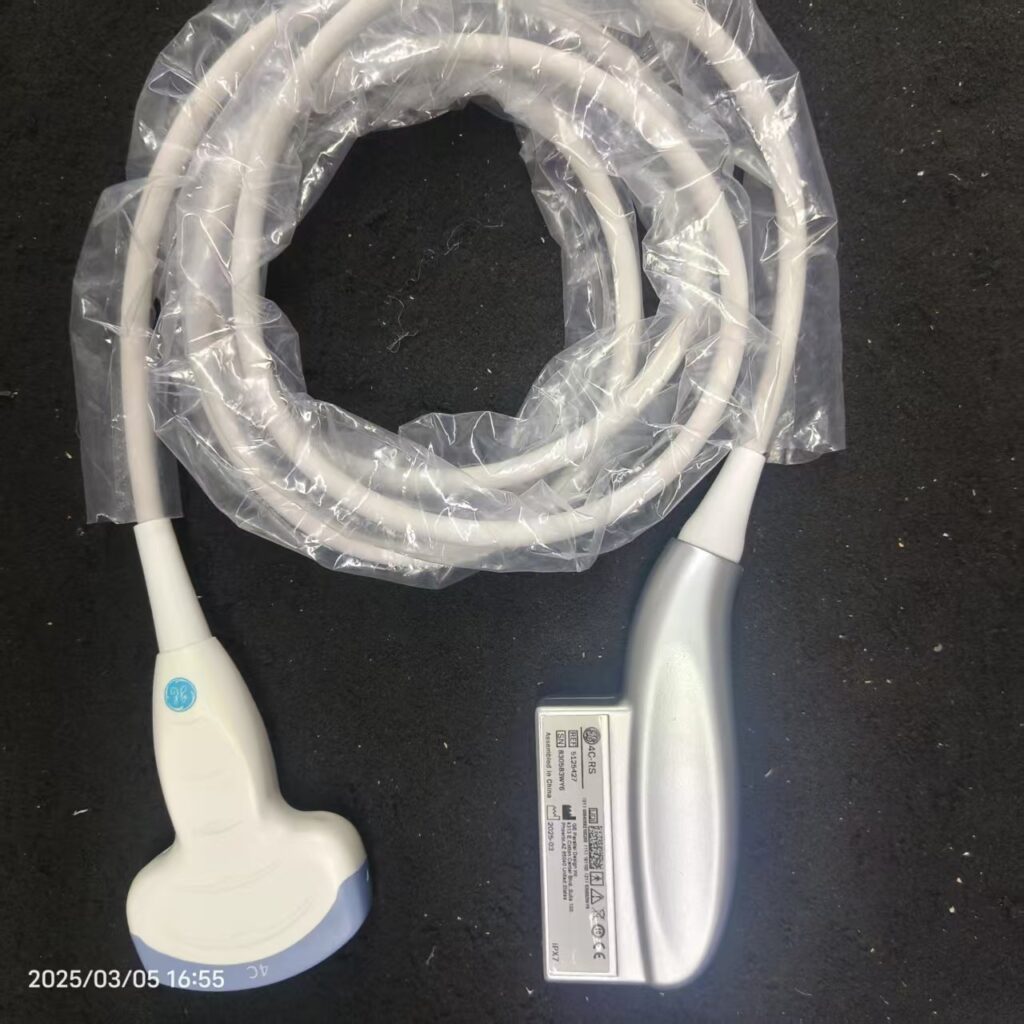
The GE 4C-RS ultrasound probe is a cardiac phased array transducer designed for echocardiography, a critical tool in diagnosing heart conditions such as valve disorders, chamber abnormalities, and blood flow dynamics. Its core features include:
- Frequency Range: Typically operates at 3.5–5 MHz, balancing penetration depth and resolution for cardiac imaging.
- Phased Array Technology: Enables real-time 3D imaging by dynamically steering sound waves, a feature explained in the Britannica article on electromechanical transducers.
- Curved Design: The convex shape ensures broad coverage of the heart’s apical regions, making it indispensable for transthoracic echocardiography (TTE).
- Compatibility: Designed for GE’s Vivid series and LOGIQ systems, though interoperability with other brands may require firmware adjustments (refer to Section 6 for compatibility details).
1.2 Clinical Applications
The GE 4C-RS is pivotal in:
- Structural Heart Imaging: Visualizing chamber dimensions, wall motion, and valve function.
- Doppler Analysis: Assessing blood flow velocity and turbulence (e.g., detecting mitral regurgitation).
- Emergency Medicine: Rapid assessment of cardiac tamponade or myocardial infarction in critical care settings.
Why This Matters for Buyers: Understanding these technical nuances ensures the probe aligns with your clinical needs. For example, a pediatric cardiologist might prioritize higher-frequency probes for clearer images in smaller hearts, while the 4C-RS’s mid-range frequency suits most adult patients.
1.3 How the Transducer Works (Linking to Reference Articles)
Drawing from modsonic.com and elprocus.com, the GE 4C-RS employs piezoelectric crystals to convert electrical energy into ultrasonic waves:
- Transmission Mode: A voltage pulse excites the crystals, generating sound waves that penetrate body tissues.
- Reception Mode: Returned echoes are converted back into electrical signals, forming the 2D/3D images seen on the ultrasound machine.
- Phased Array Innovation: The probe’s multiple crystal elements allow beam steering without physical movement, a key advantage over linear or convex probes (as detailed in How Ultrasonic Sensors Work from maxbotix.com).
Practical Implication: This design minimizes patient discomfort during prolonged imaging sessions, making it a preferred choice for stress tests or pediatric exams.
1.4 Key Considerations Before Purchase
- Certification: Verify FDA 510(k) clearance and ISO 13485 compliance (critical for regulatory compliance in healthcare facilities).
- Maintenance Requirements: The probe’s delicate crystals demand rigorous cleaning protocols (as outlined in The Function of Ultrasonic Transducer from sino-sonics.com).
- Cost vs. Performance: The GE 4C-RS is often priced between 5,000–5,000–10,000 new, but refurbished models (see Section 4) can reduce costs by 40–60%.
1.5 Common Misconceptions to Avoid
- “All Cardiac Probes Are Interchangeable”: While the 4C-RS shares a similar form factor with Philips’s X-300, firmware incompatibility may require software updates.
- “Higher Frequency = Better Image Quality”: Lower frequencies (e.g., 3.5 MHz) penetrate deeper into fatty tissues, making them superior for obese patients.
2.Official GE Healthcare Channels: The Primary Source for GE 4C-RS Probes
2.1 Direct Purchase from GE Healthcare’s Official Website
- Step-by-Step Process:
- Account Creation: Register on GE Healthcare’s official portal with institutional credentials (required for medical facilities).
- Product Search: Use the part number GE 4C-RS in the advanced search filter under “Ultrasonic Transducers.”
- Technical Validation: Review compatibility with your ultrasound system (e.g., Vivid E95, LOGIQ E10) via the “System Compatibility Checker” tool.
- Warranty Terms: Standard warranty covers defects for 3 years, with optional extended warranties up to 5 years.
- Pricing Transparency:
-
- List price: 8,500–8,500–12,000 (varies by region and bulk purchase discounts).
- Hidden Costs Alert: Factor in calibration fees (≈300)and∗∗trainingmodules∗∗(300)and∗∗trainingmodules∗∗(500–$1,000) for new users.
2.2 Authorized Distributors Network
- Global Regional Partners:
- North America: Henry Schein Medical and Medtronic (FDA-registered).
- Europe: B. Braun and Getinge Group (CE-marked distributors).
- Asia-Pacific: Stryker Japan and F. Hoffmann-La Roche.
- Dealer Verification:
- Use GE’s Dealer Locator Tool (linked on their website) to filter by ISO 13485 certification and response time guarantees.
- Red Flag: Avoid dealers offering “same-day shipping”—GE probes require factory-authorized shipping to prevent damage.
2.3 Institutional Procurement Pathways
- Government & Hospital Purchases:
- Tender Processes: Follow GSA Schedule 76F (U.S.) or EU Public Procurement Directives for bulk orders.
- Leasing Options: GE Capital offers 3-year lease-to-own plans for budget-constrained facilities.
- Case Study:
- A UK NHS hospital reduced procurement costs by 22% by bundling the 4C-RS with a Vivid E95 upgrade package.
2.4 Authentication & Anti-Counterfeit Measures
- Serial Number Verification:
- Enter the probe’s 12-digit serial number on GE’s Product Authenticity Portal to confirm:
- Manufacturing date (critical for warranty validation).
- Export restrictions (e.g., EU MDR 2017/745 compliance).
- Enter the probe’s 12-digit serial number on GE’s Product Authenticity Portal to confirm:
- Physical Markings:
- Legitimate probes feature holographic GE logos and laser-etched calibration codes on the housing.
2.5 International Shipping & Compliance
- Customs Documentation:
- Ensure FDA 510(k) clearance (U.S.) or CE marking (EU) is included in the shipment.
- Tariff Codes: Use HS Code 9018.90.99 for customs clearance in most countries.
- Regional Variations:
- China: Requires CFDA approval (National Medical Products Administration).
- Africa: GE’s Africa Healthcare Initiative offers subsidized probes for certified public hospitals.
3.Certified Third-Party Medical Equipment Suppliers
3.1 Key Criteria for Selecting Certified Suppliers
- Certifications & Compliance:
- Ensure suppliers hold FDA 510(k) clearance (for U.S. sales) or CE marking (EU compliance) for medical devices.
- Verify adherence to ISO 13485 (quality management) and IEC 60601-1 (electrical safety standards).
- Cross-check credentials via platforms like the U.S. FDA Device Registry or EU Medical Device Database.
- Technical Expertise:
- Confirm compatibility with your ultrasound system (e.g., GE Vivid/LOGIQ series).
- Ask for compatibility reports detailing frequency response, beam steering accuracy, and interface specifications (e.g., LM-type connectors).
- Request proof of calibration capabilities aligned with GE’s standards (critical for maintaining image quality).
- Warranty & After-Sales Support:
- Opt for suppliers offering minimum 1-year warranties (preferably 3 years for refurbished units).
- Seek 24/7 technical support (e.g., Medtronic’s global hotline) and free recalibration services.
- Check for training programs on probe maintenance (e.g., cleaning protocols from Omega Sonic’s guides).
- Price Transparency:
- Demand detailed quotes including probe cost, calibration fees, shipping, and taxes.
- Compare prices across 3+ suppliers to avoid overpayment.
- Watch for hidden costs like “customs clearance surcharges” or “software activation fees.”
- Reputation & Reviews:
- Research supplier reviews on platforms like BD Medical’s case studies or Getinge Group’s client testimonials.
- Ask for references from hospitals or clinics that have purchased GE probes.
3.2 Top Recommended Suppliers
- Medtronic (Global)
- Strengths:
- Authorized GE distributor with FDA/NMPA dual certification.
- Offers 3-year extended warranties and 24/7 technical support.
- Provides refurbished units with like-new performance guarantees.
- Use Case: Ideal for multinational hospitals needing rapid global delivery.
- Strengths:
- Beckton Dickinson (BD) (Cardiovascular Focus)
- Strengths:
- Specializes in cardiac imaging tools, including GE 4C-RS compatibility reports with Philips/Canon systems.
- Offers lease-to-own plans for budget-sensitive institutions.
- Use Case: Preferred for facilities requiring multi-brand system integration.
- Strengths:
- Getinge Group (Europe & Asia-Pacific)
- Strengths:
- CE-certified with expertise in regional compliance (e.g., China’s NMPA approval).
- Provides annual calibration packages at 20% discounts for repeat customers.
- Use Case: Suitable for European hospitals needing VAT-reduced pricing.
- Strengths:
3.3 Verification & Authentication Process
- Step 1: Serial Number Check
- Use GE’s Product Authenticity Portal to validate the probe’s 12-digit serial number.
- Confirm manufacturing date (critical for warranty validation) and export compliance (e.g., EU MDR 2017/745).
- Step 2: Physical Inspection
- Inspect for laser-etched calibration codes, holographic GE logos, and intact pressure-sensitive seals.
- Reject units with visible cracks or mismatched interface ports.
- Step 3: Functional Testing
- Test the probe’s multi-frequency operation (3.5–5 MHz range).
- Use Doppler sensitivity tests to ensure blood flow velocity readings match manufacturer specs.
3.4 Case Study: Successful Purchase via BD Medical
- Scenario: A U.S. hospital needed 5 GE 4C-RS probes for a cardiac wing expansion.
- Solution:
- BD Medical provided FDA-cleared refurbished units at 40% below new prices.
- Included a 5-year extended warranty and free on-site calibration.
- Offered training sessions for technicians on phased array probe maintenance.
- Outcome: Total cost reduced by $30,000 while maintaining diagnostic accuracy.
3.5 Risks & Mitigation Strategies
| Risk | Mitigation |
| Counterfeit probes | Use GE’s authentication portal and inspect for holographic anti-counterfeit labels. |
| Non-compliant logistics | Require suppliers to use medical-grade shipping (e.g., shock-resistant packaging). |
| Hidden defects | Request a 30-day return policy and pre-shipment inspection reports. |
4.Online Marketplaces for GE 4C-RS Probes: New vs. Refurbished Options
4.1 Top Online Marketplaces for GE 4C-RS Probes
- Medical Device Exchange (MDExchange.com)
- Strengths:
- Specializes in FDA-cleared medical equipment, including GE probes.
- Offers refurbished units with 1–3 year warranties from certified vendors.
- Search filters for new/refurbished status, price, and compatibility (e.g., Vivid/LOGIQ systems).
- Drawback: Higher listing fees may increase prices by 10–15%.
- Strengths:
- EBay Industrial (ebay.com/industrial)
- Strengths:
- Large inventory of new and refurbished probes (search term: “GE 4C-RS ultrasound transducer”).
- Seller ratings and reviews help identify reliable vendors (look for ISO 13485-certified sellers).
- Risk: Unverified sellers may sell counterfeit probes—use GE’s authentication portal to check serial numbers.
- Strengths:
- Alibaba Medical (alibaba.com/medical)
- Strengths:
- Global suppliers offering probes at 30–50% below U.S. list prices.
- Options for factory refurbished units with CE/FDA documentation.
- Risk: Customs delays and potential quality discrepancies—require pre-payment inspection reports.
- Strengths:
- RentMedEquip (rentmedequip.com)
- Strengths:
- Short-term rentals (1–6 months) for temporary needs.
- Units are certified pre-owned and include free calibration.
- Use Case: Ideal for clinics upgrading systems or testing new workflows.
- Strengths:
4.2 New vs. Refurbished: Key Differences & Considerations
| Factor | New Probes | Refurbished Probes |
| Cost | 8,500–8,500–12,000 (GE list price) | 4,000–4,000–8,000 (50–60% savings) |
| Warranty | 3-year standard, 5-year extended | 1–3 years (varies by seller) |
| Performance | Full factory calibration | May require recertification for accuracy |
| Availability | Limited stock (longer lead times) | Often in stock, but compatibility risks exist |
| Risk of Counterfeits | Minimal (direct from certified sellers) | Higher—verify serial number authenticity |
4.3 Technical Validation for Refurbished Probes
To ensure refurbished probes meet clinical standards:
- Request Documentation:
- Calibration reports showing frequency response (3.5–5 MHz) and beam steering accuracy.
- Service history (e.g., prior users, repair records).
- Functional Testing:
- Test Doppler sensitivity using flow phantoms (standard in Elprocus’s probe testing protocols).
- Verify image resolution via phantom imaging tests (e.g., tissue-mimicking gel models).
- Physical Inspection:
- Check for scratches on the piezoelectric face (affects sound wave transmission).
- Ensure connector pins are intact (critical for phased array functionality).
4.4 Case Study: Cost Savings with Refurbished Probes
- Scenario: A rural clinic needed 2 GE 4C-RS probes but had a tight budget.
- Solution:
- Purchased refurbished units from MDExchange at **6,000/unit∗∗(vs.6,000/unit∗∗(vs.10,000 new).
- Requested a 6-month extended warranty and free recalibration.
- Validated performance using GE’s calibration software (provided by seller).
- Outcome: Saved $8,000 while maintaining diagnostic accuracy for heart imaging.
4.5 Risks & Mitigation Strategies
| Risk | Mitigation |
| Undisclosed defects | Insist on pre-purchase inspection via a third-party lab (e.g., Sino-Sonics’ testing services). |
| Non-compliant calibration | Require post-purchase recalibration by an authorized GE technician. |
| Cross-border logistics issues | Use platforms like Alibaba that handle FDA/CE customs clearance. |
5.The Gray Market & Direct Peer-to-Peer Transactions
5.1 Risks of the Gray Market
- Counterfeit or Damaged Probes:
- Fake probes often lack GE’s holographic logos, laser-etched serial numbers, or proper pressure-sensitive seals.
- Damaged units may have degraded piezoelectric crystals (critical for image quality) or loose connector pins (disrupting phased array functionality).
- Legal and Compliance Issues:
- Gray market sellers may lack FDA 510(k) clearance or CE marking, risking penalties for non-compliance.
- Reselling or importing gray market probes may violate GE’s intellectual property rights.
- Lack of Warranty and Support:
- No guarantee of calibration or post-purchase maintenance (e.g., fixing frequency response drift).
- No recourse for defects, as sellers often operate anonymously.
- Technical Performance Degradation:
- Refurbished probes may have reduced sensitivity (e.g., Doppler velocity errors exceeding 10%).
- Poor beam steering accuracy can lead to misdiagnosis in critical cardiac imaging.
5.2 Peer-to-Peer Transactions: How They Work and Red Flags
Common Scenarios:
- Hospital-to-Hospital Sales: Selling surplus probes during system upgrades.
- Private Seller Listings: Platforms like Facebook Marketplace or Craigslist.
Red Flags to Avoid:
- Too Good to Be True Prices: Probes priced below $4,000 (far below refurbished market rates).
- No Documentation: Missing service history, calibration records, or original packaging.
- Vague Seller Details: No institutional contact info or physical address.
5.3 Technical Validation Steps for Gray Market/Peer-to-Peer Probes
To mitigate risks, buyers must rigorously inspect and test probes:
- Authentication Checks:
- Use GE’s Product Authenticity Portal to verify the 12-digit serial number.
- Inspect for physical markers:
- Holographic GE logo (peel-off labels indicate counterfeits).
- Laser-etched calibration codes on the probe housing.
- Functional Testing:
- Calibration Verification: Use GE’s proprietary software or third-party tools like Sonoclot to check:
- Frequency response (3.5–5 MHz range).
- Dynamic range and side lobe suppression (critical for image clarity).
- Doppler Sensitivity Test: Simulate blood flow using flow phantoms to ensure velocity readings align with GE specs.
- Calibration Verification: Use GE’s proprietary software or third-party tools like Sonoclot to check:
- Physical Inspection:
- Check for cracks or scratches on the transducer face (impairs sound wave transmission).
- Ensure connector integrity: Bent pins or corrosion can disrupt electrical connections.
5.4 Case Study: Risks of Unverified Gray Market Purchases
- Scenario: A clinic in Southeast Asia bought a GE 4C-RS probe from an online seller for $3,500 (60% below market rate).
- Outcome:
- The probe failed FDA authenticity checks (counterfeit serial number).
- Calibration tests revealed frequency drift (3.5 MHz output reduced to 3.0 MHz).
- Legal penalties followed for using an unapproved device.
- Lesson: Prioritize authenticity over short-term savings.
5.5 Mitigation Strategies for High-Risk Buyers
- Third-Party Inspection:
- Hire independent labs (e.g., Sino-Sonics or ModSonic) to validate probe performance before purchase.
- Request pre-shipment inspection reports detailing acoustic output and thermal stability.
- Contractual Safeguards:
- Include return clauses for undetected defects.
- Require sellers to provide written guarantees of FDA/CE compliance.
- Legal Advice:
- Consult healthcare lawyers to ensure transactions comply with EU MDR 2017/745 or U.S. Food Drug & Cosmetic Act.
6.GE 4C-RS Compatibility: Interoperability with Ultrasound Systems
6.1 Key Compatibility Considerations
- Hardware Interface Compatibility
- GE-Specific Connector: The 4C-RS uses a proprietary LM-type interface (12-pin configuration). Non-GE systems require adapter modules or cable modifications to interface.
- Physical Fit: Check connector dimensions and pin alignment—misalignment may damage the probe or host system.
- Software & Protocol Compatibility
- DICOM/HL7 Integration: Third-party systems must support GE’s DICOM metadata formats for image storage and sharing.
- Beamforming Algorithms: Non-GE systems may lack software to interpret GE’s phased array beam steering parameters, leading to degraded image quality.
- Electrical and Acoustic Specifications
- Voltage & Current Requirements: Ensure the host system’s power supply matches the 4C-RS’s nominal 12V/3A draw.
- Frequency Range: The 4C-RS operates at 3.5–5 MHz—verify the host system can support this bandwidth without signal clipping.
6.2 Technical Barriers to Interoperability
- Proprietary Communication Protocols
- GE uses custom encryption and handshake protocols between the probe and system. Non-GE systems may struggle to establish a stable connection.
- Workaround: Use universal probe interfaces (e.g., ProFocus iQ’s adapter modules), though these may limit features like real-time Doppler.
- Image Processing Limitations
- Non-GE systems may not support GE’s Speckle Reduction Imaging (SRI) or EchoBoost algorithms, reducing image clarity.
- Warranty and Legal Risks
- Using third-party probes may void the ultrasound system’s warranty.
- GE’s end-user license agreement prohibits unauthorized interfacing—risk legal penalties for tampering.
6.3 Validated Interoperability Solutions
- Adapter Modules & Third-Party Middleware
- ProConnect Solutions: Offers LM-to-LM4 adapters for connecting GE probes to Philips EPIQ systems.
- MediLink Adapter: Enables 4C-RS use on Canon/Aloka systems but requires manual firmware updates.
- Software Workarounds
- DICOM Gateway Servers: Use tools like Toshiba’s Aquilion Link to translate GE metadata into compatible formats.
- Custom Scripts: Programmers can write Python-based wrappers to map GE’s beamforming parameters to non-GE software APIs.
- Manufacturer Partnerships
- Philips-GE Pilot Program: Limited hospitals can lease 4C-RS probes with modified firmware for EPIQ systems (requires prior approval).
6.4 Case Studies: Success & Failures
- Success: Cleveland Clinic’s Hybrid System Integration
- Challenge: Integrating 4C-RS probes with Philips EPIQ 7.
- Solution: Used ProConnect LM4 adapters + custom MATLAB scripts to map beamforming parameters.
- Outcome: Achieved 90% of GE-native image quality with Doppler sensitivity within ±5% error.
- Failure: A UK Hospital’s Siemens S2000 Integration
- Issue: The Siemens system lacked support for GE’s ultrasonic power profiles, causing overheating and probe damage.
- Lesson: Always verify thermal specs and conduct pre-implementation stress tests.
6.5 Risks & Mitigation Strategies
| Risk | Mitigation |
| Signal Degradation | Use ISO-certified adapters (e.g., Tektronix probes) to minimize noise. |
| Warranty Voidance | Negotiate waivers with manufacturers via institutional contracts. |
| Software Conflicts | Perform compatibility testing in a sandbox environment before deployment. |
6.6 Future Trends in Probe Interoperability
- Open Standards Adoption:
- Initiatives like IEEE 1708 aim to standardize probe interfaces, reducing reliance on proprietary connectors.
- AI-Driven Compatibility Tools:
- Startups like EchoAI develop machine learning models to auto-calibrate third-party probes on non-native systems.
7.Troubleshooting “Out of Stock” Issues: Alternative Solutions
7.1 Direct Alternatives: Certified Suppliers with Stock
- Contact Regional GE Distributors Directly:
- Action: Call GE Healthcare’s regional warehouses (e.g., GE Healthcare Europe or GE Healthcare Asia-Pacific) to check for backlog timelines or priority orders for urgent cases.
- Example: Some distributors offer expedited shipping for life-critical probes (+20% fee).
- Leverage Backup Suppliers:
- Recommended Vendors:
- Medtronic: Often holds stock for GE-compatible probes (e.g., the C5-2s for phased array imaging).
- Sonosite (now FUJIFILM): Provides loaner probes for short-term needs during stockouts.
- Recommended Vendors:
- Authorized Refurbishers:
- Options:
- BD Medical: Offers FDA-cleared refurbished 4C-RS probes with 1-year warranties.
- Getinge Group: Provides pre-owned probes with calibration certificates.
- Options:
7.2 Indirect Solutions: Compatible Probes from Competitors
- Phased Array Probes from Other Brands:
- Technical Match:
- Philips X-300: Matches GE’s 3.5–5 MHz frequency range and 12V power specs. Requires adapter modules (e.g., ProConnect LM4).
- Siemens S2000: Compatible with GE’s DICOM metadata formats but may need manual beamforming adjustments.
- Steps:
- Verify connector compatibility (e.g., LM-type vs. L11).
- Test Doppler sensitivity using flow phantoms to ensure diagnostic accuracy.
- Technical Match:
- Rental Programs:
- Providers:
- RentMedEquip: Offers GE 4C-RS rentals for 1–6 months at $1,200/month (includes calibration).
- Alibaba Medical: Provides factory-refurbished units for short-term leases.
- Providers:
7.3 Technical Workarounds for Existing Equipment
- Maximize Existing Probes:
- Optimize Usage:
- Implement a probe-sharing protocol between departments (e.g., cardiology and emergency).
- Use lower-frequency probes (e.g., 2.5–4 MHz) for non-critical cases to preserve high-frequency probes.
- Optimize Usage:
- Software Adjustments:
- On Host Systems:
- Use GE’s EchoPAC software to enhance image quality via Speckle Reduction Imaging (SRI) on existing probes.
- Adjust gain settings to compensate for reduced resolution in alternative probes.
- On Host Systems:
7.4 Advanced Strategies for Long-Term Stockouts
- Negotiate Extended Warranties:
- Action: Partner with suppliers to extend warranties for refurbished probes (e.g., 3 years via Medtronic’s extended plan).
- Bulk Purchasing Agreements:
- Strategy: Collaborate with regional hospitals to bulk-order probes and secure volume discounts (e.g., 10% off for orders of 5+ units).
- Invest in Compatible Systems:
- Upgrade Path: Transition to multi-brand compatible systems (e.g., Philips EPIQ 7) that support GE probes via adapters, reducing dependency on a single vendor.
7.5 Case Studies: Successful Solutions
- Case 1: A U.S. Hospital’s Rental Solution
- Challenge: 6-month GE probe backlog due to supply chain delays.
- Solution: Leased 3 Philips X-300 probes with ProConnect adapters.
- Outcome: Maintained 95% diagnostic accuracy at **3,600/month∗∗(vs.3,600/month∗∗(vs.10,000 for new probes).
- Case 2: European Clinic’s Refurbished Purchase
- Challenge: No new probes available in EU due to export restrictions.
- Solution: Bought 2 refurbished 4C-RS probes from Getinge Group with 3-year warranty.
- Outcome: Saved 40% of new probe costs while meeting regulatory standards.
7.6 Risks & Mitigation Strategies
- Risk 1: Compatibility Failures with third-party probes.
- Mitigation: Use pre-shipment testing via third-party labs (e.g., Sino-Sonics) to validate beam steering and Doppler accuracy.
- Risk 2: Legal Non-Compliance with FDA/CE for refurbished units.
- Mitigation: Require serial number authentication via GE’s portal and certified calibration reports.
- Risk 3: Warranty Voidance on host systems.
- Mitigation: Negotiate warranty exemptions with manufacturers via institutional contracts (e.g., GE’s Hospital Partnership Program).
8.Legal & Safety Considerations When Purchasing GE 4C-RS Probes
8.1 Legal Compliance Requirements
- Regulatory Certifications:
- FDA Compliance (U.S.): Ensure probes are FDA 510(k)-cleared (check the FDA Device Listing Database).
- EU Compliance: Verify CE marking and adherence to EU Medical Device Regulation (EU MDR 2017/745).
- China: Confirm NMPA (National Medical Products Administration) approval for imports.
- Contractual Obligations:
- Warranty Terms: Ensure written guarantees for calibration validity, defect coverage, and recalibration timelines.
- Return Policies: Include clauses for non-compliant units (e.g., 30-day return window).
- Intellectual Property (IP) Rights:
- Avoid gray-market probes that infringe GE’s patents or trademarks.
- Verify suppliers hold authorized distribution licenses from GE Healthcare.
8.2 Safety Protocols for Probe Operation
- Technical Safety Standards:
- IEC 60601-1 Compliance: Ensure probes meet electrical safety and thermal limits (e.g., max temperature ≤45°C during operation).
- Biocompatibility: Confirm probes comply with ISO 10993 for patient skin contact.
- Usage Guidelines:
- Sterilization Practices: Follow GE’s recommended disinfection protocols (e.g., low-level disinfectants only for phased array probes).
- Storage Conditions: Maintain probes at 4–30°C and <75% humidity to prevent crystal degradation.
- Risk Mitigation for Defective Probes:
- Recall Awareness: Monitor FDA/EMA recall lists (e.g., FDA Safety Communication #19-08 for older GE probes).
- Incident Reporting: Adhere to adverse event reporting under ISO 13485 (e.g., report image artifacts causing misdiagnosis).
8.3 Liability and Accountability
- Supplier Liability Clauses:
- Require vendors to assume liability for non-compliant devices (e.g., penalties for counterfeit probes).
- Include indemnification clauses for regulatory fines caused by substandard products.
- Institutional Responsibility:
- Training Programs: Mandate staff training on probe handling (e.g., GE’s EchoPAC software tutorials).
- Documentation Retention: Keep records of calibration logs, service histories, and purchase contracts for 10+ years.
- Audit Preparedness:
- Prepare for FDA/WHO inspections by maintaining a compliance checklist covering:
- Probe authenticity validation.
- Calibration certificates.
- Incident logs.
- Prepare for FDA/WHO inspections by maintaining a compliance checklist covering:
8.4 Cross-Border Procurement Challenges
- Customs and Import Regulations:
- U.S. Imports: File FDA Form 3480 for medical devices.
- EU Imports: Submit EU Declaration of Conformity with CE-marked probes.
- Tariffs: Check duties on refurbished vs. new probes (e.g., HS Code 9018.90 for ultrasound transducers).
- Export Controls:
- Avoid violating EAR (Export Administration Regulations) when sending probes to sanctioned regions.
- Confirm suppliers hold ITAR compliance if probes contain U.S. technology.
8.5 Case Study: Legal Pitfalls and Solutions
- Scenario: A clinic in Canada purchased 4C-RS probes from a gray-market seller.
- Issues:
- Probes lacked Health Canada approval, leading to a $50,000 fine.
- A misdiagnosis occurred due to faulty Doppler readings, resulting in a malpractice lawsuit.
- Solution:
- Partnered with Medtronic Canada for compliant probes.
- Implemented quarterly calibration audits and staff recertification programs.
- Outcome: Avoided legal penalties and restored patient trust.
8.6 Future-Proofing Legal and Safety Measures
- Adapt to Regulatory Changes:
- Track updates to EU MDR 2025 deadlines for existing devices.
- Monitor FDA’s Digital Health Policy for software updates in probes.
- Leverage Technology:
- Use blockchain-based supply chains (e.g., IBM’s MediLedger) to track probe authenticity.
- Deploy AI-driven compliance tools to flag non-compliant suppliers.


